
From: The Great Gatsby (1925) by F. Scott Fitzgerald
Literary Figures of Righteousness Hall — Righteous Museum
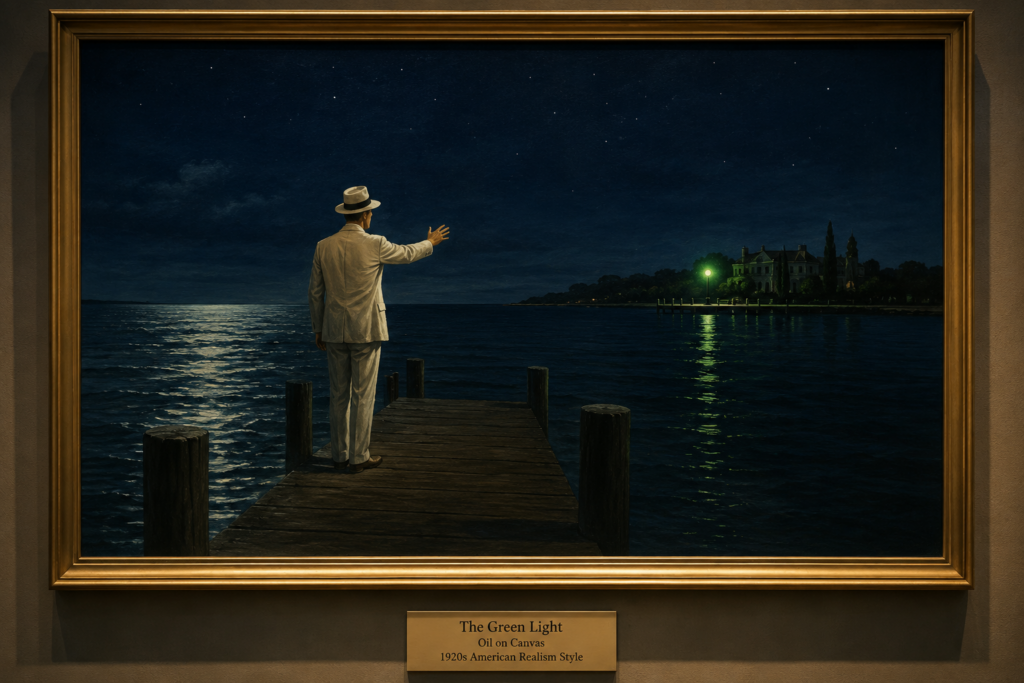
Figure 1. Jay Gatsby standing at the edge of his dock, reaching toward the green light across the bay—a visual metaphor for his unattainable dream and the moral compromises made in its pursuit.
Figure Description: A lone figure in a 1920s white suit stands at the end of a wooden dock at night. In the distance, a solitary green light glows from the opposite shore. The sky is deep navy with scattered stars, and the water reflects the moonlight. The mood is melancholic and aspirational, capturing Gatsby’s isolation and longing.
Introduction
Jay Gatsby is the mysterious, self-made millionaire protagonist of F. Scott Fitzgerald’s The Great Gatsby. Born James Gatz to a poor farming family in rural North Dakota, he reinvented himself completely, changing his name and crafting an entirely new identity. Around thirty years old, he amassed a vast fortune through organized crime—including illegal alcohol distribution and trading in stolen securities—all in pursuit of one goal: winning back Daisy Buchanan, the wealthy young woman he had loved before World War I.
Gatsby purchased a gaudy mansion in West Egg on Long Island, directly across the bay from Daisy’s home in East Egg. Every Saturday night, he threw lavish parties with jazz orchestras and well-stocked bars, hoping Daisy might one day wander in. The extravagant parties, the mansion, the fortune—none of it was for pleasure. It was all a stage, built for an audience of one.
Nick Carraway, the novel’s narrator, describes Gatsby as having “an extraordinary gift for hope” and a “romantic readiness” he had never found in any other person (Fitzgerald, 1925). Gatsby believed in the green light at the end of Daisy’s dock, believing it symbolized a future he could grasp if only he reached far enough.
“Gatsby believed in the green light, the orgastic future that year by year recedes before us” (Fitzgerald, 1925).
Yet despite his wealth, Gatsby was never truly accepted by the old-money elite. To them, he would always be a pretender. His tragic flaw—what ultimately destroyed him—was his unshakable belief that he could repeat the past.
“Can’t repeat the past?… Why of course you can!” (Fitzgerald, 1925).
But the past cannot be reclaimed. And the dream he chased was built on illusions—Daisy was not the perfect woman he imagined, and wealth could not buy him the belonging he craved. Gatsby is not a traditional hero, but his story offers one of the most powerful lessons about integrity in the pursuit of dreams.
The Righteous Dilemma: Can a Dream Be Pure If the Path Is Not?
Gatsby’s story forces us to confront a difficult question: Does a noble goal justify corrupt means?
Table 1. Gatsby’s Dream vs. His Methods: The Righteousness Paradox
| Gatsby’s Dream | Gatsby’s Methods |
|---|---|
| To win Daisy’s love and recapture the past | Illegal alcohol sales (bootlegging) |
| To escape poverty and enter high society | Stolen securities and organized crime |
| To prove he was worthy of Daisy | Lies about his background and identity |
Note. This table illustrates the central righteousness dilemma in Gatsby’s story: a noble, romantic dream pursued through corrupt and dishonest means.
Gatsby created an elaborate illusion—a false identity, fabricated stories about being an Oxford man and the son of wealthy parents. He believed that wealth had a purity that would “rub off” on him, granting him the same impunity enjoyed by the old-money elite.
The tragedy: Gatsby’s dream was romantic and idealistic, but his methods were dishonest and illegal. He spent years building an empire of illusions, only to discover that Daisy—the woman he had idealized—was shallow, materialistic, and unworthy of such devotion.
“There must have been moments even that afternoon when Daisy tumbled short of his dreams… it had gone beyond her” (Fitzgerald, 1925).
Key Insight: Gatsby teaches us that the means matter as much as the ends. A dream built on lies, no matter how beautiful, will eventually collapse under its own weight. In the end, Gatsby loses everything—his wealth, his love, his life—precisely because he used dishonest means to achieve a pure goal.
Key Scenes of Moral Choice
Scene 1: The Reinvention — Choosing a False Identity
Young James Gatz rejected his origins and reinvented himself as Jay Gatsby. He created a persona so detailed and compelling that it appeared almost true. This decision set him on a path of deception that would define the rest of his life.
“So he invented just the sort of Jay Gatsby that a seventeen-year-old boy would be likely to invent, and to this conception he was faithful to the end” (Fitzgerald, 1925).
The Question: Is it ever justified to completely abandon your true self in pursuit of a dream?
Scene 2: The Plaza Hotel Showdown — Gatsby’s Final Attempt to Claim Daisy
In a tense confrontation at the Plaza Hotel, Gatsby demands that Daisy tell Tom she never loved him. He believes he can erase the past five years and reclaim her completely. But Daisy falters—she cannot deny her history with Tom.
The Question: Can we truly erase the past and start over? Or does Gatsby’s refusal to accept reality doom his dream from the start?
Scene 3: Taking the Blame — Gatsby’s Last Act of Loyalty
After Daisy accidentally kills Myrtle Wilson in a hit-and-run, Gatsby takes full responsibility. He stands outside Daisy’s house all night, waiting to protect her. Even though Daisy never loved him fully, even though she ultimately abandoned him, Gatsby remained loyal to the end.
The Question: Is there dignity in taking the blame for someone who does not deserve your loyalty?
Scene 4: The Empty Funeral — The Cost of a Life Without True Connection
When Gatsby dies, almost no one attends his funeral. The hundreds of party guests who had eaten his food and danced in his mansion disappeared. Tom and Daisy, the people who caused the tragedy, retreated into their wealth and avoided all accountability.
The Question: What is the value of a life if it is built on illusions and empty relationships?
Memorable Quotes
Table 2. Key Quotes from The Great Gatsby on Dreams, Identity, and Righteousness
| Quote | Significance |
|---|---|
| “Can’t repeat the past?… Why of course you can!” | Gatsby’s refusal to accept reality—his tragic flaw |
| “You always have a green light that burns all night at the end of the dock.” | The green light symbolizes Gatsby’s unattainable dream |
| “Her voice is full of money.” | Gatsby’s realization that Daisy is not an ideal but a product of wealth |
| “So he invented just the sort of Jay Gatsby that a seventeen-year-old boy would be likely to invent, and to this conception he was faithful to the end.” | Gatsby’s self-creation—remarkable and tragic |
| “I knew that when I kissed this girl I would be forever wed to her.” | Gatsby’s romantic idealism |
Note. All quotes are from Fitzgerald (1925). These passages capture the tension between Gatsby’s romantic idealism and the moral compromises that ultimately destroy him.
Lessons on Righteousness from Jay Gatsby
Table 3. Lessons on Righteousness from Jay Gatsby
| Lesson | Application |
|---|---|
| Dreams are not enough—means matter | Gatsby’s goal was pure, but his methods were corrupt. He reminds us that how we pursue a dream is as important as the dream itself. |
| Honesty is the foundation of identity | Gatsby built his life on lies. No matter how impressive the façade, a false identity cannot sustain true relationships. |
| Love cannot be bought | Gatsby believed wealth would win Daisy’s love. But Daisy was drawn to his money, not his heart—and the love he sought was never really there. |
| Loyalty has limits | Gatsby remained loyal to Daisy even when she abandoned him. But loyalty to someone who does not reciprocate is not virtue—it is delusion. |
| The past cannot be reclaimed | Gatsby’s refusal to accept that time moves forward destroyed him. To live with integrity, we must accept reality as it is—not as we wish it to be. |

Figure 2. The green light at the end of Daisy’s dock—the central symbol of Gatsby’s dream and the moral illusion that drives his tragedy.
Figure Description: A close-up view across a dark bay at night, focusing on a single green light glowing at the end of a distant dock. The water reflects the green light in soft ripples. The scene is quiet, mysterious, and symbolic—representing hope, longing, and the illusion that the past can be reclaimed. The image captures the dream that Gatsby chases and the moral cost of that chase.
Further Resources
- Read the full text: Fitzgerald, F. S. (1925). The great Gatsby. New York: Charles Scribner’s Sons. The novel is in the public domain in the United States and available for free through Project Gutenberg and the Internet Archive.
- Watch the film adaptation: Luhrmann, B. (Director). (2013). The great Gatsby [Film]. Warner Bros. Pictures. Starring Leonardo DiCaprio, Tobey Maguire, and Carey Mulligan.
- Explore more: Visit the Literary Figures of Righteousness Hall to discover other literary characters who faced moral dilemmas.
References
Fitzgerald, F. S. (1925). The great Gatsby. Charles Scribner’s Sons.
Luhrmann, B. (Director). (2013). The great Gatsby [Film]. Warner Bros. Pictures.