
The Righteousness Research section of The Righteousness Museum explores how righteousness appears in different fields of human activity and in key moments of history.
This page lists selected research cases. Each case will eventually have its own article analyzing the historical background, the moral decision involved, and its impact on society.
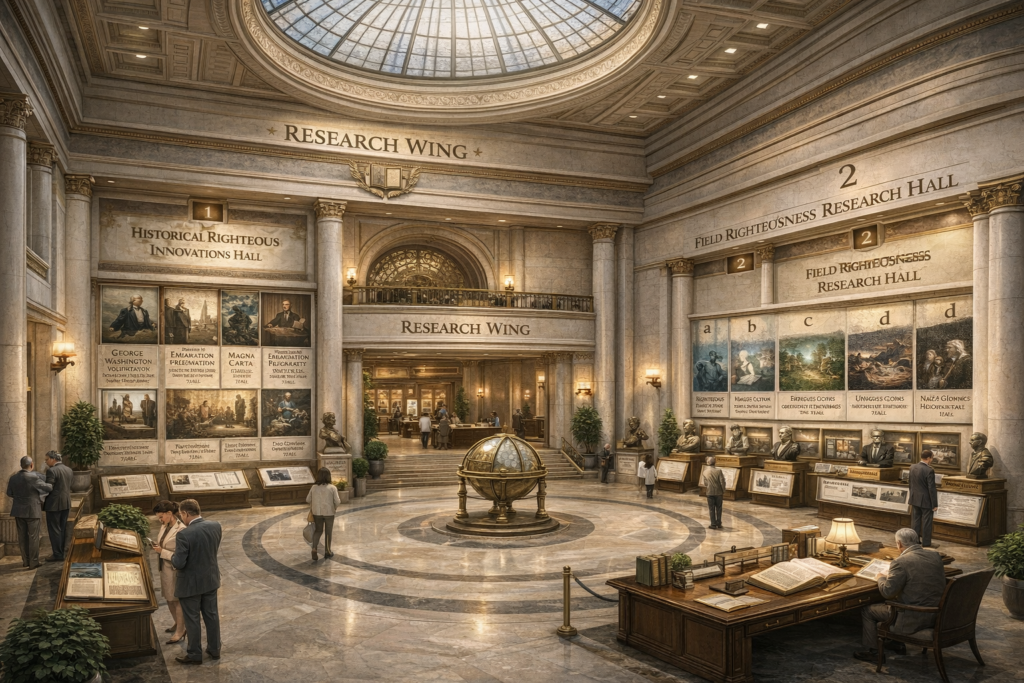
Figure 1. The Virtual Righteousness Museum research wing interior
1. Historical Righteous Innovations Hall
This category examines key moments in history when creative and courageous moral actions—Righteous Innovations—shaped the course of events.
• George Washington Voluntarily Leaving the Presidency (USA) (1797) — decision by George Washington to step down after two terms, establishing a tradition of peaceful leadership transition.
•The Emancipation Proclamation (USA) (1863) — issued by Abraham Lincoln during the American Civil War, declaring freedom for enslaved people in Confederate states.
• The Magna Carta (England) (1215) — agreement between King John and English barons establishing the principle that the ruler is subject to the law.
• The Civil Rights Act of 1964 (USA) (1964) — landmark legislation signed by Lyndon B. Johnson prohibiting racial discrimination in public accommodations and employment.
• Democratic Transition and Reconciliation (South Africa) (1994) — leadership by Nelson Mandela guiding a peaceful transition from apartheid to democratic rule.
- 1968 Olympics Protest (USA) (1968) — decision by Tommie Smith and John Carlos to raise their fists during the medal ceremony, using the global stage to protest racial injustice and redefine athlete activism.
2. Field Righteousness Research Hall
This category studies righteousness and unrighteousness within specific fields, such as sports, law, science, technology, scholarship and so on.
Righteous Figures of the Field Gallery
• Sports: Jackie Robinson (USA) (1947) — broke baseball’s racial barrier, demonstrating courage and integrity.
• Science: Marie Curie (Poland/France) (1898–1934) — advanced science with honesty and dedication to research.
• Technology: Tim Berners-Lee (UK) (1989) — invented the World Wide Web and ensured it remained open and free.
• Healthcare: Florence Nightingale (UK) (1854–1856) — improved sanitary conditions during the Crimean War, saving thousands of lives.
• Business: Anita Roddick (UK) (1976) — founded The Body Shop with ethical and sustainable business practices.
• Entertainment: Lin-Manuel Miranda (USA) (2015) — used Broadway and media to promote cultural awareness and inclusivity.
• Law: Thurgood Marshall (USA) (1954) — successfully argued Brown v. Board of Education, ending school segregation.
• Agriculture: Norman Borlaug (USA) (1940s–1960s) — pioneered high-yield crops to combat global hunger ethically.
Righteous Events of the Field Gallery
• Sports: Integration of Major League Baseball (USA) (1947) — promoted fairness and equality in professional sports.
• Science: International Human Genome Project Collaboration (Global) (1990–2003) — ethical global scientific collaboration.
• Civil Rights: Montgomery Bus Boycott (USA) (1955–1956) — peaceful protest advancing racial justice.
• Technology: Public Release of the Internet Protocol (USA) (1990) — ensured global open access to the Internet.
• Healthcare: Eradication of Smallpox (Global) (1980) — coordinated vaccination campaigns saving millions of lives.
• Business: Fairtrade Coffee Certification Launch (UK) (1988) — promoted ethical trade and fair treatment of farmers.
• Entertainment: 1964 Beatles Performance on Ed Sullivan Show (USA) (1964) — broke cultural barriers and inspired global youth movements.
• Law: Nuremberg Trials (Germany/International) (1945–1946) — held leaders accountable for war crimes, establishing justice precedent.
• Law:Minnesota Prosecutors Resignation (USA)(2026) — They resigned because DOJ ordered them to investigate a shooting victim’s widow while refusing to investigate the ICE agent who killed her.
- Agriculture: Green Revolution Adoption (Global) (1960s) — increased crop yields ethically and sustainably to reduce famine.
Righteous Decisions of the Field Gallery
• Healthcare: Jonas Salk Declining Patent on Polio Vaccine (USA) (1955) — made vaccine freely available to save millions.
• Business: Paul Polman’s Sustainable Practices at Unilever (UK/Netherlands) (2009) — prioritized environmental and social responsibility.
• Science: Rosalind Franklin’s Ethical Sharing of DNA Research (UK) (1951–1953) — ensured her X-ray images contributed to discovery responsibly.
• Sports: Muhammad Ali Refusing Draft (USA) (1967) — moral protest for peace and justice.
- Sports: 1996 NBA National Anthem Protest (USA) (1996) — protest against injustice and raising awareness of religious and civil rights.
- Sports: 2016 National Anthem Protest (USA) (2016) — kneel during the national anthem, using his platform to protest racial injustice and police brutality.
Unrighteous Events of the Field Gallery
• Sports: 1919 Black Sox Scandal (USA) (1919) — players intentionally lost the World Series.
• Business: Enron Accounting Fraud (USA) (2001) — large-scale corporate deception.
• Business: Volkswagen Emissions Scandal (Germany) (2015) — cheating on emissions tests for profit.
• Healthcare: Tuskegee Syphilis Experiment (USA) (1932–1972) — unethical experimentation on African American men.
• Science: Theranos Fraud (USA) (2015) — false claims about medical testing technology.
• Entertainment: Harvey Weinstein Sexual Abuse Scandal (USA) (2017) — abuse of power and exploitation in the film industry.
• Finance: 2008 Financial Crisis (USA/Global) (2008) — reckless practices causing global harm.
• Agriculture: Dioxin Contamination in Belgium (Belgium) (1999) — unsafe chemical practices harming livestock and humans.
• Politics: Watergate Scandal (USA) (1972–1974) — illegal actions undermining democracy.
• Politics: Nazi Germany Holocaust (Germany) (1941–1945) — state-led genocide representing extreme unrighteousness.
3. Literary Righteousness Research Hall
- Katniss Everdeen (The Hunger Games, Collins, USA, 2008). A reluctant rebel who defied an unjust system, showing compassion can be the strongest weapon.
- Harry Potter (Harry Potter series, Rowling, UK, 1997-2007). A boy who chose love over hate, proving our choices define us more than our abilities.
- Frodo Baggins (The Lord of the Rings, Tolkien, UK, 1954). A humble hobbit who bore the ring of power, teaching even the smallest can resist great evil.
- Guo Jing (The Legend of the Condor Heroes, Jin Yong, China, 1957–1959). A slow-witted boy who grew into a legendary warrior, proving that righteousness is not about talent but about a faithful heart.
4.Diligence & Perseverance in Pursuing Righteousness Hall
- Harriet Tubman (Abolitionist and Freedom Fighter, USA, c. 1822–1913). After escaping slavery, she repeatedly returned to dangerous territory to help others reach freedom, showing that righteousness requires both diligent action and courageous perseverance.
- Abraham Lincoln (16th U.S. President, USA, 1809–1865). After experiencing repeated personal, business, and political setbacks, he continued pursuing justice and preserving the Union, demonstrating that righteous purpose requires diligence through failure and perseverance through crisis.
- Nelson Mandela (Anti-Apartheid Leader and Statesman, South Africa, 1918–2013). After spending 27 years in prison for his opposition to apartheid, he continued working toward racial equality and reconciliation, showing that righteousness can remain steadfast through prolonged hardship.
- Irena Sendler (Humanitarian and Social Worker, Poland, 1910–2008). During World War II, she repeatedly risked her life to rescue Jewish children from the Warsaw Ghetto, demonstrating that righteousness sometimes requires persistent action despite extreme danger.