
Righteous Figures of the Field — Law Category
Law: Thurgood Marshall (USA) (1954)
The work of Thurgood Marshall represents a powerful example of righteous leadership in law and the pursuit of justice.
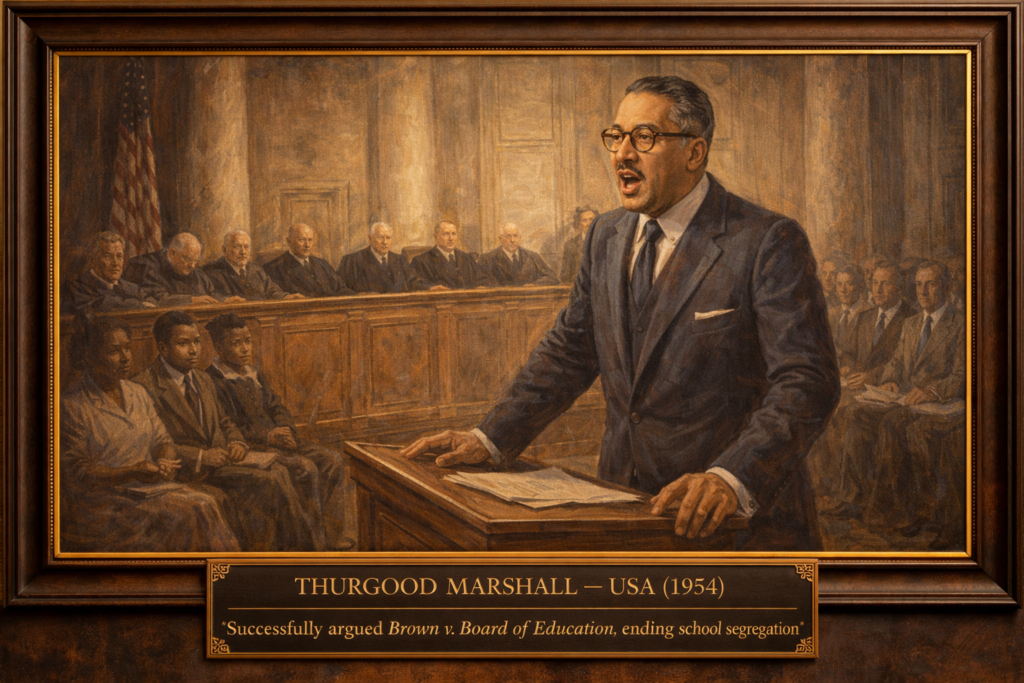
Righteous Act
In 1954, Thurgood Marshall successfully argued the landmark case Brown v. Board of Education before the Supreme Court of the United States.
The Court’s decision declared that racial segregation in public schools was unconstitutional, overturning the doctrine of “separate but equal.”
This ruling marked a major step toward ending institutionalized racial discrimination in education.
Righteous Innovation
Thurgood Marshall’s work represents a righteous innovation in using constitutional law to dismantle systemic injustice.
He developed a legal strategy in which:
- The Constitution is used to challenge inequality
- Courts become a pathway for achieving civil rights reform
- Legal arguments are grounded in both law and moral principles
This approach transformed the legal system into a powerful tool for advancing equality.
Why It Was Righteous
His actions demonstrated:
- Commitment to justice and equality under the law
- Courage in confronting institutional discrimination
- Dedication to using legal expertise for social progress
He worked persistently to challenge unjust systems through lawful means.
Impact and Influence
The decision in Brown v. Board of Education became a cornerstone of the Civil Rights Movement.
It led to the desegregation of public schools and inspired further legal and social reforms aimed at achieving racial equality.
Marshall’s legal strategies influenced future civil rights cases and advocacy efforts.
Legacy
Thurgood Marshall is remembered as a pioneer of civil rights law and a symbol of justice, perseverance, and equality.
His legacy demonstrates how legal systems can be used to correct injustice and uphold human dignity.
References
Williams, J. (1998). Thurgood Marshall: American revolutionary. Times Books.
Kluger, R. (1975). Simple justice. Knopf.
Tushnet, M. (1994). Making civil rights law. Oxford University Press.