
Righteous Events of the Field Gallery
Agriculture: Green Revolution (Global) (1960s)
The adoption of the Green Revolution represents a powerful example of righteous innovation in agriculture for human survival and well-being.
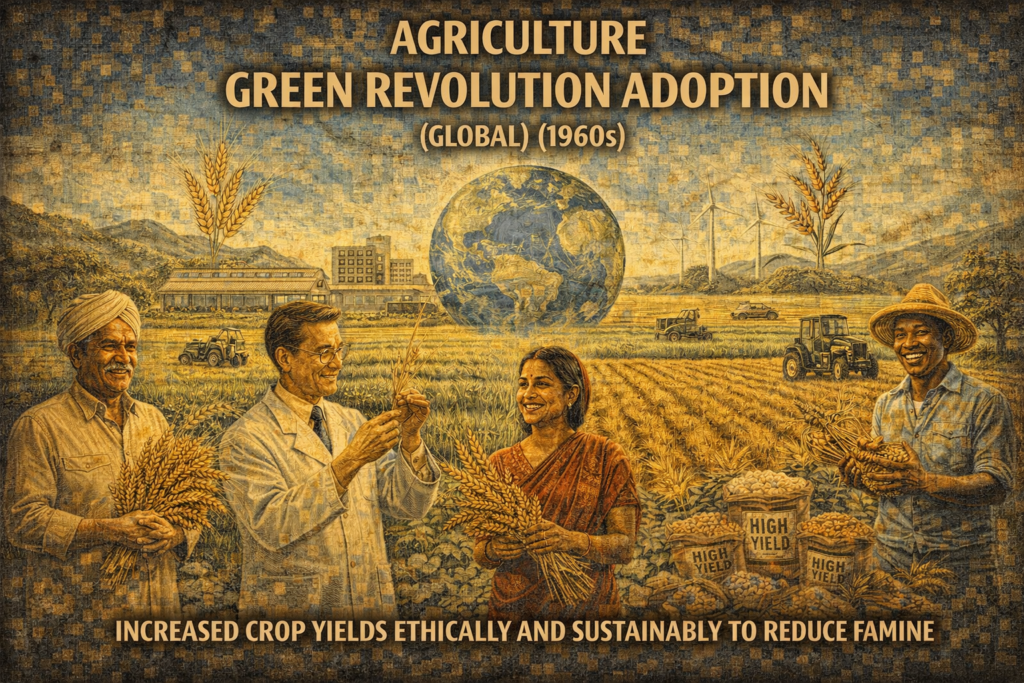
Righteous Act
During the 1960s, countries around the world adopted new agricultural methods, including high-yield crop varieties, improved irrigation, and the use of fertilizers.
These changes significantly increased food production, particularly in regions facing severe food shortages, helping to prevent widespread famine.
Righteous Innovation
The Green Revolution represents a righteous innovation in applying science and technology to address global hunger.
It established a model in which:
- Agricultural science is used to increase food production at scale
- Innovation focuses on meeting basic human needs
- Farming systems evolve to support greater efficiency and sustainability
This transformation showed how scientific advancement could be directed toward humanitarian goals.
Why It Was Righteous
This movement demonstrated:
- Commitment to reducing hunger and suffering
- Application of knowledge for the common good
- Dedication to improving global food security
Impact and Influence
The Green Revolution dramatically increased crop yields in countries such as India and Mexico, helping to stabilize food supplies and support growing populations.
It also influenced agricultural policies, research, and development programs worldwide.
Reflection
The Green Revolution invites reflection on the balance between innovation and sustainability.
It raises important questions: How can agricultural progress continue while protecting the environment? How should technology be used to ensure equitable access to food?
It reminds us that righteous innovation must consider both immediate human needs and long-term global impact.
Legacy
The Green Revolution remains one of the most significant transformations in agricultural history.
It stands as a lasting example of how science, innovation, and ethical purpose can work together to address fundamental challenges facing humanity.
References
Evenson, R. E., & Gollin, D. (2003). Assessing the impact of the Green Revolution. Science.
Pingali, P. (2012). Green Revolution: Impacts, limits, and the path ahead. Proceedings of the National Academy of Sciences.
Cullather, N. (2010). The hungry world. Harvard University Press.