
Righteous Figures of the Field — Science Category
Science: Marie Curie (Poland/France) (1898–1934)
The work of Marie Curie represents a powerful example of righteous dedication to scientific truth and human advancement.
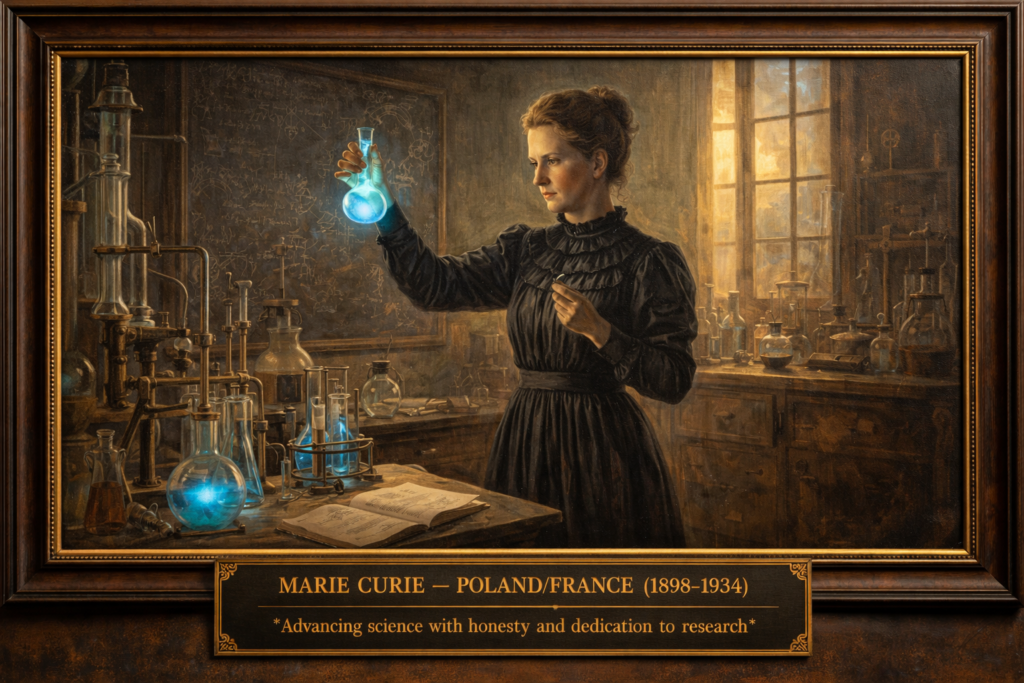
Righteous Act
Beginning in 1898, Marie Curie conducted groundbreaking research on radioactivity, leading to the discovery of the elements polonium and radium.
Working under difficult conditions, she pursued scientific knowledge with precision, honesty, and intellectual integrity, helping to establish a new field of modern physics and chemistry.
Righteous Innovation
Marie Curie’s work represents a righteous innovation in open and ethical scientific discovery.
She chose not to patent her discoveries, creating a model in which:
- Scientific knowledge is shared for the benefit of humanity
- Research is guided by truth rather than personal profit
- Innovation advances through collaboration and openness
This approach helped accelerate global scientific progress and set a standard for ethical research.
Why It Was Righteous
Her actions demonstrated:
- Commitment to truth and evidence
- Selflessness in sharing knowledge
- Dedication to scientific integrity despite hardship
She placed the advancement of science and human well-being above personal gain.
Impact and Influence
Marie Curie’s discoveries transformed the understanding of atomic science and laid the foundation for developments in medicine, particularly in cancer treatment through radiation therapy.
Her work also helped open opportunities for women in science, challenging barriers in education and research institutions.
Legacy
Marie Curie is remembered as one of the most influential scientists in history and a symbol of integrity, perseverance, and intellectual courage.
Her legacy continues to shape modern science and serves as a model for ethical and impactful research.
References
Curie, E. (1937). Madame Curie: A biography. Doubleday.
Quinn, S. (1995). Marie Curie: A life. Simon & Schuster.
Goldsmith, B. (2005). Obsessive genius: The inner world of Marie Curie. W. W. Norton & Company.