
Unrighteous Events of the Field Gallery
Healthcare: Tuskegee Syphilis Study (USA) (1932–1972)
The Tuskegee Syphilis Study stands as a profound example of the absence of righteousness in healthcare, highlighting the consequences of violating medical ethics and human dignity.
Unrighteous Act
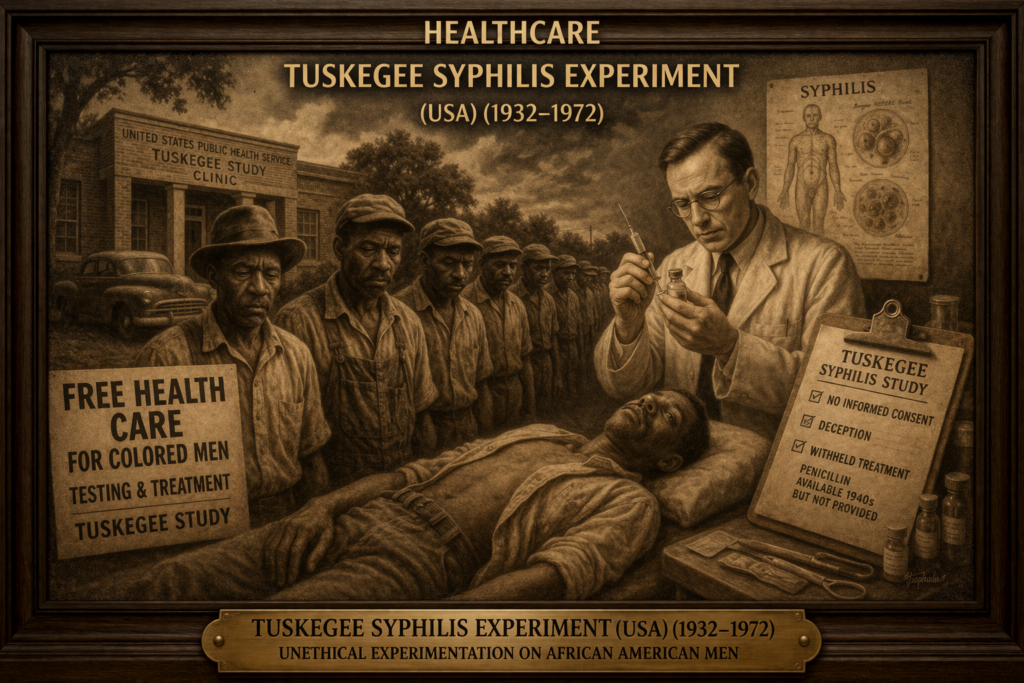
From 1932 to 1972, the U.S. Public Health Service conducted a study on African American men with syphilis in Tuskegee, Alabama.
Participants were misled and denied proper treatment—even after effective therapies such as penicillin became available—in order to observe the natural progression of the disease.
This deception resulted in unnecessary suffering, illness, and death.
Ethical Breakdown
This case illustrates severe violations of ethical standards in which:
- Informed consent was denied
- Patients were deceived and exploited
- Medical professionals failed to uphold the principle of do no harm
It revealed a breakdown of trust between healthcare institutions and vulnerable communities.
Why It Matters
The study demonstrated:
- The critical importance of medical ethics and patient rights
- The dangers of systemic bias and exploitation in research
- The need for accountability and ethical oversight
Impact and Influence
Public exposure of the study led to widespread outrage and major reforms in research ethics.
It contributed to the establishment of stricter regulations, including informed consent requirements and institutional review boards (IRBs).
It also influenced ethical guidelines such as the Belmont Report.
Reflection
The Tuskegee study invites reflection on the responsibilities of medical professionals and institutions.
It raises important questions: How can trust be protected in healthcare? What safeguards are necessary to ensure ethical treatment of all individuals?
It reminds us that science without ethics can lead to profound injustice and harm.
Legacy
The Tuskegee Syphilis Study remains a lasting warning about the consequences of unethical research.
It underscores the necessity of respect, transparency, and human dignity in all areas of healthcare and scientific inquiry.
References
Jones, J. H. (1993). Bad blood: The Tuskegee syphilis experiment. Free Press.
Reverby, S. M. (2009). Examining Tuskegee. University of North Carolina Press.
U.S. Department of Health, Education, and Welfare. (1979). The Belmont Report.