
Righteous Events of the Field Gallery
Law: Nuremberg Trials (Germany/International) (1945–1946)
The Nuremberg Trials represent a defining example of righteous justice in international law and accountability.
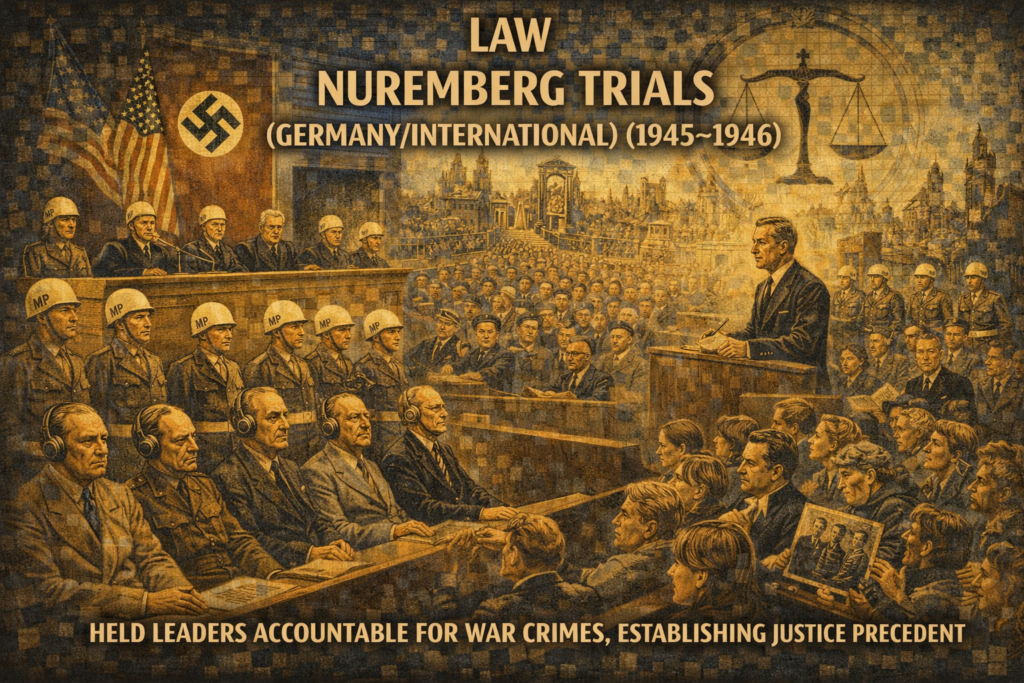
Righteous Act
From 1945 to 1946, leading officials of Nazi Germany were prosecuted by an international tribunal for crimes against humanity, war crimes, and crimes against peace.
For the first time in history, political and military leaders were held legally accountable for actions committed during war.
The trials established that individuals, not just states, are responsible for violations of fundamental human rights.
Righteous Innovation
The Nuremberg Trials represent a righteous innovation in international criminal law.
They introduced a new model in which:
- Leaders are held personally accountable for war crimes
- International law can override claims of absolute national authority
- Justice is pursued through legal process rather than revenge
This framework laid the foundation for modern systems of international justice.
Why It Was Righteous
The trials demonstrated:
- Commitment to justice after large-scale atrocities
- Rejection of impunity for powerful leaders
- Dedication to establishing legal and moral accountability
They showed that even in the aftermath of war, justice could be pursued through lawful means.
Impact and Influence
The principles established at Nuremberg influenced the development of international law, including later institutions such as the International Criminal Court.
They also helped define legal standards for human rights and accountability that continue to shape global justice systems.
Reflection
The Nuremberg Trials invite reflection on the responsibility of individuals and nations in times of conflict.
They raise important questions: How should justice be pursued after large-scale injustice? What standards should govern the conduct of leaders and nations?
They remind us that justice must extend beyond victory and power, ensuring accountability and upholding human dignity.
Legacy
The Nuremberg Trials remain a cornerstone of modern international law and a lasting symbol of the pursuit of justice.
They demonstrate that no individual is above the law, and that righteous action can establish enduring principles for humanity.
References
Taylor, T. (1992). The anatomy of the Nuremberg trials. Knopf.
Bass, G. J. (2000). Stay the hand of vengeance. Princeton University Press.
Marrus, M. R. (1997). The Nuremberg war crimes trial 1945–46. Bedford Books.