
Righteous Decisions of the Field Gallery
Science: Rosalind Franklin (UK) (1951–1953)
The work of Rosalind Franklin represents a powerful example of righteous integrity in scientific research and knowledge sharing.
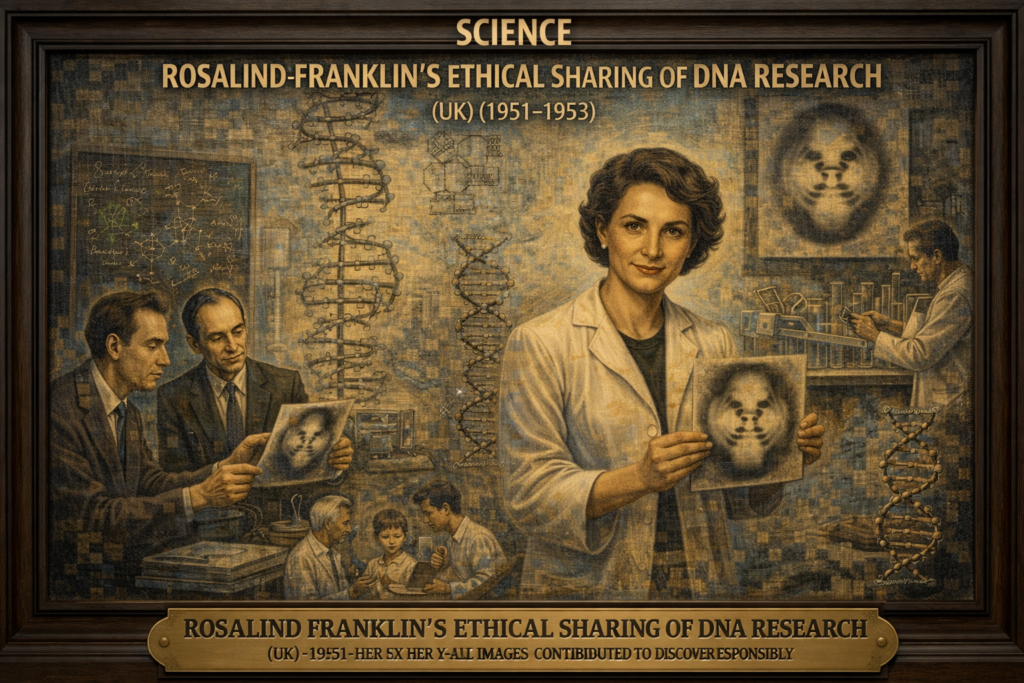
Righteous Act
Between 1951 and 1953, Rosalind Franklin conducted pioneering research using X-ray crystallography to study the structure of DNA.
Her precise and high-quality images, including the famous “Photo 51,” provided critical evidence that contributed to understanding the double-helix structure of DNA.
Her work demonstrated exceptional accuracy, discipline, and commitment to scientific truth.
Righteous Innovation
Franklin’s contribution represents a righteous innovation in ethical scientific contribution and data integrity.
It established a model in which:
- Scientific research is conducted with rigor and precision
- Data is produced and shared to advance collective knowledge
- Discoveries are built upon evidence rather than speculation
Her work helped shape modern standards for scientific reliability and collaboration.
Why It Was Righteous
Her actions demonstrated:
- Commitment to truth and scientific accuracy
- Integrity in research practices
- Dedication to advancing knowledge for the benefit of humanity
Impact and Influence
Franklin’s research played a crucial role in the discovery of DNA’s structure, one of the most important breakthroughs in modern science.
Her work has influenced fields such as genetics, medicine, and biotechnology.
She also became a symbol of the importance of recognition and ethics in scientific collaboration.
Reflection
Franklin’s story invites reflection on the ethical responsibilities within scientific communities.
It raises important questions: How should credit and recognition be fairly assigned? How can collaboration be conducted with integrity and respect?
It reminds us that righteous science depends not only on discovery, but on honesty, fairness, and ethical responsibility.
Legacy
Rosalind Franklin is remembered as a pioneering scientist and a symbol of integrity in research.
Her legacy continues to inspire scientists to pursue truth with rigor and uphold ethical standards in the advancement of knowledge.
References
Maddox, B. (2002). Rosalind Franklin: The dark lady of DNA. HarperCollins.
Sayre, A. (1975). Rosalind Franklin and DNA. W. W. Norton & Company.
Watson, J. D. (1968). The double helix. Atheneum.