
1968 Olympics Protest (USA) (1968)
The protest by Tommie Smith and John Carlos at the 1968 Summer Olympics represents a groundbreaking righteous innovation in the role of athletes in society.
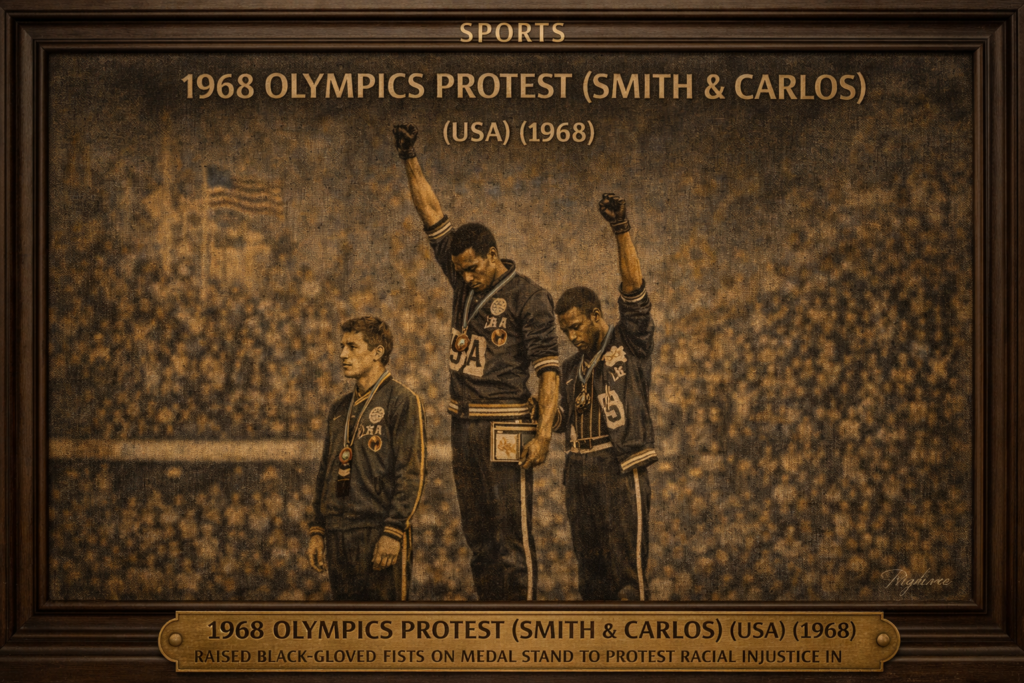
Righteous Innovation
In 1968, during the medal ceremony for the 200-meter race, Smith and Carlos raised their black-gloved fists while the U.S. national anthem played.
This silent gesture was a protest against racial injustice and inequality, using the global Olympic stage to communicate a moral message. (HISTORY TV Nederland)
Their action transformed a moment of personal achievement into a platform for human rights advocacy.
Why It Was Innovative
This act created a new model in which:
- Athletes use global visibility to express moral and social concerns
- Sports become a platform for peaceful protest and awareness
- Personal success is leveraged to advance justice and equality
At the time, the Olympics were expected to remain apolitical. By breaking this expectation, Smith and Carlos redefined the role of athletes in public life.
Impact and Influence
The protest became one of the most iconic images in sports history and sparked worldwide discussion on civil rights and inequality. (HISTORY TV Nederland)
Although they faced immediate backlash and were expelled from the Olympic Village, their actions inspired future generations of athletes to speak out on social and political issues. (HISTORY TV Nederland)
Their example helped establish the precedent of athlete activism on a global stage.
Reflection
The 1968 Olympic protest invites reflection on the relationship between achievement and responsibility.
It raises important questions: Should individuals use moments of visibility to address injustice? What risks are worth taking to stand for moral principles?
It reminds us that righteous innovation often requires courage to challenge expectations, transforming platforms of recognition into platforms of conscience.
Legacy of the Innovation
The protest by Smith and Carlos remains a defining example of how individual action can reshape cultural norms.
It demonstrates that athletes are not only competitors, but also citizens with voices capable of influencing society.
Their legacy continues to shape conversations about justice, equality, and the role of sports in social change.
References
Bass, A. (2002). Not the triumph but the struggle. University of Minnesota Press.
Hartmann, D. (2003). Race, culture, and the revolt of the Black athlete. University of Chicago Press.
Edwards, H. (1969). The revolt of the Black athlete. Free Press.