
Righteous Events of the Field Gallery
Business: Fairtrade Certification Launch (UK) (1988)
The launch of Fairtrade Certification Launch represents a powerful example of righteous innovation in ethical commerce and global trade.
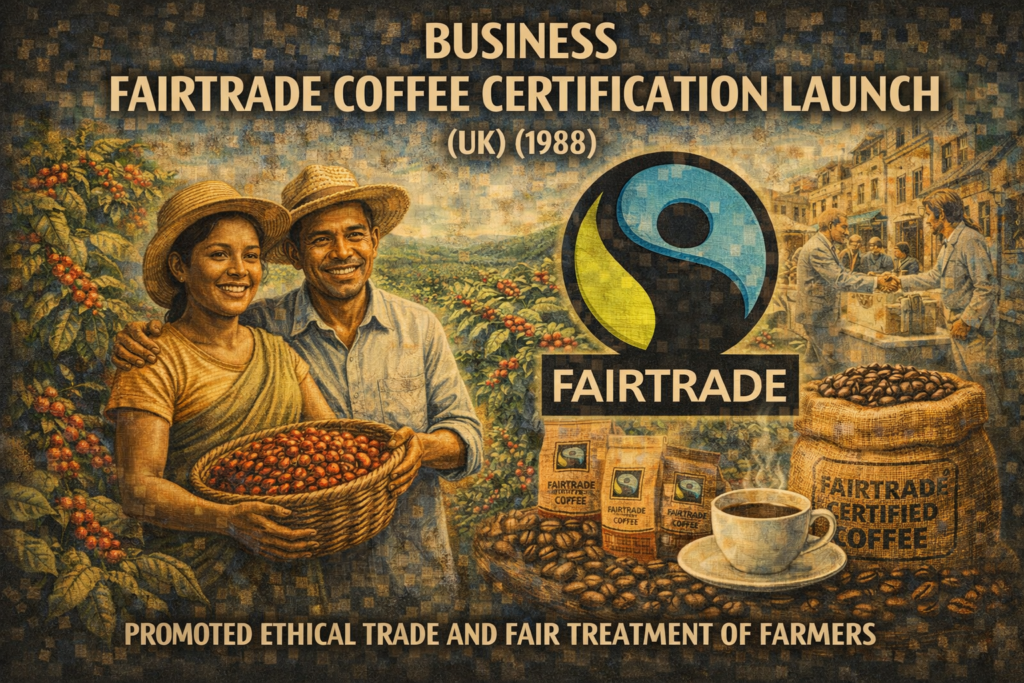
Righteous Act
In 1988, the first fair trade certification initiative was introduced, creating a system that ensured coffee producers received fair prices and worked under humane conditions.
Organizations such as Fairtrade International helped establish standards for ethical sourcing, transparency, and accountability in global supply chains.
This effort connected consumers with producers, promoting fairness in international trade.
Righteous Innovation
The Fairtrade certification represents a righteous innovation in values-based market systems.
It created a new model in which:
- Consumers can support ethical production through purchasing choices
- Producers receive fair compensation and improved working conditions
- Markets operate with transparency and social responsibility
This system transformed trade into a mechanism for advancing social justice.
Why It Was Righteous
This initiative demonstrated:
- Commitment to fairness in global trade
- Respect for the dignity of farmers and workers
- Dedication to aligning economic activity with ethical principles
Impact and Influence
Fairtrade certification expanded globally, influencing industries beyond coffee, including tea, cocoa, and other agricultural products.
It raised awareness about supply chain ethics and encouraged companies to adopt more responsible sourcing practices.
Consumers became more engaged in supporting ethical and sustainable products.
Reflection
The Fairtrade movement invites reflection on the role of individuals and markets in shaping a more just world.
It raises important questions: How can everyday economic choices promote fairness? What responsibility do businesses and consumers share in ensuring ethical production?
This innovation shows that righteous action can be embedded in daily economic life, transforming ordinary transactions into opportunities for justice.
Legacy
Fairtrade certification remains a symbol of ethical business innovation and the power of aligning commerce with human values.
It continues to influence global trade practices and promote a more equitable economic system.
References
Nicholls, A., & Opal, C. (2005). Fair trade: Market-driven ethical consumption. Sage.
Raynolds, L. T., Murray, D., & Wilkinson, J. (2007). Fair trade: The challenges of transforming globalization. Routledge.
Fridell, G. (2007). Fair trade coffee: The prospects and pitfalls of market-driven social justice. University of Toronto Press.