
Righteous Events of the Field Gallery
Civil Rights: Montgomery Bus Boycott (USA) (1955–1956)
The Montgomery Bus Boycott represents a powerful example of righteous collective action through nonviolent resistance.
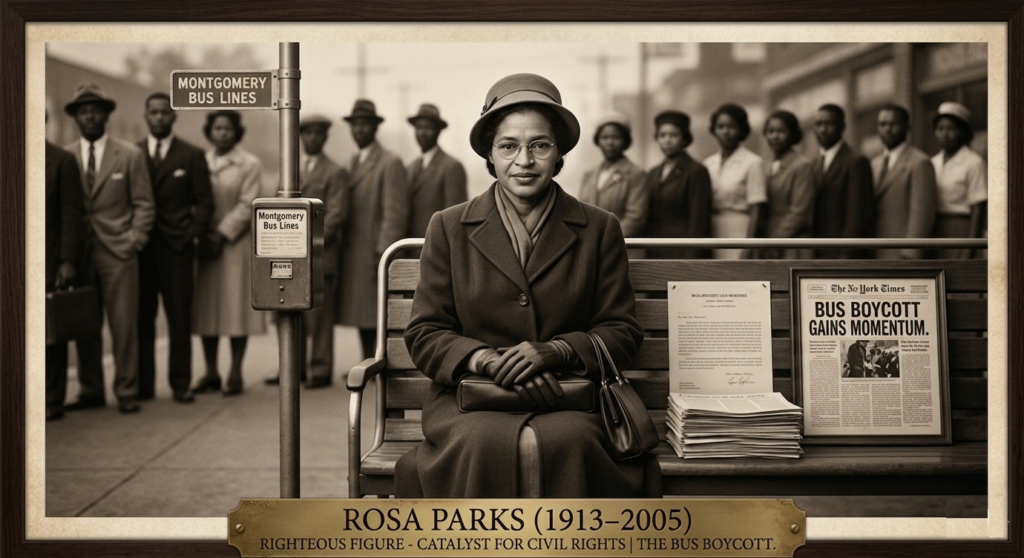
Righteous Act
From 1955 to 1956, African American citizens in Montgomery, Alabama refused to use segregated public buses in protest against racial discrimination.
The movement was sparked by the arrest of Rosa Parks and was led in part by Martin Luther King Jr..
Through sustained, peaceful protest, participants challenged unjust laws and demanded equal treatment.
Righteous Innovation
The boycott represents a righteous innovation in organized, nonviolent mass protest.
It established a new model in which:
- Nonviolence becomes a powerful tool for social change
- Collective action applies economic and moral pressure
- Ordinary citizens drive transformation through unity and persistence
This approach demonstrated that disciplined, peaceful resistance could effectively challenge systemic injustice.
Why It Was Righteous
This movement demonstrated:
- Courage in the face of intimidation and hardship
- Commitment to peaceful protest and moral discipline
- Dedication to achieving justice through lawful and ethical means
Participants endured inconvenience, threats, and economic pressure while maintaining nonviolent principles.
Impact and Influence
The boycott led to a Supreme Court ruling that declared bus segregation unconstitutional, marking a major victory for civil rights.
It also helped launch the broader Civil Rights Movement and established nonviolent protest as a central strategy for social reform.
Legacy
The Montgomery Bus Boycott remains a defining example of how peaceful collective action can produce meaningful change.
It stands as a lasting symbol of unity, courage, and the power of righteous action to transform society.
References
King, M. L., Jr. (1958). Stride toward freedom. Harper & Row.
Branch, T. (1988). Parting the waters: America in the King years 1954–63. Simon & Schuster.
Garrow, D. J. (1986). Bearing the cross. HarperCollins.