
Unrighteous Events of the Field Gallery
Finance: 2008 Financial Crisis (USA/Global) (2008)
The 2008 Financial Crisis represents a major example of the absence of righteousness in financial systems, highlighting the consequences of reckless practices and ethical failure.
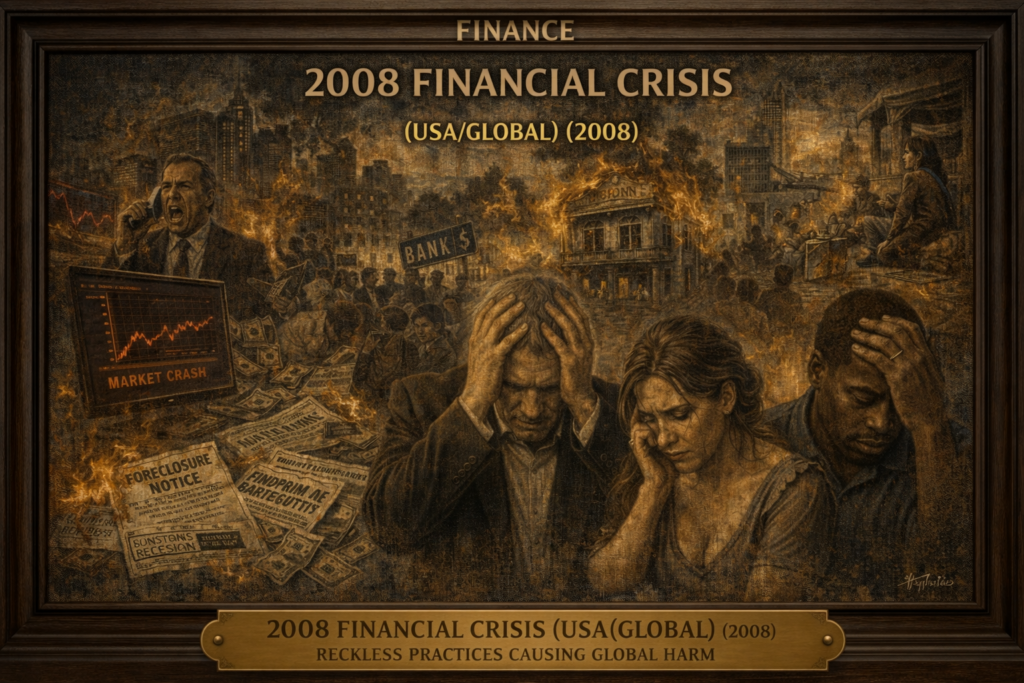
Unrighteous Act
In 2008, major financial institutions engaged in high-risk lending, complex financial instruments, and inadequate risk management.
Practices such as subprime mortgage lending and the packaging of risky loans into securities created instability within the global financial system.
Institutions including Lehman Brothers ultimately failed, triggering a widespread economic collapse.
Ethical Breakdown
This crisis illustrates a failure of ethical responsibility in which:
- Short-term profit was prioritized over long-term stability
- Financial risks were hidden or misunderstood
- Accountability and transparency were insufficient
It revealed systemic weaknesses in both corporate behavior and regulatory oversight.
Why It Matters
The crisis demonstrated:
- The importance of ethical responsibility in financial decision-making
- The risks of excessive speculation and lack of oversight
- The need for strong regulatory frameworks and accountability
Impact and Influence
The crisis led to a global recession, widespread unemployment, and significant economic hardship for millions of people.
It prompted major financial reforms, including increased regulation and oversight, such as the Dodd-Frank Act.
It also reshaped global discussions about financial ethics and systemic risk.
Reflection
The 2008 financial crisis invites reflection on the responsibilities of financial institutions and policymakers.
It raises important questions: How can financial systems balance innovation with stability? What safeguards are necessary to prevent systemic collapse?
It reminds us that financial systems must be grounded in integrity, transparency, and responsibility to serve society effectively.
Legacy
The crisis remains a defining moment in modern economic history.
It underscores the importance of ethical leadership, accountability, and sustainable financial practices in maintaining global stability.
References
Lewis, M. (2010). The big short. W. W. Norton & Company.
Sorkin, A. R. (2009). Too big to fail. Viking.
Gorton, G. (2010). Slapped by the invisible hand. Oxford University Press.