
Righteous Decisions of the Field Gallery
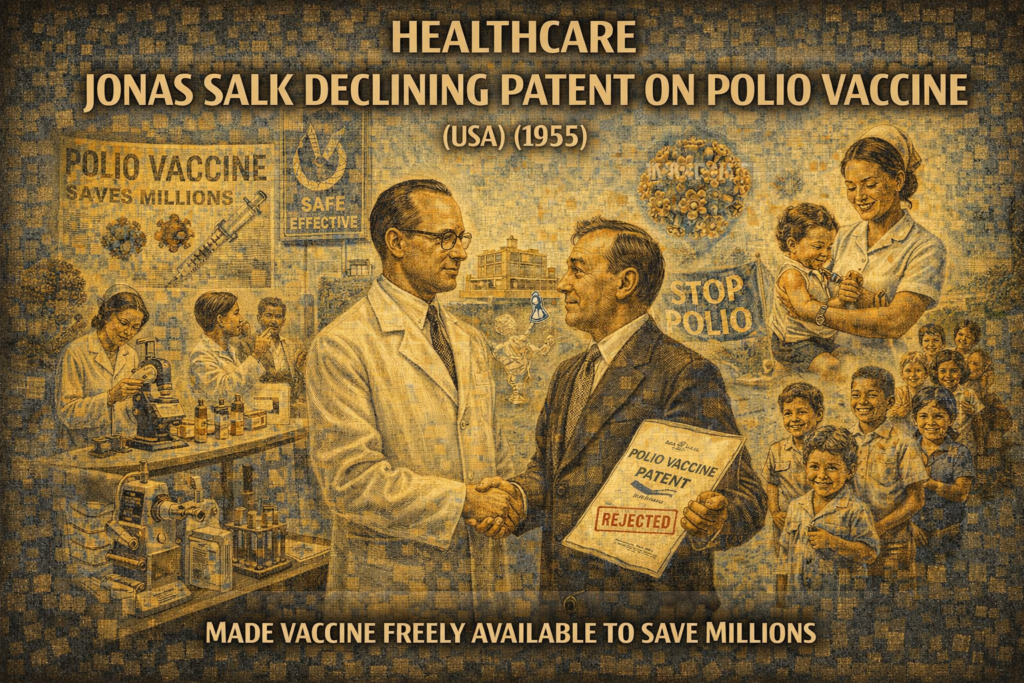
Healthcare: Jonas Salk (USA) (1955)
The actions of Jonas Salk represent a powerful example of righteous leadership in medical ethics and public health.
Righteous Act
In 1955, Jonas Salk successfully developed the first effective vaccine against Polio, a disease that had caused widespread fear and disability.
When asked who owned the patent, Salk famously responded that there was no patent, asking, “Could you patent the sun?”
By declining to patent the vaccine, he ensured it would be widely accessible, allowing rapid distribution to protect millions of people.
Righteous Innovation
Salk’s decision represents a righteous innovation in ethical medical accessibility.
It established a model in which:
- Life-saving treatments are made freely available to the public
- Scientific breakthroughs prioritize human well-being over profit
- Medical innovation is guided by ethical responsibility
This approach demonstrated how healthcare advancements can be shared for the greatest possible benefit.
Why It Was Righteous
His actions demonstrated:
- Commitment to saving lives above personal gain
- Integrity in scientific and medical practice
- Dedication to the common good of humanity
Impact and Influence
The widespread distribution of the polio vaccine led to a dramatic decline in polio cases worldwide.
It became a cornerstone of global vaccination efforts and influenced future discussions about access to essential medicines.
Reflection
Salk’s decision invites reflection on the ethical responsibilities of scientists and medical innovators.
It raises important questions: Should life-saving treatments be treated as public goods? How can innovation balance reward and accessibility?
It reminds us that righteous action in healthcare places human life and dignity at the center of decision-making.
Legacy
Jonas Salk is remembered as a symbol of ethical leadership in medicine and a pioneer who placed humanity above profit.
His legacy continues to inspire efforts to ensure equitable access to healthcare around the world.
References
Smith, J. S. (1990). Patenting the sun: Polio and the Salk vaccine. William Morrow.
Oshinsky, D. M. (2005). Polio: An American story. Oxford University Press.
Kluger, J. (2004). Splendid solution. Penguin Books.