

Country: USA
Museum Path: Research Wing > Diligence & Perseverance in Righteousness Hall
Abraham Lincoln (16th President of the United States, USA, 1809–1865) rose from a modest frontier background to the presidency during the nation’s greatest constitutional and moral crisis. His life illustrates a distinctive relationship between diligence, perseverance, and righteousness: he continually developed himself through learning, recovered from setbacks, maintained political and moral convictions through opposition, and accepted enormous responsibility during the American Civil War.
Lincoln’s story should not be presented simply as a story of success. His historical importance lies partly in the long process that preceded success. He had limited formal schooling, educated himself through reading and study, experienced business failure and political defeats, lost a U.S. Senate race to Stephen A. Douglas, and then faced the unprecedented pressures of civil war as president. The National Park Service records that Lincoln’s early formal education was extremely limited and that he became largely self-educated. His own autobiography described his additional education as something he acquired gradually through necessity (National Park Service, 2022). (National Park Service)
For a museum devoted to righteousness, however, diligence should not be confused with mere ambition. Lincoln’s example is valuable because his persistent effort increasingly became connected to questions of justice, human freedom, constitutional government, responsibility, and national reconciliation. His life therefore offers visitors an opportunity to examine a deeper principle:
Diligence develops ability; perseverance sustains purpose; righteousness gives that effort a worthy direction.
1. Early Struggles — Learning to Persevere
Lincoln was born on February 12, 1809, near Hodgenville, Kentucky, and grew up in frontier environments where formal education was limited. His family moved to Indiana when he was young. Lincoln later described his schooling as extremely limited, while the National Park Service notes that the total amount of his formal education was roughly equivalent to about one year. Despite these limitations, he became a voracious reader and continued educating himself. (National Park Service)
His early adult life was far from a straightforward path to success. After moving to Illinois, Lincoln worked in several occupations. A store partnership failed, leaving him in debt; he served as postmaster and surveyor; he studied law; and in 1832 he lost his first campaign for the Illinois legislature. He subsequently won election to the legislature in 1834 and was reelected in 1836. (National Park Service)
These experiences reveal an important dimension of perseverance: continuing development after disappointment.
Lincoln did not interpret one failure as proof that he was incapable. Instead, he continued searching for useful work, learning new skills, and preparing himself for future responsibility.
Righteousness Principle
A righteous life is not necessarily an easy life. Perseverance begins when failure is treated as a challenge to growth rather than an excuse for surrender.
Table 1. Lincoln’s Early Challenges and Responses
| No. | Challenge | Lincoln’s Response | Diligence & Perseverance Lesson |
|---|---|---|---|
| 1 | Limited formal education | Read and educated himself | Use available opportunities to grow |
| 2 | Store business failure | Pursued other work and responsibilities | Failure does not require giving up |
| 3 | 1832 political defeat | Continued political involvement | Learn and try again |
| 4 | Financial difficulties | Worked in surveying, law, and public service | Develop practical abilities |
| 5 | Uncertain career direction | Continued studying and preparing | Persistence creates future opportunities |
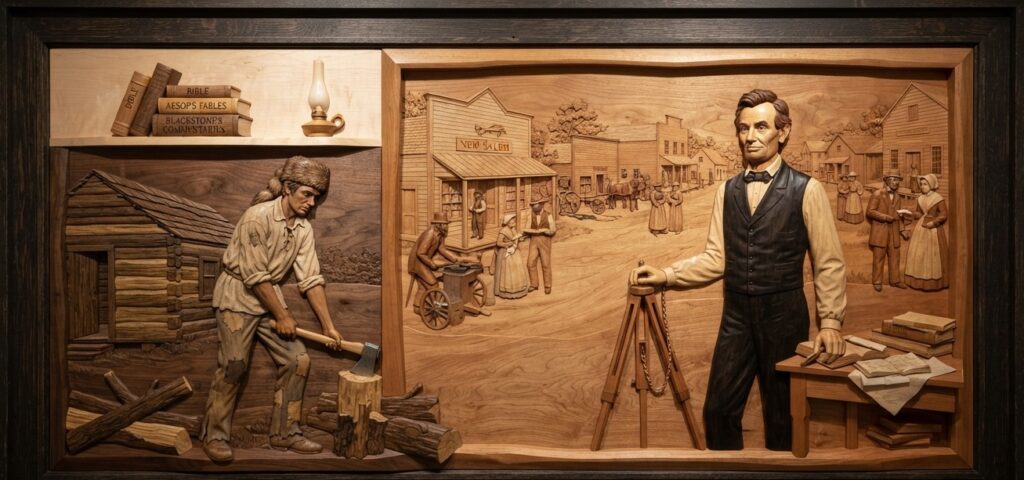
Figure 1. From Frontier Hardship to Future Leadership
2. Self-Education — Diligence in Learning
One of the strongest examples of Lincoln’s diligence is his commitment to self-education.
Because formal educational opportunities were limited, Lincoln relied heavily on books and independent study. The National Park Service records that he borrowed books from neighbors and friends and studied subjects beyond his limited schooling. His legal education was likewise largely self-directed. After being encouraged to study law, he borrowed books and pursued the subject seriously, eventually obtaining his law license in 1836. (National Park Service)
This is important because diligence is often expressed through repeated ordinary effort rather than dramatic events.
Lincoln’s education did not occur in a single moment. Reading one book did not make him a lawyer. Studying one evening did not make him a statesman. His abilities developed through accumulated effort.
The museum can therefore present Lincoln’s education as an example of character through practice.
Righteousness Principle
Diligence means faithfully developing the abilities needed to fulfill one’s responsibilities.
Learning is therefore not merely a path to personal achievement. Knowledge can become a means of serving others more wisely and responsibly.
Table 2. Lincoln’s Self-Education
| Area | Evidence of Diligence | Character Meaning |
|---|---|---|
| Reading | Read extensively despite limited schooling | Intellectual discipline |
| Law | Studied independently and earned a law license | Persistence in skill development |
| Public speaking | Developed reasoning and communication abilities | Preparation for responsibility |
| Politics | Studied major questions such as slavery and constitutional government | Serious preparation for leadership |
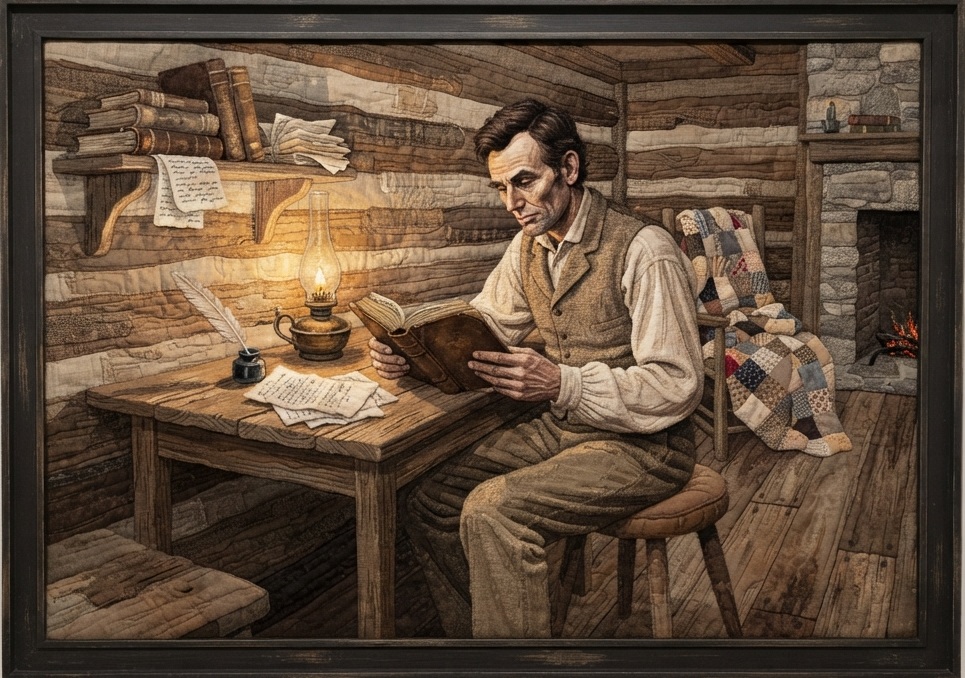
Figure 2. The Self-Educated Lincoln
3. Political Defeats — Perseverance Through Failure
Lincoln’s political career was marked by both achievement and disappointment.
He won election to the Illinois legislature in 1834 and again in 1836, but his political path was not consistently upward. His opposition to the Mexican War contributed to his failure to secure renomination to Congress in 1848. Later, he unsuccessfully sought a U.S. Senate seat in 1855. In 1858 he challenged Stephen A. Douglas for the Senate and lost, even though the Lincoln-Douglas debates significantly increased his national reputation. (National Park Service)
This distinction is essential for the exhibit.
The 1858 election produced a political defeat but a long-term leadership opportunity.
Lincoln lost the Senate election, but his debates with Douglas brought him national attention and helped establish him as a major Republican figure. Two years later, he was nominated for president and won the 1860 election. (National Park Service)
The lesson is not that every failure automatically produces success. Rather, the lesson is that a setback does not have to terminate meaningful work.
Righteousness Principle
Perseverance does not guarantee immediate victory. It means remaining committed to responsible action when the desired result has not yet arrived.
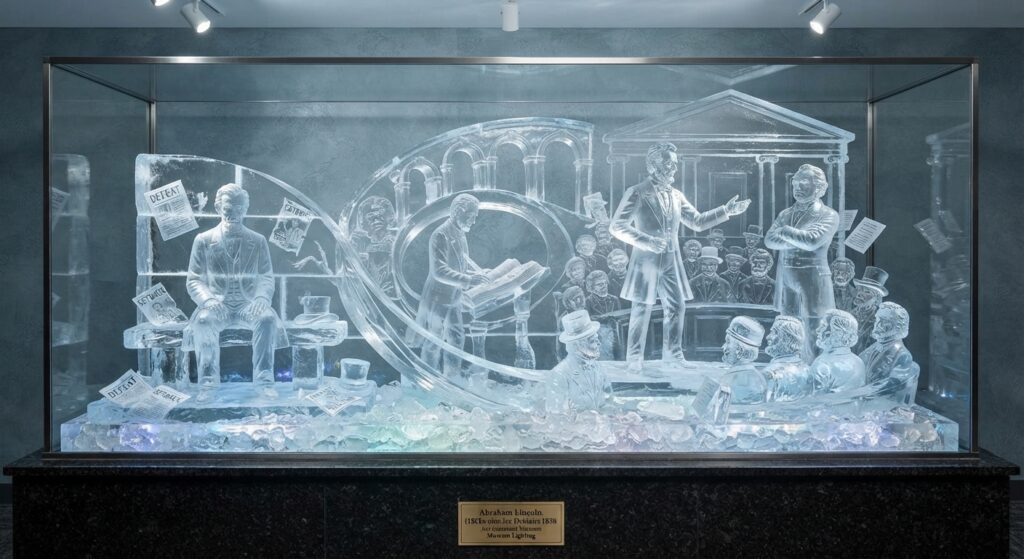
Figure 3. Defeat That Became Preparation
4. Moral Conviction — Standing for What Is Right
Lincoln’s development as a public figure increasingly centered on the question of slavery and the future of the American republic.
In the 1850s, the repeal of the Missouri Compromise and the expansion of slavery into western territories brought Lincoln back into national politics. The National Park Service describes his increasing engagement with the slavery question and his arguments against its expansion. (National Park Service)
Lincoln’s position developed within the political and constitutional context of his time, and it is important for a museum to avoid presenting his views as static from childhood onward. His historical significance comes partly from the way his ideas and political commitments developed as the national crisis deepened.
For the righteousness exhibit, this section should focus on the relationship between conviction and sustained action.
A moral principle has little practical influence if it remains only a private belief. Lincoln increasingly connected his position on slavery with political leadership and national policy.
Righteousness Principle
Righteousness requires more than recognizing a moral problem; it requires the diligence to study it, the courage to address it, and the perseverance to remain engaged when solutions are difficult.
Table 3. From Conviction to Action
| Stage | Lincoln’s Development | Righteousness Dimension |
|---|---|---|
| Recognition | Studied the political and moral conflict surrounding slavery | Moral awareness |
| Reasoning | Developed arguments concerning slavery’s expansion | Intellectual diligence |
| Public engagement | Debated and spoke publicly | Courageous action |
| Leadership | Made the issue part of presidential decision-making | Responsibility |
| Policy | Issued the Emancipation Proclamation | Conviction translated into action |
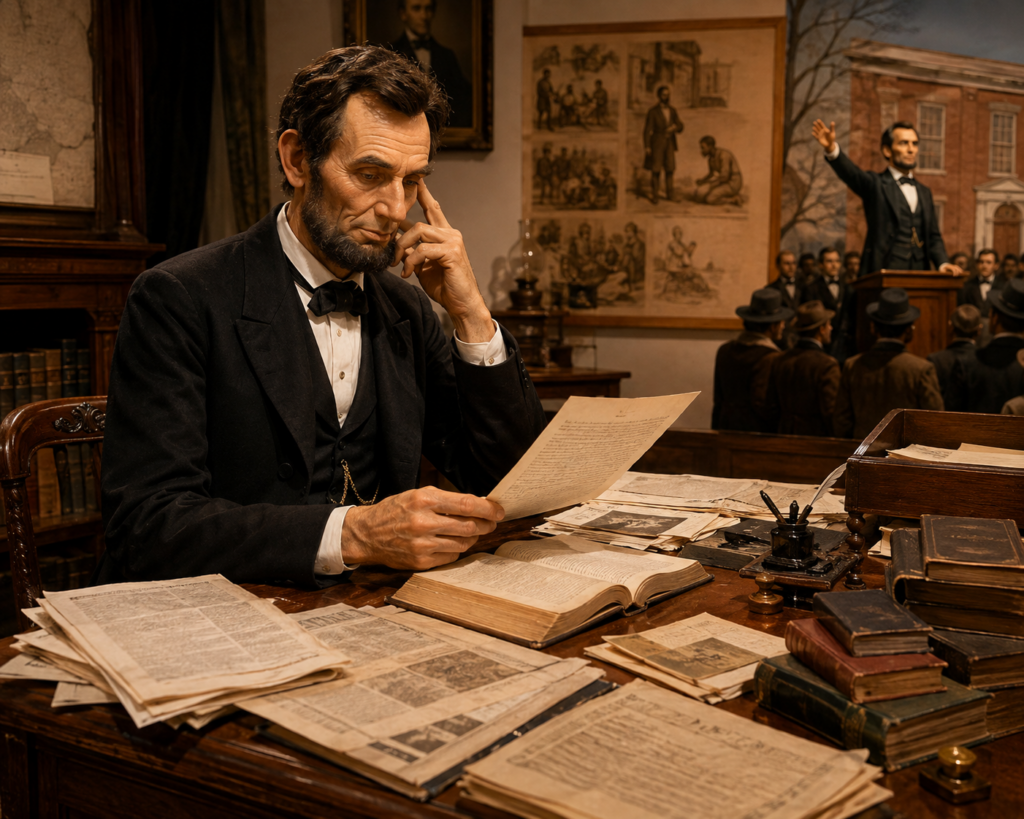
Figure 4. Conviction Becoming Action
5. Civil War Leadership — Perseverance Under Pressure
Lincoln became president in March 1861 as the United States entered an extraordinary national crisis. The Civil War created enormous political, military, constitutional, and human pressures.
Leadership during the war required persistent decision-making despite incomplete information and devastating consequences. Lincoln had to manage military commanders, political factions, public opinion, emancipation policy, foreign concerns, and the preservation of the Union.
The National Park Service describes his presidency as a period in which he faced the enormous pressures of civil war, while the Library of Congress documents his continuing work as commander in chief and his development of the ideas expressed in the Gettysburg Address. (National Park Service)
This section should not portray perseverance as stubbornness. Perseverance requires judgment.
A person who refuses to change course regardless of evidence is not necessarily diligent or righteous. Lincoln’s wartime leadership involved reassessment, consultation, decision-making, and adaptation.
Righteousness Principle
Perseverance is not blind stubbornness. It is the disciplined willingness to continue pursuing a worthy responsibility while learning, adapting, and accepting its burdens.
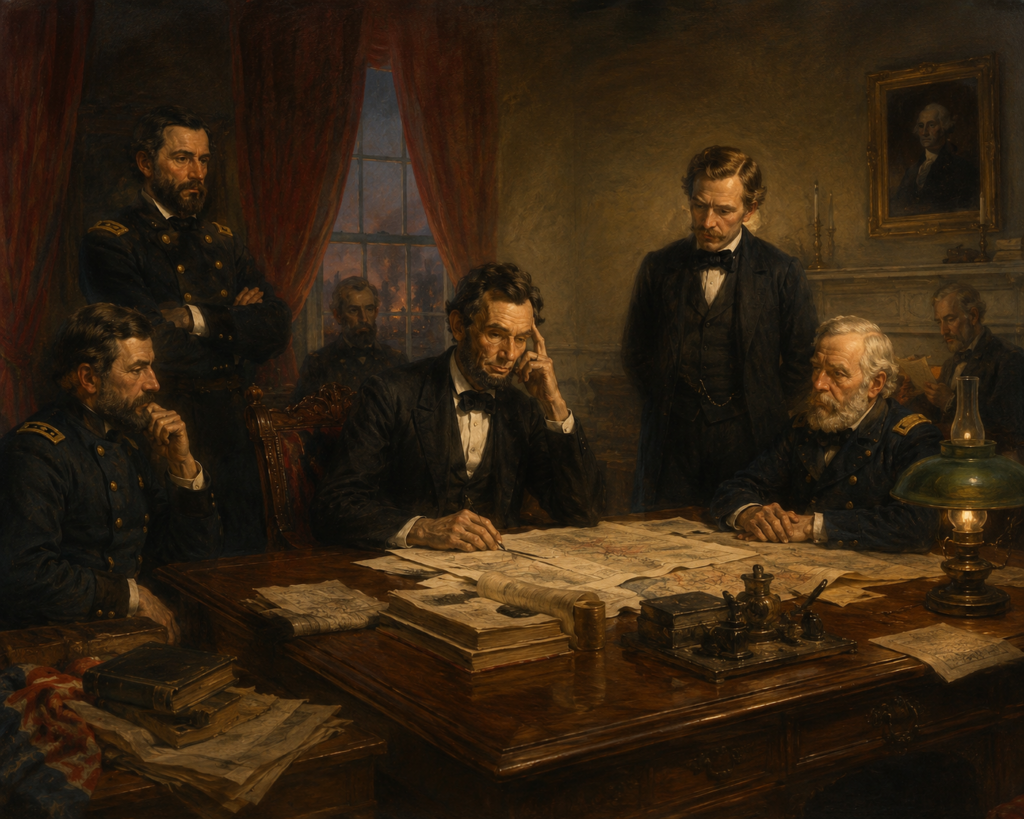
Figure 5. Leadership Under Pressure
6. Emancipation — Turning Conviction into Action
One of the most significant examples of Lincoln’s transition from conviction to action was the Emancipation Proclamation.
Lincoln issued the final Emancipation Proclamation on January 1, 1863. It declared that people held as slaves within designated areas of the rebellious states “are, and henceforward shall be free.” The National Archives emphasizes that the proclamation had important limitations: it applied to areas in rebellion and did not immediately abolish slavery everywhere in the United States. Nevertheless, it fundamentally changed the character of the war and connected Union military action with the destruction of slavery. (National Archives)
This historical complexity should remain visible in the exhibit. The proclamation was both a wartime measure and a major milestone toward the destruction of slavery.
Lincoln’s action illustrates an important principle of diligent righteousness:
Good intentions must eventually become responsible action.
The National Archives preserves the original document and identifies it as one of the nation’s major historical documents. (National Archives)
Righteousness Principle
Righteousness is strengthened when moral conviction is translated into concrete action that accepts responsibility and consequences.
Table 4. Emancipation as a Process
| Element | Historical Significance | Righteousness Dimension |
|---|---|---|
| Moral conflict | Slavery remained central to the national crisis | Recognition of injustice |
| Presidential responsibility | Lincoln acted within his wartime authority | Responsible leadership |
| January 1, 1863 | Emancipation Proclamation took effect | Action |
| Military enforcement | Freedom depended on Union military success | Perseverance |
| Long-term result | Became a milestone toward slavery’s final destruction | Enduring historical impact |
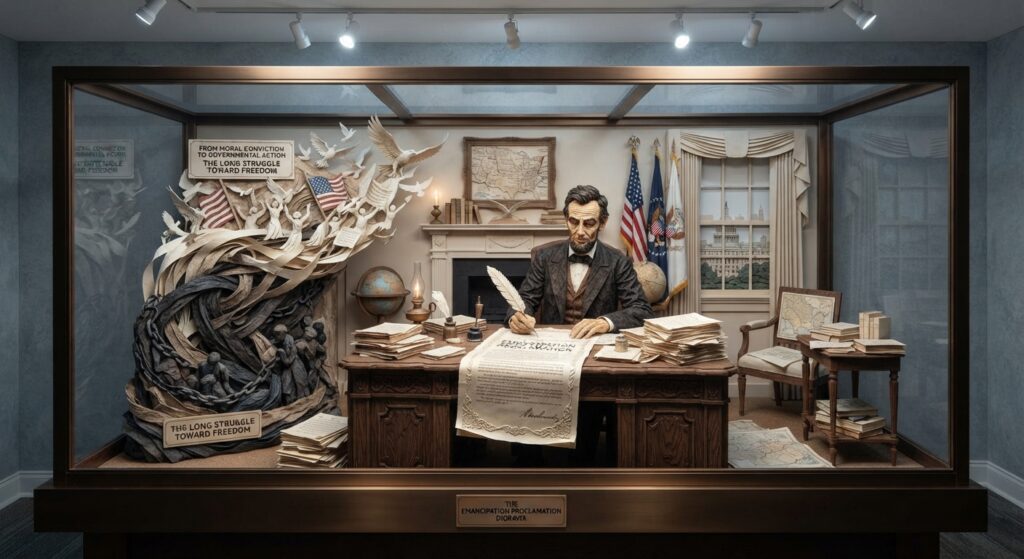
Figure 6. The Emancipation Proclamation
7. Gettysburg — Articulating a Righteous Vision
On November 19, 1863, Lincoln delivered the Gettysburg Address at the dedication of the Soldiers’ National Cemetery at Gettysburg, Pennsylvania. The Library of Congress identifies five known manuscript copies of the address, including two held in its collections. (Research Guides)
The speech transformed a ceremony honoring the dead into an opportunity to articulate a larger vision of national purpose. Lincoln connected the sacrifices of the Civil War with the ideals of equality, freedom, and democratic government. The Library of Congress describes the address as placing the suffering of the war within the larger effort of Americans to live up to the principle that all people are created equal. (Library of Congress)
The Gettysburg Address demonstrates that perseverance needs a vision of what the struggle is for.
Without a worthy purpose, persistence can become empty endurance. Lincoln’s speech gave the enormous suffering of the Civil War a moral and civic framework.
Righteousness Principle
Perseverance becomes meaningful when it serves a vision of justice, freedom, human dignity, and responsible community.
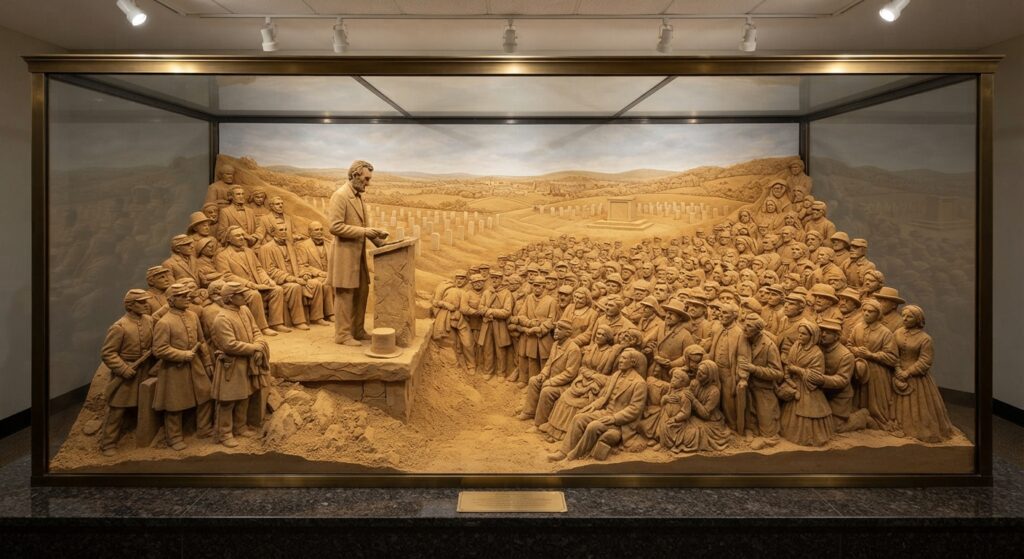
Figure 7. The Gettysburg Address (Sand Sculpture)
8. Legacy — Character Through Diligence & Perseverance
Lincoln was assassinated on April 15, 1865, only days after the surrender of Robert E. Lee’s Army of Northern Virginia. His presidency therefore ended before the full reconstruction of the nation could take place.
His historical legacy cannot be reduced to a simple story of personal success. Lincoln’s life contained poverty, limited education, business failure, political defeat, grief, national crisis, moral controversy, and enormous responsibility.
Yet these difficulties form the foundation of the lesson presented in this hall.
Lincoln demonstrates that character develops through repeated choices.
He learned when formal education was limited.
He continued after political defeat.
He developed his abilities through sustained study.
He remained engaged with difficult moral questions.
He accepted responsibility during national crisis.
He translated conviction into public action.
He articulated a vision of freedom and democratic government.
The purpose of this exhibit is therefore not to suggest that every person who works hard will become president. That would reduce diligence to achievement.
The deeper lesson is that diligence is a habit of faithful effort, while perseverance is the ability to sustain that effort when circumstances become difficult.
When these qualities are directed toward justice, responsibility, human dignity, and service, they become part of a broader concept of righteous character.
Righteousness Principle
Diligence builds the person.
Perseverance strengthens the person.
Righteousness directs the person.
Table 5. Lincoln’s Diligence & Perseverance Framework
| No. | Life Dimension | Diligence | Perseverance | Righteousness Connection |
|---|---|---|---|---|
| 1 | Education | Continuous self-study | Continued despite limited schooling | Responsible self-development |
| 2 | Career | Learned multiple skills | Recovered from failures | Responsibility |
| 3 | Politics | Studied public issues | Continued after defeat | Public service |
| 4 | Moral questions | Studied slavery and government | Stayed engaged despite conflict | Justice and human dignity |
| 5 | Presidency | Worked through complex decisions | Continued through national crisis | Responsibility under pressure |
| 6 | Emancipation | Developed policy | Sustained wartime effort | Freedom |
| 7 | Gettysburg | Developed a powerful civic message | Continued national purpose during war | Equality and democratic government |
| 8 | Legacy | Built abilities over decades | Continued serving despite adversity | Character expressed through action |
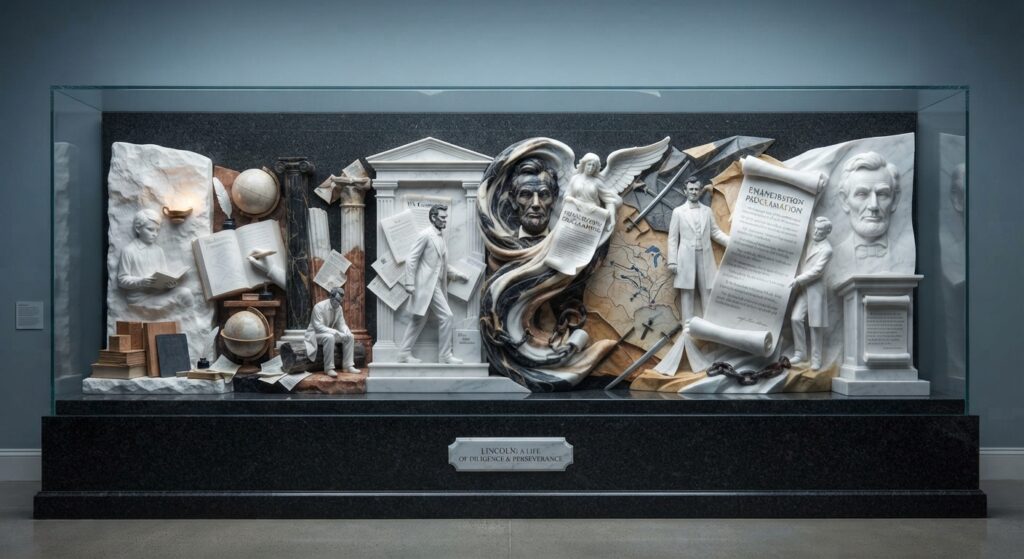
Figure 8. The Lincoln Character Model
Museum Interpretation: What Can We Learn From Lincoln?
Lincoln’s story can be translated into a practical model for everyday character development:
Small responsibility → repeated effort → developed ability → resilience → responsible action → character
This is especially important for young visitors.
A student does not need to face the Civil War to practice perseverance.
Getting out of bed when tired can be an exercise in responsibility.
Studying when the material is difficult can be an exercise in diligence.
Trying again after receiving a poor grade can be an exercise in perseverance.
Telling the truth when lying would be easier can be an exercise in integrity.
Helping someone who cannot repay you can be an exercise in service.
These actions may appear small compared with the events of Lincoln’s life. Yet character is not normally created in one dramatic moment. It is developed through repeated decisions.
Lincoln’s historical example therefore invites visitors to ask:
What am I practicing every day?
What do I do when I fail?
What do I continue doing when nobody rewards me?
What purpose directs my effort?
Am I becoming more capable only, or am I becoming more responsible as well?
The central lesson of this hall is not simply:
“Never give up.”
It is more demanding:
“Keep developing yourself, keep doing what is right, and keep serving a worthy purpose—even when the path becomes difficult.”
That is the connection between diligence, perseverance, and righteousness.
Table 6. From Lincoln’s Life to Everyday Character
| Historical Example | Everyday Application |
|---|---|
| Lincoln’s self-education | Study even when learning is difficult |
| His early political defeat | Try again after failure |
| His legal preparation | Prepare before accepting responsibility |
| His political development | Think carefully before acting |
| His Civil War leadership | Continue responsible work under pressure |
| Emancipation | Turn principles into responsible action |
| Gettysburg Address | Connect effort with a worthy purpose |
| His overall life | Build character through repeated choices |
Curator’s Summary
Abraham Lincoln represents diligence and perseverance not because his life was free from failure, but because failure did not permanently determine his direction. From limited schooling and frontier hardship to legal study, political defeat, national leadership, emancipation, and the Gettysburg Address, his life illustrates how sustained effort can develop personal capacity and how perseverance can carry responsibility through periods of extraordinary difficulty.
For the Diligence & Perseverance in Righteousness Hall, Lincoln’s most important contribution is therefore not simply the story of a successful president.
It is the example of a person whose abilities were gradually developed, whose failures did not end his efforts, and whose leadership ultimately became associated with questions of freedom, equality, national unity, and human dignity.
Diligence asks: “Will I faithfully do what needs to be done?”
Perseverance asks: “Will I continue when it becomes difficult?”
Righteousness asks: “Is what I am doing worthy and right?”
Together, these questions form a powerful framework for character.
References
Library of Congress. (1863). Abraham Lincoln papers: Series 3. General correspondence, 1837–1897: Abraham Lincoln, November 1863—Gettysburg Address: Hay Copy. Manuscript Division. Library of Congress — Gettysburg Address: Hay Copy
Library of Congress. (2026). Gettysburg Address: Primary documents in American history. Library of Congress — Gettysburg Address Research Guide
National Archives. (1863/2022). Emancipation Proclamation (1863). National Archives — Emancipation Proclamation
National Park Service. (2022). Abraham Lincoln’s boyhood in Indiana, 1816 to 1830. U.S. Department of the Interior. National Park Service — Lincoln’s Boyhood in Indiana
National Park Service. (2022). Abraham Lincoln autobiography. U.S. Department of the Interior. National Park Service — Lincoln Autobiography
National Park Service. (2015). Pre-presidential political career, 1830–1860. Lincoln Home National Historic Site, U.S. Department of the Interior. National Park Service — Lincoln’s Political Career
National Park Service. (2026). Abraham Lincoln. Lincoln Memorial, U.S. Department of the Interior. National Park Service — Abraham Lincoln
National Park Service. (2015). The formative years, 1809–1830. Lincoln Home National Historic Site, U.S. Department of the Interior. National Park Service — Lincoln’s Formative Years