
Abraham Lincoln — United States (1809–1865)
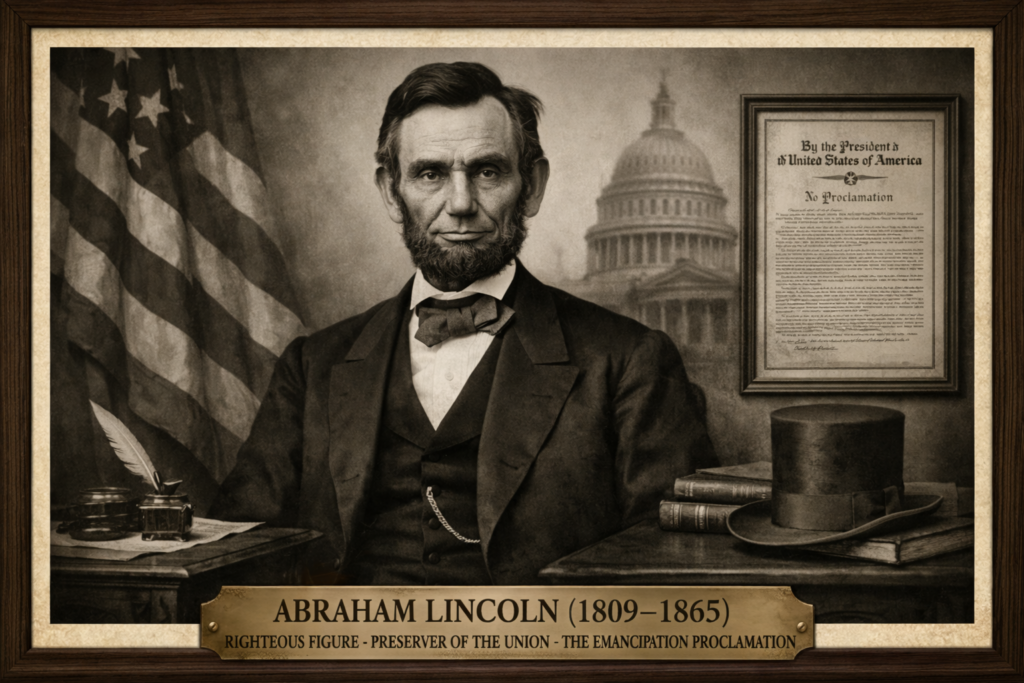
Abraham Lincoln was the 16th President of the United States and one of the most influential leaders in American history. He is widely remembered for his commitment to human equality, national unity, and moral leadership during one of the most difficult periods in the nation’s history.
Lincoln led the United States through the American Civil War, preserving the Union while advancing the cause of freedom and human rights. His leadership helped bring about the abolition of slavery, a transformative moment in the history of the United States and the broader struggle for justice and human dignity.
Historical Context
Lincoln assumed the presidency in 1861, at a time when the United States was deeply divided over the issue of slavery and states’ rights. Shortly after his election, several Southern states seceded from the Union, leading to the outbreak of the American Civil War (1861–1865).
During the war, Lincoln issued the Emancipation Proclamation in 1863, declaring that enslaved people in Confederate territories were to be set free. This action reframed the Civil War as a struggle not only for national unity but also for human freedom and equality.
Lincoln also supported the passage of the Thirteenth Amendment, which permanently abolished slavery in the United States.
Civic Virtue and Leadership
Lincoln’s leadership reflected a strong commitment to justice, moral conviction, and democratic principles. Despite intense political pressure and national turmoil, he remained dedicated to preserving the Union while promoting the ideals of liberty and equality.
One of Lincoln’s most famous speeches, the Gettysburg Address (1863), emphasized the principle that the United States was founded on the idea that all people are created equal. In this brief but powerful address, Lincoln called for renewed dedication to a nation based on freedom, democracy, and the rule of law.
His leadership demonstrated how moral conviction can guide political decisions during times of profound national crisis.
Righteous Decision: The Emancipation Proclamation
One of the most defining moments of Lincoln’s presidency was his decision to issue the Emancipation Proclamation on January 1, 1863. This executive order declared that enslaved people in territories controlled by the Confederacy were to be forever free.
Although the proclamation did not immediately end slavery everywhere in the United States, it transformed the moral purpose of the Civil War and signaled a national commitment to human liberty and justice. It also encouraged formerly enslaved individuals to seek freedom and allowed African Americans to serve in the Union Army, further strengthening the cause of emancipation.
Lincoln’s decision reflected a profound commitment to moral principle and human dignity, marking a pivotal step toward the eventual abolition of slavery through the Thirteenth Amendment in 1865.
Lincoln’s Righteous Innovation: Turning Rivals into Partners
Abraham Lincoln’s most remarkable righteous innovation was the way he built his The Origin of the Term “Team of Rivals”
The phrase “Team of Rivals” was coined by the renowned American historian Doris Kearns Goodwin in her bestselling 2005 book, Team of Rivals: The Political Genius of Abraham Lincoln.
Goodwin used this phrase to capture Lincoln’s extraordinary decision after winning the 1860 presidential election: he appointed his former political opponents — William H. Seward, Salmon P. Chase, and Edward Bates — to the most powerful positions in his Cabinet. Before Goodwin’s book, there was no commonly used phrase to describe this remarkable Cabinet.
Washington’s Precedent: Hamilton and Jefferson
This practice was not entirely new. George Washington had also brought together political opposites like Alexander Hamilton and Thomas Jefferson. However, the comparison with Lincoln reveals a crucial difference.
Initially, Hamilton and Jefferson worked together amicably. But as Hamilton’s financial policies took shape, their fundamental disagreements rapidly escalated. Hamilton championed a strong federal government, industry, and commerce; Jefferson advocated for limited federal power, states’ rights, and an agrarian society. Hamilton supported a national bank and federal credit system; Jefferson opposed it as unconstitutional.
By 1792, their relationship had become “open and painful political hostility.” They viewed each other as threats to the nation, formed opposing political parties, and engaged in personal attacks. Hamilton called Jefferson “treasonous,” while Jefferson dismissed Hamilton as a “parvenu.”
However, their relationship was not purely hatred. In the 1800 presidential election deadlock, Hamilton supported Jefferson over Aaron Burr, calling him the “lesser of two evils.” After Hamilton’s death in 1804, Jefferson expressed a complex sense of loss — “I had no rival.”
Washington’s challenge: He could not reconcile the fundamental differences between Hamilton and Jefferson, and they ultimately became bitter enemies. Lincoln’s achievement: He successfully united four former rivals in his Cabinet, transforming personal grievances into collaborative service for the common cause of saving the Union. This is why Lincoln’s “Team of Rivals” is considered an innovation — he found a way to turn personal political competition into a force for national unity.
Lincoln’s Radical Approach: Appointing Those Who Mocked and Criticized Him
What made Lincoln truly remarkable was his willingness to appoint not just rivals, but people who had personally mocked, insulted, and humiliated him.
Edwin M. Stanton: From “Gorilla” to Secretary of Defence
The most famous example is Edwin M. Stanton. Before Lincoln became president, they worked together on a patent case. Stanton completely dismissed Lincoln, treating him like a “country bumpkin” and mocking him as a “long-armed ape.” Even after Lincoln was elected, Stanton publicly insulted him, calling him a “gorilla” and an “imbecile.”
Despite these insults, Lincoln appointed Stanton as Secretary of War in 1862. Lincoln reportedly said: “Stanton is my enemy… but for the sake of the country, I believe he is the best man for the job.”
Stanton transformed the chaotic War Department with his iron will and became one of Lincoln’s most trusted advisors. The most remarkable detail? When Stanton publicly called Lincoln’s orders “foolish,” Lincoln simply replied: “If Stanton says I’m a fool, then I must be one — because he is almost always right.” Lincoln even gave Stanton the power to veto his own orders. The two eventually became close friends.
Salmon P. Chase: The Ambitious Treasury Secretary
Chase was one of Lincoln’s main rivals for the 1860 nomination. After joining the Cabinet, he never hid his ambition for the presidency. He repeatedly threatened to resign, publicly criticized Lincoln’s decisions in Cabinet meetings, and privately dismissed Lincoln as weak.
Lincoln was fully aware of this. He once remarked that Chase had “the presidential fever” and that his mind was “full of maggots about the presidency.” Yet Lincoln still valued Chase’s abilities, calling him “a very able man.” Lincoln’s principle was: “I do not wish to get rid of anyone, even though he may be foolishly opposing me behind my back.”
William H. Seward: The Arrogant Secretary of State
Seward was Lincoln’s strongest opponent for the nomination. He initially accepted the position of Secretary of State with condescension, maintaining an arrogant and critical attitude toward Lincoln. There is a famous anecdote: Seward once visited the White House and saw Lincoln polishing his own shoes. Seward scolded him, saying: “In Washington, we don’t polish our own shoes.” Lincoln replied with a smile: “Then, Mr. Secretary, whose shoes do you polish?”
Despite Seward’s arrogance, Lincoln recognized his intellect. Seward eventually became one of Lincoln’s most loyal allies.
The Righteous Logic Behind Lincoln’s Decisions
Lincoln’s approach was a true righteous innovation because it challenged the conventional logic of power:
First, national purpose above personal pride. Lincoln understood that in a time of national crisis, the country needed the best minds — regardless of personal grievances. Personal grudges were trivial; the survival of the nation was paramount.
Second, criticism as a safeguard. Lincoln did not see criticism as a threat but as a corrective mechanism. By giving Stanton the power to veto his orders, he used his critic’s honesty to protect himself from his own mistakes.
Third, transforming enemies into partners. Lincoln’s greatness lay in his ability to unite former rivals in a common cause. He trusted and valued his critics not because they were friends, but because they were the most honest and capable advisors he could find.
His logic was both simple and revolutionary: in a time of life-and-death struggle, he needed people who could get things done — not people who would simply flatter him.
Inspiring Future Generations
Lincoln’s righteous innovation has deeply influenced leaders across generations:
Barack Obama: President Obama appointed his primary primary opponent, Hillary Clinton, as Secretary of State in his first term — widely seen as a direct echo of Lincoln’s “Team of Rivals” approach.
Modern Leadership: This principle is now widely embraced in business, academia, and other fields. Leaders are encouraged to “embrace diverse perspectives” and recognize that in difficult times, they need people around them who can “challenge their assumptions.”
Applying This Wisdom to Our Daily Lives
In teams: Actively invite colleagues who hold different or opposing views into decision-making conversations. Treat disagreements as opportunities to refine ideas, not as personal conflicts.
In relationships: Learn to collaborate — even build friendships — with people with whom you have had past disagreements or rivalries. Focus on shared goals.
In personal growth: Cultivate Lincoln’s emotional intelligence — learn to manage your own emotions, understand others’ feelings, and navigate conflict with empathy.
Lincoln’s “Team of Rivals” was not without friction and internal struggle. But it ultimately became the force that held the Union together. True righteousness is not simply walking alongside those who already agree with you — it is the ability to transform former opponents and critics into partners in the cause of justice.
Challenges and Adversity
Abraham Lincoln’s presidency was marked by extraordinary political, military, and personal challenges. The Civil War resulted in immense loss of life and deep divisions within the country. Yet Lincoln’s response to these challenges revealed the depth of his righteous leadership.
Throughout the conflict, Lincoln faced military setbacks, fierce criticism from political opponents, and the constant struggle to maintain national unity in a time of war. Many of his sharpest critics were not distant enemies but members of his own Cabinet — men who had publicly mocked him, challenged his decisions, and even plotted to replace him. Rather than silencing or dismissing them, Lincoln chose a different path: he kept them close, listened to their honest counsel, and used their criticism as a safeguard against his own errors.
Lincoln also endured profound personal hardship, including the death of his son Willie Lincoln in 1862, which deeply affected him during the most difficult years of the war. Yet through this grief, Lincoln’s resilience deepened, and his commitment to justice and unity remained steadfast.
These experiences tested Lincoln’s character and strengthened his determination to guide the nation through one of its most turbulent periods. His ability to transform personal pain into national purpose, and to turn critics into allies, became one of the most powerful expressions of his righteous leadership.
Legacy
Abraham Lincoln is remembered as a symbol of moral courage, justice, and principled leadership. His role in preserving the United States and ending slavery reshaped the nation’s legal and moral foundations.
But Lincoln’s legacy is not only about what he achieved — it is also about how he achieved it. His righteous innovation lay in his ability to unite former rivals and critics into a team devoted to the common good. He demonstrated that true leadership is not about surrounding oneself with supporters, but about having the courage to work alongside those who challenge you — and to trust them when it matters most.
Lincoln’s life and leadership continue to inspire discussions about human rights, equality, and ethical leadership. His dedication to the ideals of freedom and democratic governance remains central to the historical identity of the United States.
Today, Lincoln is widely regarded as one of the most influential leaders in modern history and an enduring example of leadership guided by conscience, resilience, and moral responsibility.
References
Burlingame, M. (2008). Abraham Lincoln: A life. Johns Hopkins University Press.
Donald, D. H. (1995). Lincoln. Simon & Schuster.
Gienapp, W. E. (2002). Abraham Lincoln and civil war America: A biography. Oxford University Press.

Museum Test Prep App – Abraham Lincoln
The Righteousness Museum Album – Lincoln