
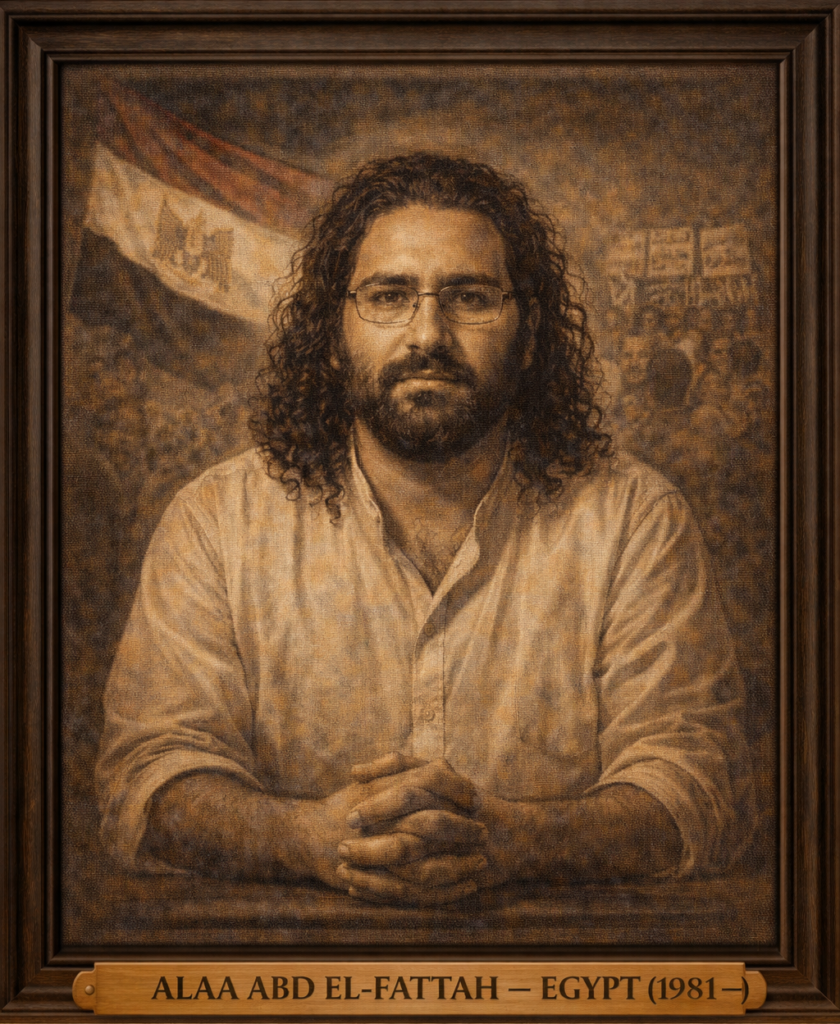
Alaa Abd El-Fattah — Egypt (1981– )
Alaa Abd El-Fattah is an Egyptian activist, writer, and software developer known for his advocacy of freedom of expression, digital rights, and democratic reform in Egypt. He became a prominent figure during the country’s pro-democracy movements, using both technology and public discourse to support civic participation and political accountability.
Through his activism, he has drawn international attention to issues of human rights and political freedom in Egypt.
Historical Context
In 2011, widespread protests erupted across Egypt as part of the Arab Spring.
Citizens called for political reform, an end to corruption, and greater civil liberties. These protests led to significant political changes, including the resignation of long-time president Hosni Mubarak.
However, the years that followed were marked by continued political instability, shifts in government, and restrictions on dissent and public expression.
Alaa Abd El-Fattah emerged as one of the most visible activists during and after these events.
Civic Virtue and Leadership
Alaa Abd El-Fattah played a key role in promoting digital activism and the use of online platforms to support civic engagement.
As a blogger and software developer, he contributed to the development of tools and networks that enabled activists to share information, organize protests, and communicate ideas.
He consistently advocated for freedom of speech, open internet access, and the protection of civil liberties.
His leadership combined technological innovation with a strong commitment to democratic principles.
Righteous Act: Defending Freedom of Expression
Alaa Abd El-Fattah’s most significant contribution has been his persistent defense of freedom of expression and digital rights, even under conditions of imprisonment.
He used writing and online platforms to challenge censorship and promote open political dialogue.
Despite repeated arrests, he continued to advocate for the rights of citizens to speak freely and participate in public life.
His writings from prison have also drawn international attention to issues of political detention and human rights.
Challenges and Adversity
Alaa Abd El-Fattah has faced numerous arrests and periods of imprisonment over more than a decade.
He has been charged under various laws related to protest and national security, reflecting the broader restrictions placed on political activism in Egypt.
His detention has been the subject of international concern, with organizations such as Amnesty International and the United Nations calling attention to his case.
Despite these challenges, he has continued to advocate for democratic freedoms and human rights.
Legacy
Alaa Abd El-Fattah is regarded as a significant figure in the movement for digital rights and democratic reform in the Middle East.
His work highlights the role of technology in modern activism and the importance of protecting freedom of expression in both physical and digital spaces.
His legacy reflects moral courage, intellectual resistance, and a commitment to the principles of freedom and justice.
References
Abd El-Fattah, A. (2021). You have not yet been defeated. Fitzcarraldo Editions.
Amnesty International. (2022). Egypt: Case of Alaa Abd El-Fattah.
Human Rights Watch. (2023). Egypt: Crackdown on dissent.
United Nations. (2022). Statements on freedom of expression and detention.