
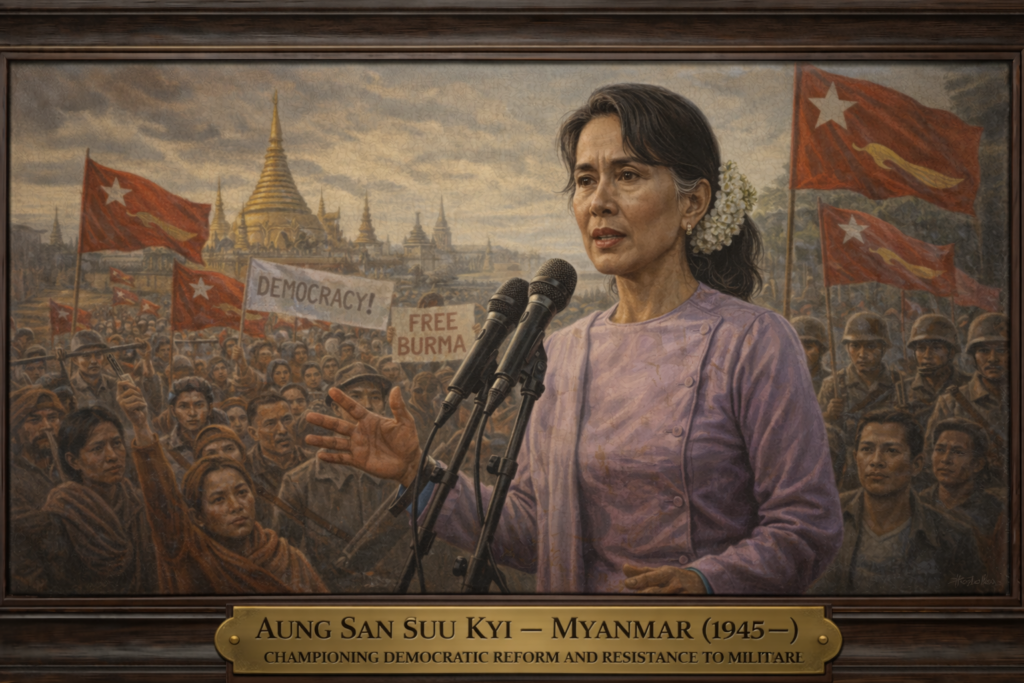
Aung San Suu Kyi — Myanmar (1945– )
Aung San Suu Kyi is a Burmese political leader, democracy advocate, and former government official who became internationally known for her long struggle to promote democratic reform and nonviolent political change in Myanmar. Through years of political activism and personal sacrifice, she became one of the most recognized figures in the global movement for democracy and human rights.
As the leader of the National League for Democracy (NLD), Aung San Suu Kyi encouraged peaceful resistance against military rule and advocated for political freedoms, free elections, and civilian government.
Her commitment to nonviolent political struggle drew global attention and inspired many supporters both within Myanmar and internationally.
Historical Context
After gaining independence from Britain in 1948, Myanmar experienced periods of political instability and military rule.
In 1962, the military seized control of the government and established an authoritarian regime that restricted political freedoms and limited democratic participation.
For decades, opposition parties and political activists faced censorship, imprisonment, and strict limitations on public political activity.
During the late 1980s, widespread public protests calling for democratic reforms emerged across the country. These events brought Aung San Suu Kyi into national political life as a leading advocate for democratic change.
Civic Virtue and Leadership
Aung San Suu Kyi entered politics in 1988, during a major nationwide movement demanding democratic reform.
She helped lead the National League for Democracy, which quickly gained popular support among citizens seeking political freedom and civilian government.
In 1990, Myanmar held national elections in which the NLD won an overwhelming majority of parliamentary seats. However, the military government refused to recognize the results and prevented the party from forming a government.
For many years, Aung San Suu Kyi remained under house arrest, restricted from political activity but continuing to advocate peacefully for democratic reform.
Her perseverance during these years made her a global symbol of nonviolent resistance and political courage.
Righteous Act: Nonviolent Resistance to Military Rule
Aung San Suu Kyi’s most significant contribution was her long campaign advocating nonviolent democratic reform in Myanmar.
Inspired by principles of peaceful resistance similar to those promoted by Mahatma Gandhi, she consistently called for dialogue, national reconciliation, and democratic elections.
Despite long periods of house arrest and restrictions on her movement, she continued communicating with supporters and encouraging peaceful civic participation.
Her leadership helped sustain the democratic movement in Myanmar during decades of authoritarian rule.
In recognition of her commitment to peaceful political change, she was awarded the Nobel Peace Prize in 1991.
Challenges and Controversy
Aung San Suu Kyi’s later political career has been complex and controversial.
After political reforms allowed elections in the 2010s, the National League for Democracy won national elections in 2015, and she became the country’s de facto civilian leader.
However, her government faced significant international criticism over the treatment of the Rohingya population, particularly during military operations that led to large-scale displacement and allegations of human rights abuses.
These events generated intense debate internationally regarding her leadership and the limitations of civilian authority within Myanmar’s political system.
Legacy
Aung San Suu Kyi remains a complex and widely discussed figure in modern political history.
Her early activism helped inspire global movements supporting democracy, human rights, and peaceful political resistance.
At the same time, later developments in Myanmar’s politics have led scholars and observers to reexamine her role and legacy.
Despite these debates, her early leadership in the struggle for democratic reform in Myanmar remains an important chapter in the country’s political history.
References
Clements, A. (1999). The voice of hope: Conversations with Aung San Suu Kyi. Seven Stories Press.
Steinberg, D. I. (2010). Burma/Myanmar: What everyone needs to know. Oxford University Press.
Seekins, D. M. (2002). The disorder in order: The army-state in Burma since 1962. White Lotus Press.
Lintner, B. (1999). Burma in revolt: Opium and insurgency since 1948. Silkworm Books.