
Bao Zheng — China (999–1062)
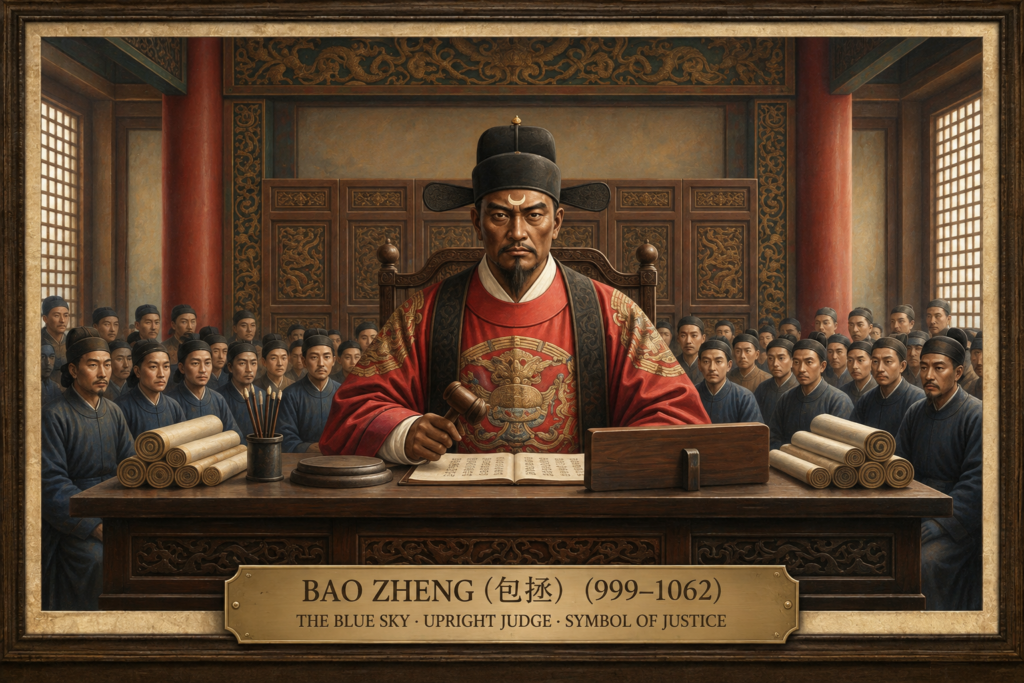
Bao Zheng was a distinguished judge, government official, and statesman of the Northern Song dynasty. Renowned for his incorruptibility and commitment to justice, he became one of the most enduring symbols of righteous governance in Chinese history.
Serving in various administrative and judicial positions, Bao Zheng gained a reputation for impartial judgment and fearless integrity. He was known for applying the law equally to all individuals, regardless of social status or political influence. Bao Zheng earned the nickname “Bao Qingtian” (包青天), meaning “Blue Sky Bao,” symbolizing his impartiality and moral uprightness.
Over time, his reputation grew beyond historical records, and he became a legendary figure in Chinese culture, widely known as “Bao Gong” (Lord Bao)—a model of moral courage and judicial fairness.
Historical Context
Bao Zheng lived during the Northern Song dynasty, a period characterized by administrative reform, economic development, and a strong civil service system.
The Song government relied heavily on the Confucian examination system, which selected officials based on scholarly merit. Bao Zheng successfully passed the imperial examinations and began his career in public service, eventually rising to high-ranking judicial positions in the imperial government.
During this time, corruption and abuse of power remained ongoing challenges within the bureaucracy. Bao Zheng’s strict adherence to law and moral principles distinguished him as an exceptional official within the Song administration.
Civic Virtue and Leadership
Bao Zheng became famous for his unwavering dedication to fair judgment and moral responsibility in public office. His leadership reflected the Confucian ideal that government officials must act with integrity, impartiality, and loyalty to justice.
He consistently defended the rights of ordinary citizens and resisted pressure from powerful elites. His reputation for honesty earned him widespread respect among the people, who saw him as a protector against corruption and injustice.
Because of his moral character and administrative competence, Bao Zheng was appointed to important roles within the central government, including positions that allowed him to oversee legal matters and government accountability.
Righteous Act: Justice Without Favor
Bao Zheng’s reputation for righteousness was built on his uncompromising commitment to impartial justice.
One of the most famous aspects of his career was his willingness to investigate and punish corruption among powerful officials, even those connected to influential families. According to historical accounts and later traditions, Bao Zheng believed that the law must apply equally to everyone, regardless of rank.
In many stories associated with his career, Bao Zheng is depicted as refusing to accept bribes or political pressure, ensuring that legal judgments were based solely on evidence and fairness.
His strict sense of justice made him both respected and feared within the bureaucracy, reinforcing the idea that public officials must remain accountable to ethical principles.
Challenges and Adversity
Bao Zheng’s dedication to justice often placed him in conflict with powerful political figures and influential families.
In a hierarchical imperial system where personal connections could influence decisions, enforcing the law without bias required exceptional courage. Bao Zheng faced political resistance, pressure from elites, and the risk of damaging his career by challenging corruption.
Despite these difficulties, he continued to uphold legal fairness and administrative integrity. His perseverance demonstrated the belief that true righteousness requires moral courage in the face of authority and pressure.
Legacy
Bao Zheng remains one of the most celebrated figures of justice and integrity in Chinese history.
His reputation inspired centuries of literature, theater, and folklore, especially in traditional Chinese opera and storytelling, where he is portrayed as the ideal judge who protects the innocent and punishes wrongdoing.
Today, Bao Zheng is remembered not only as a historical official but also as a lasting symbol of ethical governance, judicial fairness, and unwavering righteousness.
His legacy continues to represent the principle that justice must remain impartial and grounded in moral integrity.
References
Huang, R. (1981). 1587, a year of no significance: The Ming dynasty in decline. Yale University Press.
McKnight, B. E. (1992). Law and order in Sung China. Cambridge University Press.
Twitchett, D., & Smith, P. J. (Eds.). (2009). The Cambridge history of China: Volume 5, Sung China, 960–1279. Cambridge University Press.
Zhang, L. (2015). Judge Bao and the rule of law in Chinese tradition. Journal of Chinese Historical Studies, 8(2), 45–60.