
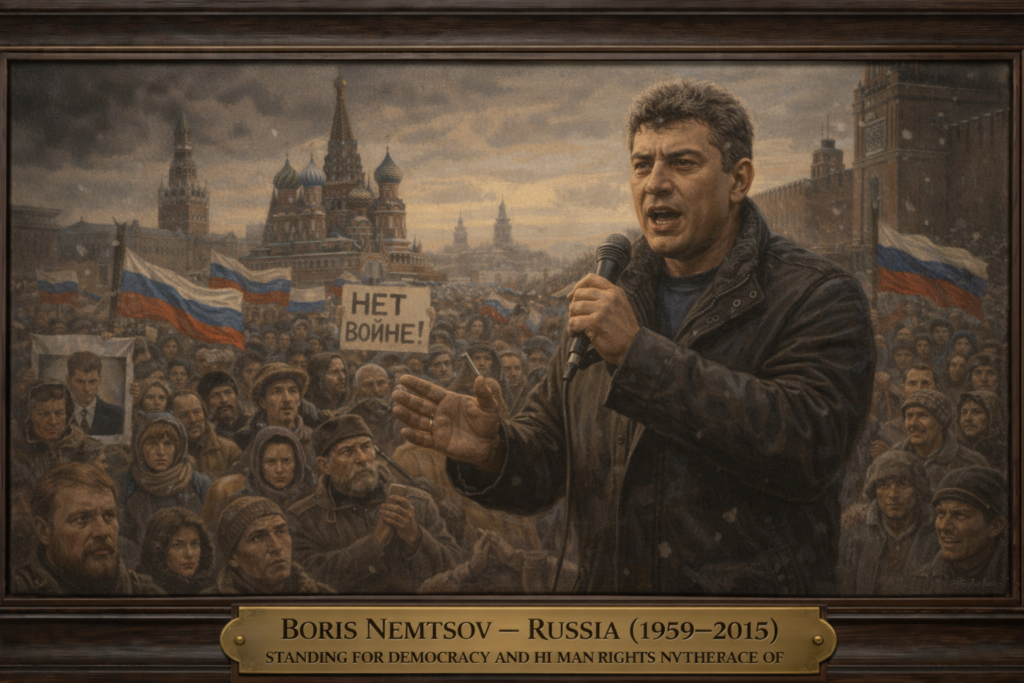
Boris Nemtsov — Russia (1959–2015)
Boris Nemtsov was a Russian politician, reform advocate, and democracy activist who became one of the most prominent critics of political corruption and authoritarian governance in modern Russia. Throughout his career, he advocated for democratic institutions, government transparency, and human rights.
Initially rising to prominence during the political reforms of the 1990s, Nemtsov later became an outspoken opposition leader who criticized corruption and the concentration of political power in Russia. His public advocacy and political activities made him one of the most visible voices calling for democratic reform.
Today, he is remembered as a symbol of political courage, commitment to democratic values, and the defense of civil liberties.
Historical Context
Following the collapse of the Soviet Union, Russia underwent major political and economic transformations.
During the 1990s, reforms aimed to transition the country from a centrally planned economy to a market-based system and establish democratic political institutions.
Boris Nemtsov served in several government positions during this period, including as a deputy prime minister under Boris Yeltsin.
In the early twenty-first century, political power increasingly consolidated under Vladimir Putin, and opposition figures began raising concerns about declining democratic freedoms, restrictions on the media, and government corruption.
Nemtsov became one of the leading figures voicing these concerns.
Civic Virtue and Leadership
During the 1990s, Nemtsov gained a reputation as a reform-oriented politician committed to economic modernization and democratic governance.
After leaving government, he continued participating in public life as an opposition leader, organizing political movements and participating in peaceful demonstrations advocating for fair elections and political accountability.
Nemtsov also published reports and investigations that criticized corruption within government institutions.
Through these activities, he emphasized the importance of transparency, rule of law, and citizen participation in democratic societies.
His leadership demonstrated a willingness to challenge powerful institutions in defense of democratic principles.
Righteous Act: Advocating for Democracy and Transparency
One of Boris Nemtsov’s most significant contributions was his persistent advocacy for democratic reform and government accountability.
He helped organize peaceful public demonstrations calling for fair elections, freedom of expression, and respect for civil rights.
Nemtsov also worked on investigative reports examining alleged corruption and misuse of public resources.
Despite increasing political pressure on opposition leaders, he continued speaking publicly about these issues and encouraged civic engagement among Russian citizens.
His commitment to transparency and democratic governance made him an influential voice in Russia’s political opposition.
Challenges and Adversity
As an outspoken critic of government policies, Nemtsov faced increasing political marginalization and pressure.
Opposition activists often encountered restrictions on public demonstrations and limited access to national media.
Despite these challenges, Nemtsov continued participating in political debates and public protests.
On February 27, 2015, Boris Nemtsov was assassinated near the Kremlin in Moscow.
His death drew international attention and prompted widespread expressions of concern about political violence and the safety of opposition figures.
Legacy
Boris Nemtsov remains an important symbol of the struggle for democratic governance and civil liberties in modern Russia.
Supporters and activists continue to remember his efforts to promote transparency, political accountability, and public participation in government.
His legacy is often associated with the broader movement advocating for political reform, human rights, and the protection of democratic institutions.
Today, Boris Nemtsov’s life is remembered as an example of moral courage in political leadership and the willingness to defend democratic values despite personal risk.
References
Colton, T. J., & McFaul, M. (2003). Popular choice and managed democracy: The Russian elections of 1999 and 2000. Brookings Institution Press.
Gel’man, V. (2015). Authoritarian Russia: Analyzing post-Soviet regime changes. University of Pittsburgh Press.
Sakwa, R. (2020). Russian politics and society. Routledge.
Dawisha, K. (2014). Putin’s kleptocracy: Who owns Russia? Simon & Schuster.