
Chiune Sugihara — Japan (1900–1986)
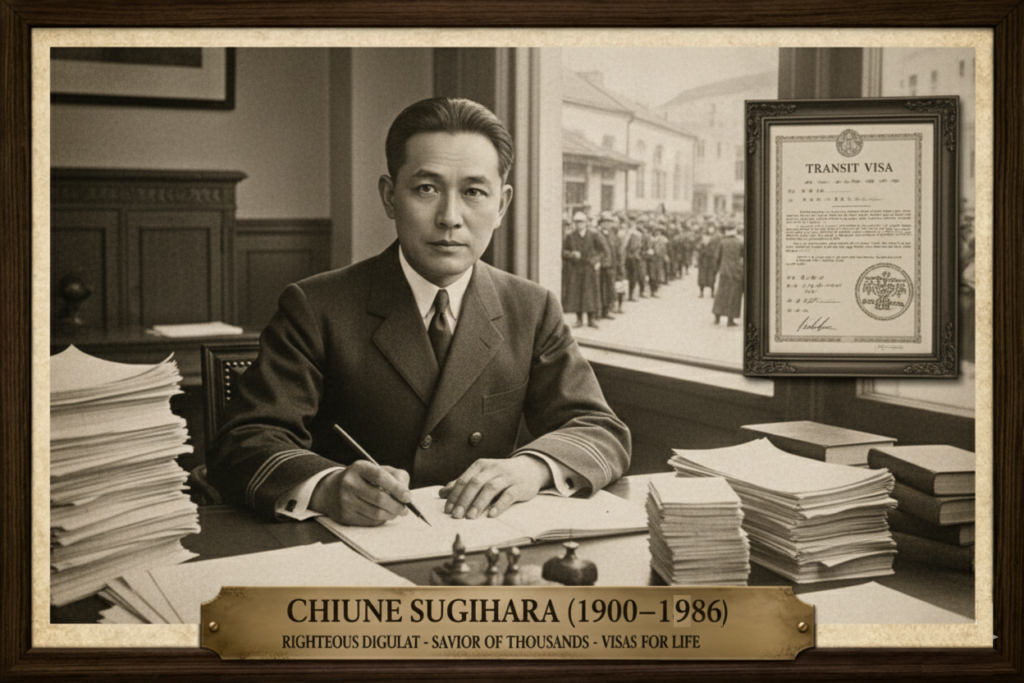
Chiune Sugihara was a Japanese diplomat who became known for saving thousands of Jewish refugees during the Second World War by issuing transit visas that allowed them to escape Nazi persecution. Serving as Japan’s vice-consul in Lithuania, Sugihara chose to follow his moral conscience rather than strict government orders.
Through his courageous actions, Sugihara helped thousands of refugees flee Europe and avoid capture by the advancing Nazi regime. His decision to issue visas, often in direct defiance of official instructions, saved an estimated 6,000 lives.
Today, Sugihara is remembered as one of the most remarkable examples of humanitarian courage, moral responsibility, and compassionate leadership during the Holocaust.
Historical Context
During the early years of the Second World War, Jewish communities across Europe faced escalating persecution under Nazi rule. After Germany invaded Poland in 1939, many Jewish refugees attempted to flee eastward to escape violence and deportation.
By 1940, thousands of refugees had gathered in Lithuania, desperately seeking travel documents that would allow them to leave Europe. Without valid visas, they faced the threat of capture and deportation as Nazi influence expanded.
At the time, obtaining legal passage across international borders was extremely difficult. Refugees needed a transit visa that would allow them to travel through the Soviet Union and eventually reach safer countries such as Japan or destinations in Asia.
Within this desperate situation, Chiune Sugihara became a key figure in helping refugees secure the documents they needed to escape.
Civic Virtue and Leadership
As Japan’s vice-consul in Kaunas, Lithuania, Sugihara received requests from thousands of Jewish refugees seeking travel visas. According to Japanese government policy, visas could only be issued under strict conditions, and many applicants did not meet those requirements.
Sugihara repeatedly requested permission from the Japanese government to issue visas for the refugees. However, his requests were denied.
Faced with this dilemma, Sugihara made a profound ethical decision. He chose to follow his humanitarian conscience rather than obey the restrictive policy.
Working long hours each day, Sugihara personally wrote thousands of transit visas, often continuing late into the night to help as many refugees as possible.
His actions reflected a deep commitment to human dignity, compassion, and the belief that saving lives was a moral responsibility that transcended bureaucratic rules.
Righteous Act: Issuing Life-Saving Visas
Chiune Sugihara’s most significant act of moral courage occurred in 1940, when he began issuing transit visas to Jewish refugees seeking escape from Europe.
Despite clear instructions from Tokyo limiting the issuance of such documents, Sugihara decided that the humanitarian crisis required immediate action. He and his wife worked tirelessly to produce visas for refugees who had gathered outside the Japanese consulate.
These documents allowed refugees to travel through the Soviet Union by rail and eventually reach safety in other parts of the world, including Japan and various countries in Asia.
Even after the Japanese consulate was ordered to close, Sugihara continued writing visas until the very last moment before leaving Lithuania. According to historical accounts, he continued signing visas from the train window as he departed.
Through these efforts, Sugihara helped save approximately 6,000 refugees, many of whose descendants are alive today.
Challenges and Adversity
Sugihara’s decision to issue visas without full government approval carried significant professional risk. Diplomats were expected to follow strict instructions from their government, and disobedience could have serious consequences.
After the war, Sugihara left the Japanese diplomatic service. Although the exact reasons remain debated by historians, his actions during the war were not widely recognized for many years.
For decades, Sugihara lived a relatively modest life, working in various civilian occupations while the story of his humanitarian actions remained largely unknown outside the communities he had helped save.
Despite the lack of recognition at the time, Sugihara remained humble about his actions, stating that he had simply done what he believed was morally right.
Legacy
Chiune Sugihara is now widely honored as one of the most courageous diplomats of the twentieth century.
In 1985, he was recognized as Righteous Among the Nations by Yad Vashem for his role in saving thousands of Jewish refugees during the Holocaust.
Today, Sugihara is celebrated in Japan, Israel, and many other countries as a symbol of moral courage, human compassion, and ethical leadership.
The families of those he helped—often referred to as “Sugihara survivors”—number in the tens of thousands today, demonstrating the profound and lasting impact of his decision.
His story remains a powerful reminder that individual acts of conscience can change the course of many lives and stand as enduring examples of righteousness in history.
References
Levine, H. (1996). In search of Sugihara: The elusive Japanese diplomat who risked his life to rescue 10,000 Jews from the Holocaust. Free Press.
Seishiro, S. (2000). Chiune Sugihara and Japan’s foreign policy. University Press of America.
Sugihara, Y. (2001). Visas for life. Edu-Comm Plus.
Zuroff, E. (2009). Operation last chance: One man’s quest to bring Nazi criminals to justice. Palgrave Macmillan.