
Dietrich Bonhoeffer — Germany (1906–1945)
Dietrich Bonhoeffer was a German theologian, pastor, and Christian ethicist who became one of the most prominent religious figures to resist the Nazi regime during the Second World War. Through his teachings, writings, and personal actions, he challenged the moral corruption of the state and defended the principles of human dignity, faith, and ethical responsibility.
Bonhoeffer strongly opposed the attempts by the Nazi government to control German churches and manipulate Christian institutions for political purposes. He became an active member of the Confessing Church, a movement that resisted Nazi interference in religious life.
His commitment to moral truth and ethical resistance eventually led him to participate in efforts to oppose the Nazi dictatorship, even at great personal risk. Today, Bonhoeffer is remembered as a powerful example of faith-driven courage and moral integrity in the face of tyranny.
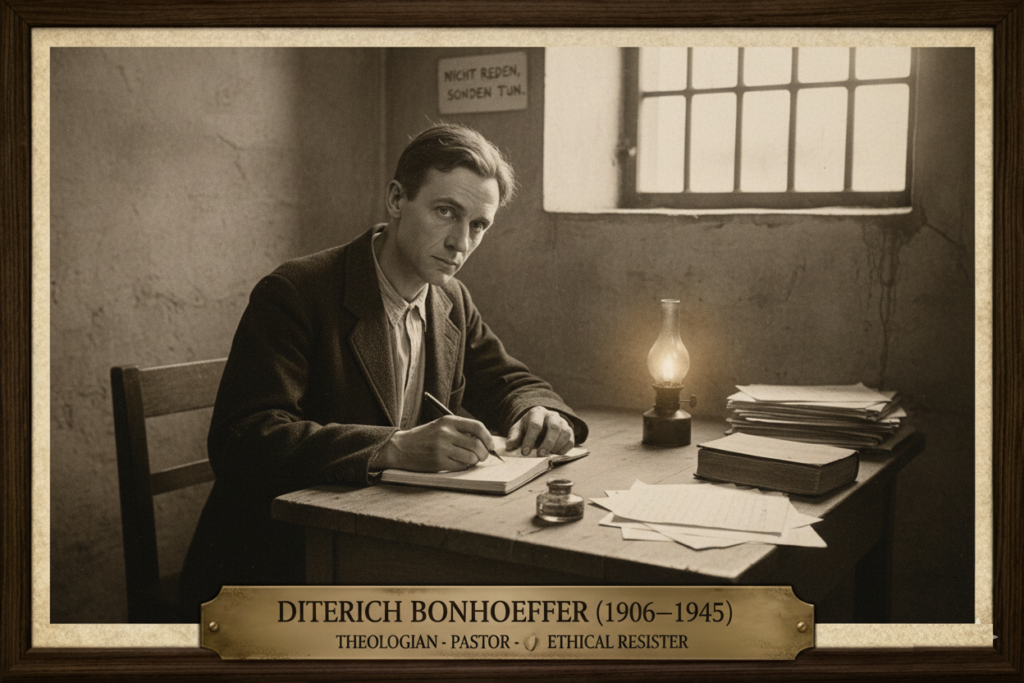
Historical Context
In 1933, Adolf Hitler and the Nazi Party came to power in Germany, establishing a totalitarian regime that sought to control nearly every aspect of public life.
The government attempted to bring Christian churches under political control through a movement known as the German Christian movement, which aimed to align church teachings with Nazi ideology. Many religious leaders either supported the regime or remained silent.
However, some theologians and pastors believed that the state had overstepped its authority and that the church had a duty to defend truth, justice, and human dignity.
Out of this conflict emerged the Confessing Church, a movement of clergy and believers who resisted the Nazification of the German Protestant Church.
Dietrich Bonhoeffer became one of the most important voices within this movement, arguing that Christians had a moral obligation to oppose injustice and tyranny.
Civic Virtue and Leadership
Bonhoeffer believed that faith required moral action. For him, Christian belief was inseparable from ethical responsibility toward society.
He helped establish an underground seminary to train pastors for the Confessing Church, ensuring that religious leadership would remain independent from Nazi control. Through teaching and writing, he emphasized the importance of moral courage, responsibility, and obedience to conscience.
Bonhoeffer argued that silence in the face of injustice was itself a form of wrongdoing. In his view, ethical leadership required individuals to stand against injustice, even when doing so involved personal risk.
His theological writings and sermons inspired many Christians to reflect on the relationship between faith, ethics, and political responsibility.
Righteous Act: Resistance to the Nazi Regime
Dietrich Bonhoeffer’s most significant act of moral courage was his involvement in efforts to resist the Nazi dictatorship.
As the crimes of the regime became increasingly clear, Bonhoeffer concluded that merely preaching against injustice was not enough. He believed that Christians had a duty to actively oppose tyranny in order to protect innocent lives.
Through contacts within the German resistance, Bonhoeffer became connected with a group of officials and military officers who were secretly working against the Nazi regime.
Although primarily known as a theologian and pastor, Bonhoeffer assisted resistance efforts by helping communicate information and supporting plans aimed at ending the dictatorship.
His involvement demonstrated a profound commitment to ethical responsibility, showing that moral conviction sometimes requires difficult and courageous choices.
Challenges and Adversity
Bonhoeffer’s opposition to the Nazi regime placed him under increasing scrutiny from the authorities. His writings, speeches, and involvement with the Confessing Church attracted the attention of the Gestapo, the Nazi secret police.
In 1943, he was arrested and imprisoned for his connections to the German resistance.
During his imprisonment, Bonhoeffer continued writing letters and theological reflections that later became some of his most influential works. Despite facing uncertain circumstances, he remained committed to his faith and his belief in the importance of truth and moral responsibility.
In April 1945, shortly before the end of the war in Europe, Bonhoeffer was executed by the Nazi regime at the Flossenbürg concentration camp.
Legacy
Dietrich Bonhoeffer is remembered as one of the most significant Christian thinkers and moral leaders of the twentieth century.
His writings on ethics, faith, and responsibility have influenced theologians, philosophers, and social leaders around the world. His life demonstrated that religious conviction can serve as a powerful foundation for moral resistance against injustice.
Bonhoeffer’s courage in confronting the Nazi regime continues to inspire discussions about the relationship between faith, political authority, and human rights.
Today, he stands as a symbol of moral integrity, spiritual courage, and the belief that individuals have a responsibility to defend justice and human dignity, even in the most dangerous circumstances.
References
Bethge, E. (2000). Dietrich Bonhoeffer: A biography. Fortress Press.
Bonhoeffer, D. (1997). Letters and papers from prison. Touchstone.
Marsh, C. (2014). Strange glory: A life of Dietrich Bonhoeffer. Alfred A. Knopf.
Metaxas, E. (2010). Bonhoeffer: Pastor, martyr, prophet, spy. Thomas Nelson.