
The Donkey (Equus asinus): Humble Service, Patient Righteousness
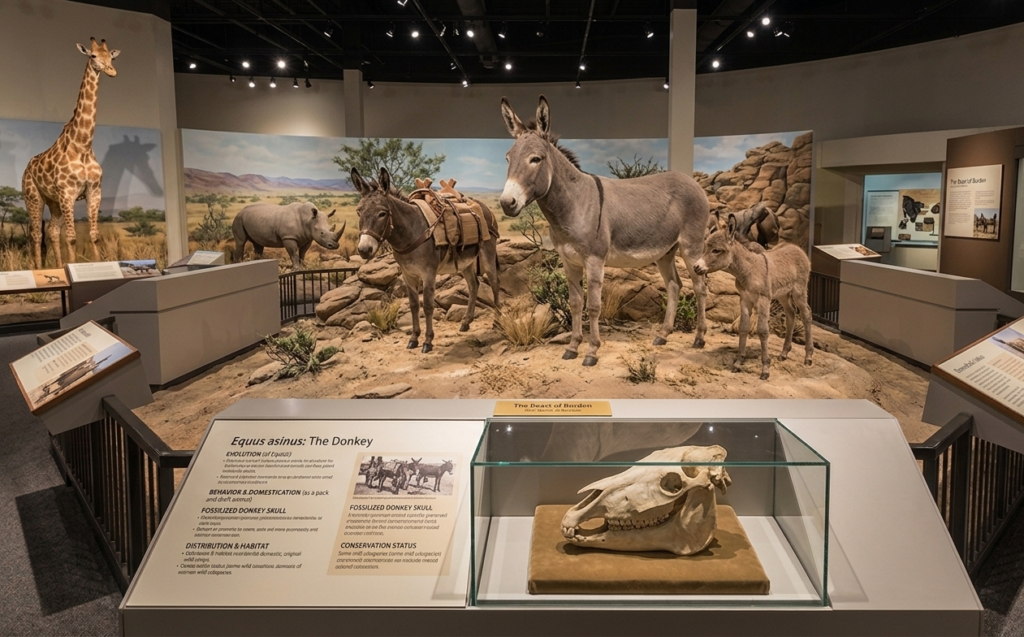
Figure 1. Donkey in Ancient Landscape.
Introduction to the Animal
The donkey, known in Hebrew as chamor (from the root meaning “reddish-brown”) and in Greek as onos, is one of the most frequently mentioned animals in the Bible—appearing over 150 times. Domesticated approximately 6,000 years ago in Northeast Africa, the donkey served as the primary beast of burden for ancient Near Eastern societies, capable of carrying up to 30% of its body weight (200-300 pounds) across harsh terrain (Clutton-Brock, 2012).
Unlike the horse, which was associated with war, chariots, and human pride, the donkey was the animal of peace, agriculture, and common people. Kings rode donkeys when they came in peace; they rode horses only for battle. This distinction is crucial for understanding the donkey’s symbolic meaning (Borowski, 2002).
The Bible mentions donkeys in moments of both judgment and grace:
- Abraham saddled a donkey to journey toward Mount Moriah with Isaac (Genesis 22:3)
- Balaam’s donkey saw the Angel of the Lord and spoke a word of rebuke (Numbers 22:21-33)
- The Fourth Commandment includes the donkey in the Sabbath rest (Exodus 20:10)
- Jesus Christ fulfilled prophecy by riding a donkey into Jerusalem (Zechariah 9:9; Matthew 21:1-11)
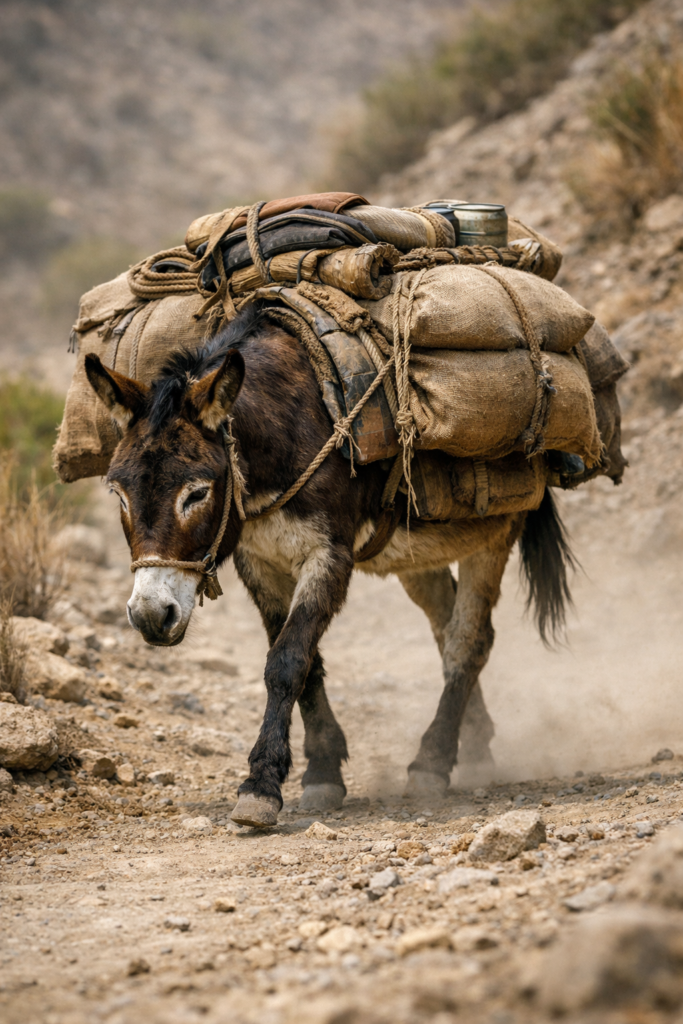
Figure 2. Donkey Carrying a Load.
The Wisdom of the Donkey
The wisdom of the donkey is rooted in patient endurance and accurate self-assessment. The donkey knows it is not the fastest, not the strongest, not the most beautiful. Yet it carries what no horse will carry and goes where no camel can fit. Its wisdom is the refusal to compare itself to others and the acceptance of its appointed role.
Table 1. Wisdom Traits of the Donkey and Their Practical Lessons
| Wisdom Trait | Behavioral Evidence | Practical Lesson |
|---|---|---|
| Patient endurance | Carries heavy loads for long distances without complaint | Righteous service does not require recognition or reward |
| Discernment of danger | Stops or refuses to move when genuine threat is present (Balaam’s donkey) | Wisdom sometimes looks like stubbornness to the ignorant |
| Contentment with role | Does not envy the horse’s speed or the camel’s height | Righteousness flourishes when you accept your calling |
| Memory of paths | Can find water and navigate familiar routes after years | Faithfulness is built through repeated small obediences |
| Gentle strength | Carries children, elders, and the weak without harming them | True power serves the vulnerable, not itself |
The donkey’s wisdom includes a fascinating paradox: what humans often call “stubbornness” is frequently discernment. The donkey does not move forward when it senses danger—precisely what Balaam’s donkey did when it saw the Angel of the Lord blocking the path. The prophet, blinded by his own ambition, beat the animal for its “stubbornness.” But the donkey was right, and the prophet was wrong (Numbers 22:21-33).
Table 2. Donkey “Stubbornness” vs. True Disobedience
| Human Perception | Donkey Reality | Lesson |
|---|---|---|
| “Stubborn” | Refusing to move into danger | Discernment is not rebellion |
| “Slow” | Maintaining sustainable pace | Endurance requires pacing |
| “Unimpressive” | Suited for humble, necessary work | God chooses the lowly for essential tasks |
| “Uncooperative” | Resisting mistreatment or overloading | Boundaries are not sin |
The Righteousness of the Donkey
If the rock badger’s righteousness is humility that hides and the lion’s righteousness is boldness that stands, the donkey’s righteousness is service that carries.
The donkey does not hide in the crags. It does not roar on the savanna. It walks the dusty road, day after day, bearing whatever load is placed upon its back—not because it lacks the strength to rebel, but because it has the wisdom to know that faithful service is its highest calling.
Table 3. Virtues of the Donkey and Their Ethical Implications
| Virtue Demonstrated | Behavioral Evidence | Ethical Implication |
|---|---|---|
| Humble service | Carries burdens without seeking applause | Righteousness often appears in unnoticed daily labor |
| Patience | Endures harsh conditions, poor treatment, and heavy loads | Love is patient; righteousness does not retaliate |
| Peacefulness | Associated with agriculture and civilian life, never with war | The righteous pursue peace, not conflict |
| Faithfulness | Returns to the same path, same master, same duty for years | Consistency is a form of holiness |
| Prophetic role | Balaam’s donkey spoke God’s truth when the prophet would not | God can use the humblest creature to deliver His message |
The most profound expression of donkey righteousness appears in Zechariah’s prophecy and its fulfillment in Jesus Christ:
“Rejoice greatly, Daughter Zion! Shout, Daughter Jerusalem! See, your king comes to you, righteous and victorious, lowly and riding on a donkey, on a colt, the foal of a donkey.” — Zechariah 9:9 (NIV)
This is the scandal of the donkey: the Messiah came on a donkey. Not on a stallion of conquest. Not in a chariot of bronze. On a donkey—the same animal that carried farmers’ produce, potters’ clay, and mothers’ children.
Table 4. Horse vs. Donkey in Biblical Symbolism
| Aspect | Horse | Donkey |
|---|---|---|
| Association | War, chariots, human pride | Peace, agriculture, humble service |
| Speed | Fast | Slow |
| Posture | Proud, high-headed | Patient, low-headed |
| Biblical warning | “Do not trust in horses” (Psalm 20:7) | “Blessed is he who comes on a donkey” (Zechariah 9:9) |
| Messiah’s mount | Never | Yes (Triumphal Entry) |
The apostle Paul captured the donkey’s righteousness when he wrote:
“Do nothing out of selfish ambition or vain conceit. Rather, in humility value others above yourselves, not looking to your own interests but each of you to the interests of the others.” — Philippians 2:3-4 (NIV)
The donkey does not demand recognition. It does not compare its load to another’s. It simply carries—and in carrying, it becomes the vehicle of God’s purposes.
Reflection
The donkey invites every visitor to this museum to ask a searching question: What burden have I refused to carry because I thought it was beneath me?
In a world that celebrates the lion’s roar and envies the eagle’s flight, the donkey is easily overlooked. Yet Scripture elevates this humble animal again and again. Consider:
1. Are you a lion who needs to learn donkey humility?
- Do you demand recognition for your service? Do you refuse tasks that seem “too small” or “beneath your dignity”? Do you roar when you should carry?
- Example: Refusing to wash dishes after a meal because you are “too important,” or declining to help with menial tasks at your place of worship or work.
2. Are you a rock badger who needs to learn donkey service?
- Do you hide from necessary burdens? Do you retreat so completely that you never engage? Do you confuse hiding with holiness?
- Example: Avoiding a difficult family responsibility because it is “too heavy,” or refusing to help a neighbor because it might inconvenience you.
3. Do you know that your ordinary work is righteous?
- The donkey did not preach sermons or write psalms. It carried wood, grain, and people. Yet God used a donkey to speak prophecy (Numbers 22) and to carry the King of Kings (Matthew 21).
- Your daily work—changing diapers, filing paperwork, sweeping floors, caring for aging parents—is donkey work. And it is holy.
The great theologian and writer C.S. Lewis observed this truth in his own life, noting that most of God’s work is done by ordinary people doing ordinary things with extraordinary faithfulness—not by heroes, but by donkeys.
As you look upon this donkey, ask yourself:
- What burden have I been avoiding? (Not the dramatic, heroic burden—the daily, hidden one.)
- Am I too proud to carry what God has placed before me?
- Do I compare my load to others’ loads and grow resentful?
- And crucially: Am I willing to be the donkey that carries the King?
The donkey does not choose its load. The load is given. The donkey does not choose the path. The master directs. The donkey does not demand applause. The work itself is the reward.
This is the righteousness of the donkey: to carry what is given, to go where sent, to serve without complaint, and to rest when the work is done.
“Whatever you do, work at it with all your heart, as working for the Lord, not for human masters… It is the Lord Christ you are serving.” — Colossians 3:23-24 (NIV)
References
- Borowski, O. (2002). Every Living Thing: Daily Use of Animals in Ancient Israel. AltaMira Press.
- Clutton-Brock, J. (2012). A Natural History of Domesticated Mammals (2nd ed.). Cambridge University Press.
- Keener, C. S. (2009). The Gospel of Matthew: A Socio-Rhetorical Commentary. Eerdmans.
Disclaimer:
This website is an independent digital museum. All product names, trademarks, and brands are the property of their respective owners and are used for identification and educational purposes only. No affiliation or endorsement is implied.