
The Dove (Rock Dove / Pigeon): Gentle Loyalty, Covenant Faithfulness
Exhibit Music: The Song of Dove, [Lyrics]
Listen to the Dove Exhibit – Wisdom, Righteousness & Reflection
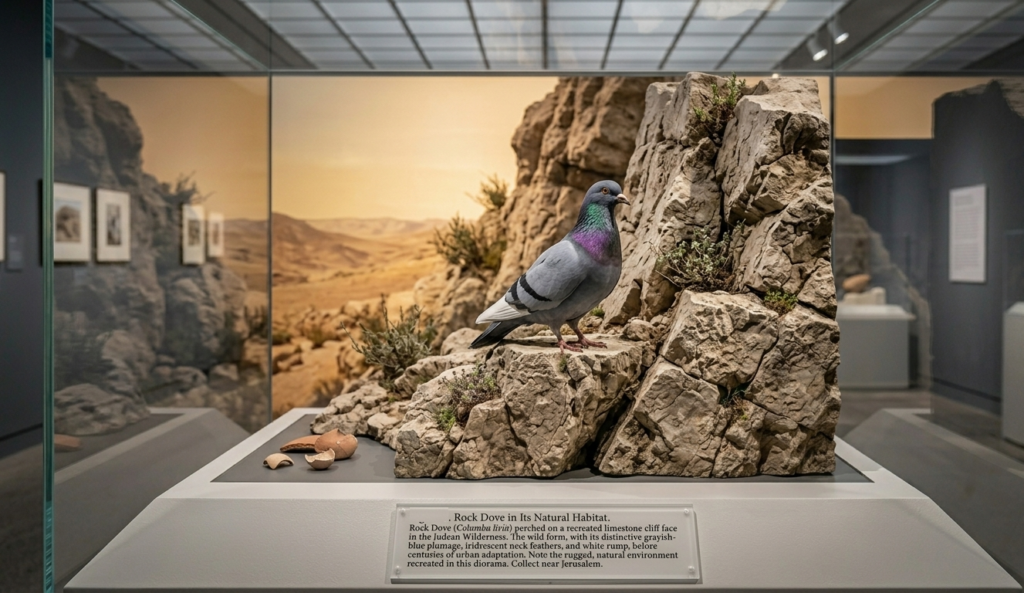
Figure 1. Rock Dove in Its Natural Habitat. A museum diorama photograph of a rock dove perched on a limestone cliff face in the Judean wilderness. The bird has a grayish-blue body, iridescent purple-green neck feathers, and a distinctive white rump. The image captures the wild, original form of the bird before urban domestication.
Introduction to the Animal
The dove, known in Hebrew as yonah and in Greek as peristera, is one of the most frequently mentioned birds in Scripture—appearing over 50 times. Biologically, the dove and the common city pigeon belong to the same family (Columbidae), with the rock dove (Columba livia) being the wild ancestor of the feral pigeon. These birds weigh approximately 200-400 grams (7-14 ounces) and possess remarkable homing abilities, capable of finding their way back to their nest from over 1,000 kilometers (600 miles) away (Gibbs, 2019).
The Bible mentions doves and pigeons in several significant contexts:
- Noah’s Ark: A dove returned with an olive leaf, signaling the end of God’s judgment and the restoration of peace (Genesis 8:8-12)
- Sacrificial System: Doves and pigeons were the permitted offering for the poor—including Mary and Joseph at Jesus’s presentation (Leviticus 5:7; Leviticus 12:8; Luke 2:22-24)
- Jesus’s Baptism: The Holy Spirit descended “in bodily form like a dove” upon Jesus (Matthew 3:16; Mark 1:10; Luke 3:22)
- Loyalty Metaphor: The dove is used as a symbol of faithful, exclusive love in the Song of Solomon (Song of Solomon 1:15; 2:14; 5:2; 6:9)
Yet it is in the Gospels that the dove receives its highest moral commendation, as Jesus instructs His disciples:
“Be as innocent as doves.” — Matthew 10:16 (NIV)
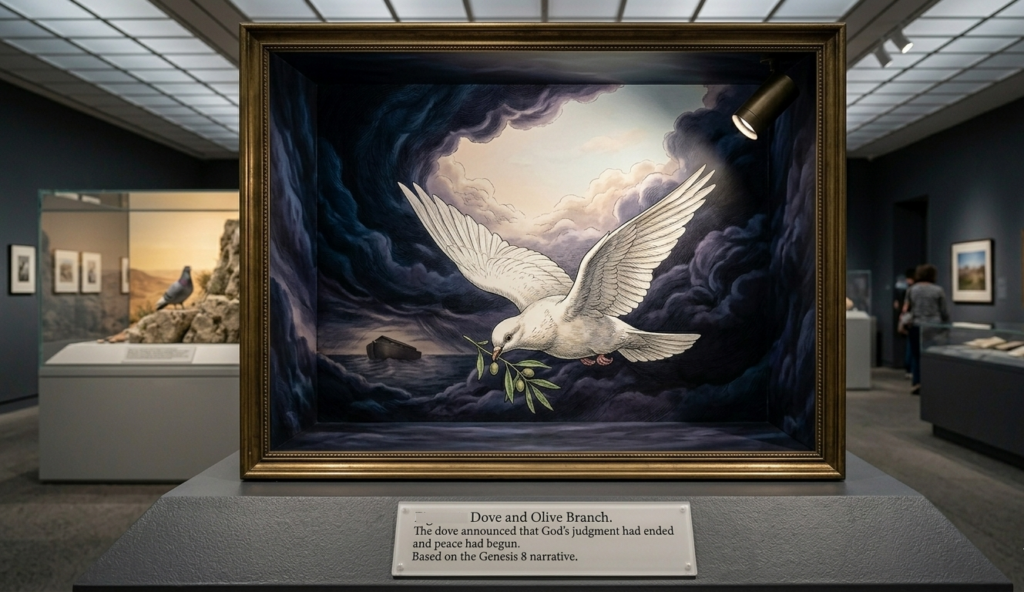
Figure 2. Dove and Olive Branch. A museum illustration showing a dove in flight carrying a small olive branch in its beak, based on the Genesis 8 narrative. The background is a dark, stormy sky parting to reveal light. The caption reads: “The dove announced that God’s judgment had ended and peace had begun.”
The Wisdom of the Dove
The wisdom of the dove is rooted in loyalty, gentleness, and homing instinct. Unlike many birds that take multiple mates, doves are known to mate for life—a pair bond that can last for decades. The male and female share equally in nest-building, incubation, and feeding their young (Gibbs, 2019).
Table 1. Wisdom Traits of the Dove and Their Practical Lessons
| Wisdom Trait | Behavioral Evidence | Practical Lesson |
|---|---|---|
| Lifelong mating | Pairs remain together until death, sharing all parental duties | Covenant faithfulness requires daily commitment, not just wedding vows |
| Homing ability | Can navigate hundreds of miles back to the nest | The righteous have a “homing instinct” for God’s presence |
| Gentleness | Non-aggressive; does not attack other birds or animals | Righteousness is not weakness but controlled strength |
| Vantage point | Builds nests on high, inaccessible cliffs and ledges | The righteous gain perspective by dwelling with God on high places |
| Mournful call | The “turtledove” is named for its distinctive “turr-turr” call | There is a righteous grief that is not despair but faithful waiting |
The dove’s wisdom also includes the ability to navigate by the sun, stars, and Earth’s magnetic field. Even when released in unfamiliar territory, the dove orients itself and flies home. This homing instinct is the wisdom of orientation toward the source of safety and love (Wiltschko & Wiltschko, 2015).
Furthermore, the dove demonstrates wisdom through its vantage point. Doves build their nests on high, inaccessible places—cliffs, rock ledges, and tall trees. From these heights, they can see danger approaching and have a broader perspective on the landscape below. As the psalmist writes:
“Oh, that I had the wings of a dove! I would fly away and be at rest.” — Psalm 55:6 (NIV)
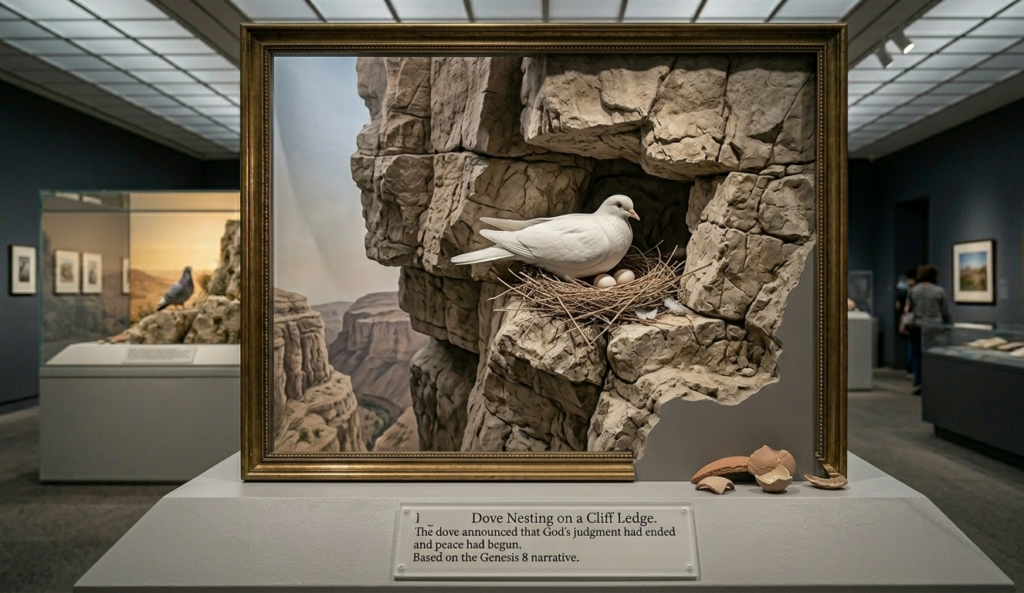
Figure 3. Dove Nesting on a Cliff Ledge. A close-up museum photograph of a dove’s nest built on a narrow, inaccessible limestone ledge high above a valley. The nest contains two eggs, with one parent bird sitting on them. The image conveys security through strategic positioning.
The Righteousness of the Dove
If wisdom is knowing how to remain faithful and oriented toward home, righteousness is the daily practice of that faithfulness. The dove’s choice to “mate for life” and “return to its nest” is not merely instinct—it is a model for righteous living.
Table 2. Virtues of the Dove and Their Ethical Implications
| Virtue Demonstrated | Behavioral Evidence | Ethical Implication |
|---|---|---|
| Covenant loyalty | Mates for life; shares all parental duties | Righteousness is faithful commitment, not convenience |
| Innocence | Non-aggressive, harmless in nature | Righteousness does not harm others, even when provoked |
| Purity | White or clean gray plumage; associated with cleanliness | Righteousness involves moral purity and simplicity |
| Peace-making | The olive branch-bearing dove is the universal symbol of peace | The righteous are peacemakers, not agitators |
| Homing devotion | Returns to its mate and nest from any distance | Righteousness returns to God after every wandering |
The most profound expression of dove righteousness appears in the Song of Solomon, where the beloved is called a dove—not once, but repeatedly:
“How beautiful you are, my darling! Oh, how very beautiful! Your eyes are like doves.” — Song of Solomon 1:15
“My dove in the clefts of the rock, in the hiding places on the mountainside, show me your face.” — Song of Solomon 2:14
“My dove, my perfect one, is unique.” — Song of Solomon 6:9
Table 3. The Dove as a Metaphor for Covenant Love
| Element in Song of Solomon | Meaning |
|---|---|
| “Your eyes are like doves” | Single-focused, loyal gaze—not wandering to others |
| “My dove in the clefts of the rock” | Hidden, safe, protected in the refuge of the beloved |
| “Show me your face” | Intimacy without shame; vulnerability in safety |
| “My perfect one is unique” | Exclusive love; no rival is accepted |
The prophet Hosea uses the dove to describe the double-heartedness of Israel—but even then, the dove’s instinct to return becomes a metaphor for repentance:
“Ephraim is like a dove, easily deceived and senseless—now calling to Egypt, now turning to Assyria.” — Hosea 7:11 (NIV)
The dove’s instinct to return home is good when it returns to God; it is foolish when it returns to bondage. The righteous dove, therefore, is the one whose homing instinct is oriented correctly—toward the Rock, not toward Egypt (Reyburn & Fry, 2000).
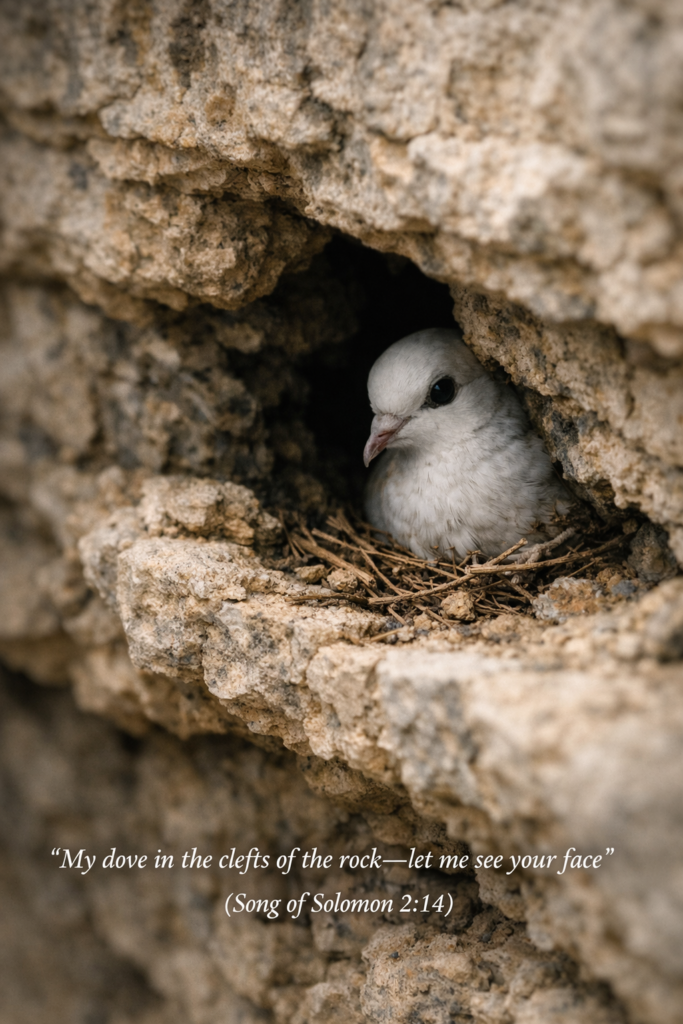
Figure 4. Dove in the Clefts of the Rock. A museum photograph showing a white dove nestled in a deep crevice of a limestone cliff. The bird is barely visible, hidden in the shadow of the rock. The caption reads: “My dove in the clefts of the rock—let me see your face” (Song of Solomon 2:14).
Even the dove’s designation in the sacrificial system carries a profound lesson about righteousness. When Mary and Joseph offered “a pair of doves or two young pigeons” at Jesus’s presentation (Luke 2:24), they were exercising the provision for the poor. The Messiah was redeemed with the offering of the poor. The King of Kings was ransomed with the sacrifice of the dove.
Table 4. The Dove in Sacrificial System
| Aspect | Meaning |
|---|---|
| Permitted for the poor | Righteousness does not require wealth; God accepts humble offerings |
| Clean bird | The dove is pure, acceptable to God |
| Often paired with a sin offering | Doves carried the sins of the offerer symbolically |
| Two doves for Mary and Joseph | The Messiah was ransomed with the poorest offering |
Reflection
The dove invites every visitor to this museum to ask a searching question: To whom—or to what—do I return, no matter how far I wander?
In a world that celebrates independence, self-sufficiency, and “free agency,” the dove stands as a quiet rebuke. It does not apologize for needing its mate. It does not consider its homing instinct a weakness. It does not envy the eagle’s solitary flight or the hawk’s predatory speed. Instead, it simply returns—again and again, to the same nest, to the same mate, to the same home.
Consider your own life:
1. Are you faithful in your covenants?
- The dove mates for life. Have you honored your marriage vows—not just in avoiding adultery, but in daily, shared labor, patience, and presence?
- Example: Staying present in a difficult marriage rather than emotionally abandoning or seeking escape. Staying faithful to a church community when it is easier to leave.
2. Do you have a homing instinct for God?
- When you wander—through sin, distraction, or doubt—do you find your way back? Or do you stay lost, ashamed to return?
- The dove returns to its loft even after days of wandering. The righteous person returns to God even after failure.
- Example: Coming back to prayer after a season of neglect. Confessing sin quickly rather than hiding.
3. Are you gentle?
- Jesus said, “Be as innocent as doves.” Have you used your strength to harm others? Do you repay evil for evil? Do you nurse grudges?
- The dove’s gentleness is not weakness—it is the strength to refuse to strike back.
- Example: Responding to insult with silence, to accusation with truth spoken kindly, to injury with forgiveness.
4. Where is your nest?
- The dove builds its nest on high, inaccessible cliffs. Have you built your life on the Rock—or on the shifting sand of popularity, wealth, or human approval?
- Example: Making decisions based on what is right, not on what is popular. Finding your security in God’s presence, not in social media validation.
As you look upon this dove, ask yourself:
- What is my homing instinct? (Do I return to God? Or to Egypt—old habits, old sins, old dependencies?)
- Is my gaze single? (Are my “eyes like doves”—focused on one Beloved? Or do I wander to many lovers—approval, success, escape?)
- Am I hidden in the cleft of the Rock? (Do I dwell in the safety of God’s presence—or am I exposed, vulnerable, unprotected?)
- And crucially: When the storm ends, what bird will fly from my life? A raven that never returns? Or a dove that comes back with an olive branch of peace?
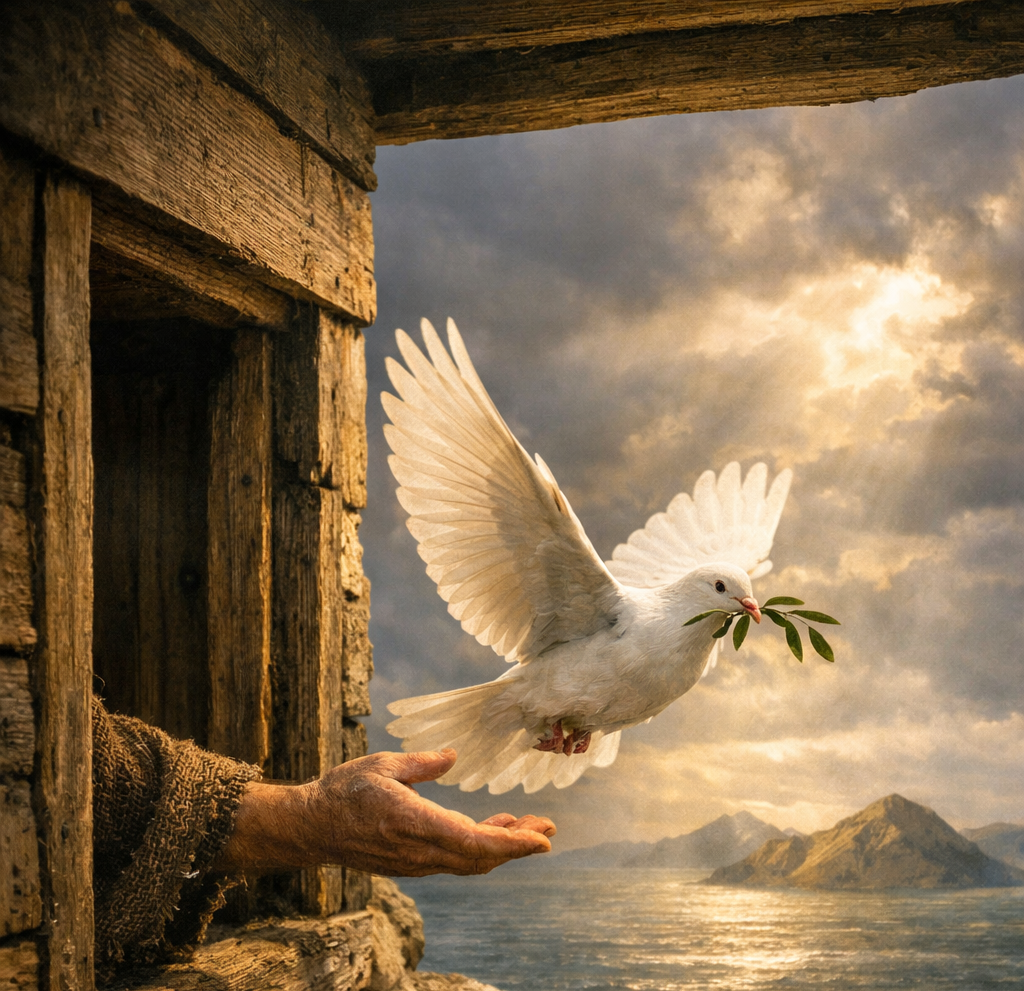
Figure 5. Dove Released from the Ark. A museum diorama showing Noah’s hand releasing a white dove from the window of a wooden ark. The background is a vast, receding floodwater with the first mountain peaks visible. The dove’s wings are spread for flight. The caption reads: “She waited. She returned. She brought hope.”
The dove did not find rest on the first flight. She returned to the ark. She waited. She flew again. On the second flight, she brought the olive leaf. On the third flight, she did not return at all—because the earth was dry, and she had found her home.
This is the righteousness of the dove: to keep flying, keep returning, keep hoping—until at last, the waters recede, and we find our eternal home.
“We have an anchor for the soul, firm and secure.” — Hebrews 6:19 (NIV)
May all who visit the WiseRighteous Nature Hall look upon the gentle dove and remember: true righteousness is not found in solitary heroism or aggressive conquest. It is found in daily faithfulness, gentle innocence, and the homing instinct that always, always returns to the Beloved.
References
- Gibbs, D. (2019). Pigeons and Doves: A Guide to the Columbidae Family. Yale University Press.
- Reyburn, W. D., & Fry, E. M. (2000). A Handbook on Proverbs. United Bible Societies.
- Wiltschko, R., & Wiltschko, W. (2015). Magnetic Orientation in Animals. Springer.
Disclaimer:
This website is an independent digital museum. All product names, trademarks, and brands are the property of their respective owners and are used for identification and educational purposes only. No affiliation or endorsement is implied.