
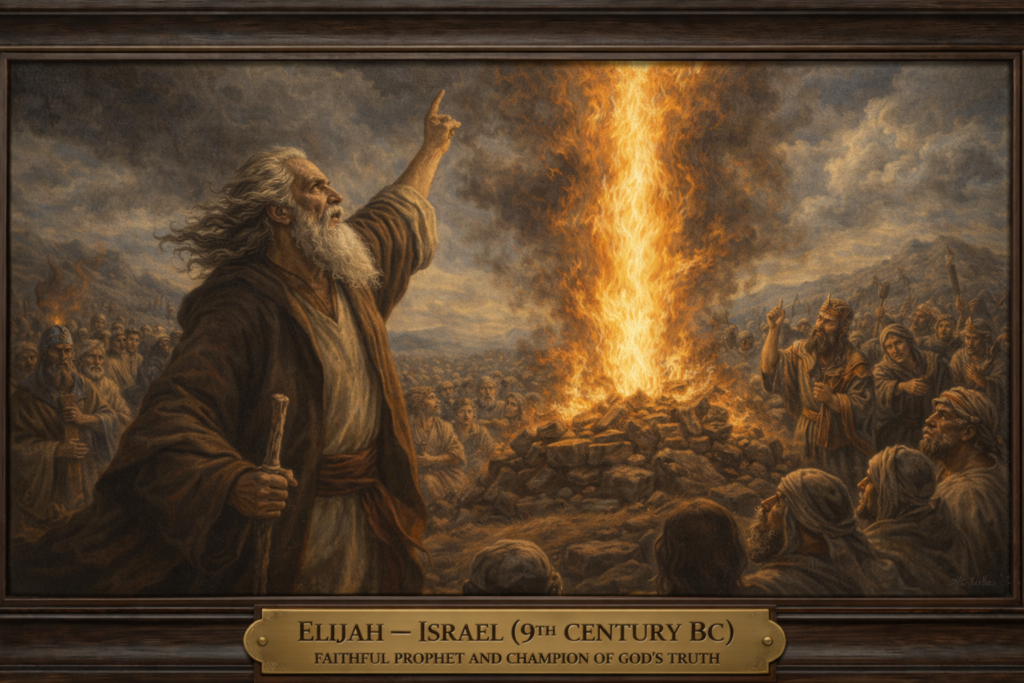
Elijah — Israel (9th century BC)
Elijah was a prophet in ancient Israel known for his unwavering defense of faithfulness to God, his opposition to idolatry, and his courage in confronting powerful rulers. His life and actions, recorded in the Books of Kings, portray him as a defender of moral righteousness and religious integrity during a time of spiritual crisis in Israel.
Elijah’s ministry took place during the reign of Ahab, when many Israelites were influenced by the worship of foreign gods. Through his teachings and dramatic public challenges to false prophets, Elijah sought to restore devotion to the God of Israel.
Today, Elijah is remembered in Jewish, Christian, and Islamic traditions as a powerful example of faithful leadership, moral courage, and commitment to truth.
Historical Context
During the ninth century BC, the northern kingdom of Israel experienced significant political and religious tensions.
King Ahab and his wife Jezebel promoted the worship of Baal, a deity widely worshiped in surrounding cultures.
This shift led to conflict between those who followed traditional Israelite worship and those who supported the new religious practices.
Prophets such as Elijah emerged during this period to call the people back to faithfulness and to challenge the influence of foreign religious traditions.
Civic Virtue and Leadership
Elijah’s leadership was characterized by his willingness to speak truth to power.
Despite the authority of the king and the influence of royal officials, Elijah openly criticized policies and actions that he believed violated moral and religious principles.
He warned rulers and citizens alike about the consequences of abandoning justice and spiritual responsibility.
His prophetic role required him to confront both political authority and widespread social practices, often placing his own safety at risk.
Through these actions, Elijah demonstrated a commitment to moral accountability, religious integrity, and courage in leadership.
Righteous Act: The Challenge on Mount Carmel
One of Elijah’s most well-known acts occurred during the dramatic confrontation with the prophets of Baal on Mount Carmel.
According to the biblical account in the First Book of Kings, Elijah challenged the prophets of Baal to a public test to determine which deity was truly worthy of worship.
The challenge involved preparing sacrifices and calling upon their respective gods to send fire from heaven.
After the prophets of Baal were unable to produce a response, Elijah prayed and, according to the narrative, fire descended and consumed the offering on his altar.
This event was intended to demonstrate the power of the God of Israel and to encourage the people to return to faithful worship.
Challenges and Adversity
Elijah’s bold actions created intense opposition from the royal court, particularly from Jezebel.
After the events on Mount Carmel, Jezebel threatened Elijah’s life, forcing him to flee for safety.
During this time, Elijah experienced periods of fear and exhaustion as he continued his prophetic mission.
Despite these challenges, he persisted in his work, continuing to speak out against injustice and calling the nation to moral and spiritual renewal.
Legacy
Elijah remains one of the most significant prophetic figures in the religious traditions of Judaism, Christianity, and Islam.
In Jewish tradition, Elijah is associated with hope for future redemption and is symbolically welcomed during the Passover.
In Christianity, Elijah is remembered as a model of prophetic courage and appears in the New Testament during the Transfiguration of Jesus.
Across these traditions, Elijah’s story continues to represent the enduring importance of truth, faithfulness, and the courage to defend righteousness even in the face of powerful opposition.
References
Coogan, M. D. (2018). The Old Testament: A historical and literary introduction to the Hebrew Scriptures. Oxford University Press.
Freedman, D. N. (2000). Eerdmans dictionary of the Bible. Eerdmans.
Walton, J. H., & Hill, A. E. (2012). Old Testament today. Zondervan.
Cogan, M. (2008). 1 Kings: A new translation with introduction and commentary. Yale University Press.