
Émile Zola — France (1840–1902)
Émile Zola was a French novelist, journalist, and public intellectual who became one of the most prominent defenders of justice and truth during the Dreyfus Affair in France. Through his writings and public advocacy, Zola challenged political corruption, judicial injustice, and rising antisemitism within French society.
Although widely known for his influential literary works, Zola’s greatest act of civic courage occurred when he used his public voice to expose a wrongful conviction within the French military and government.
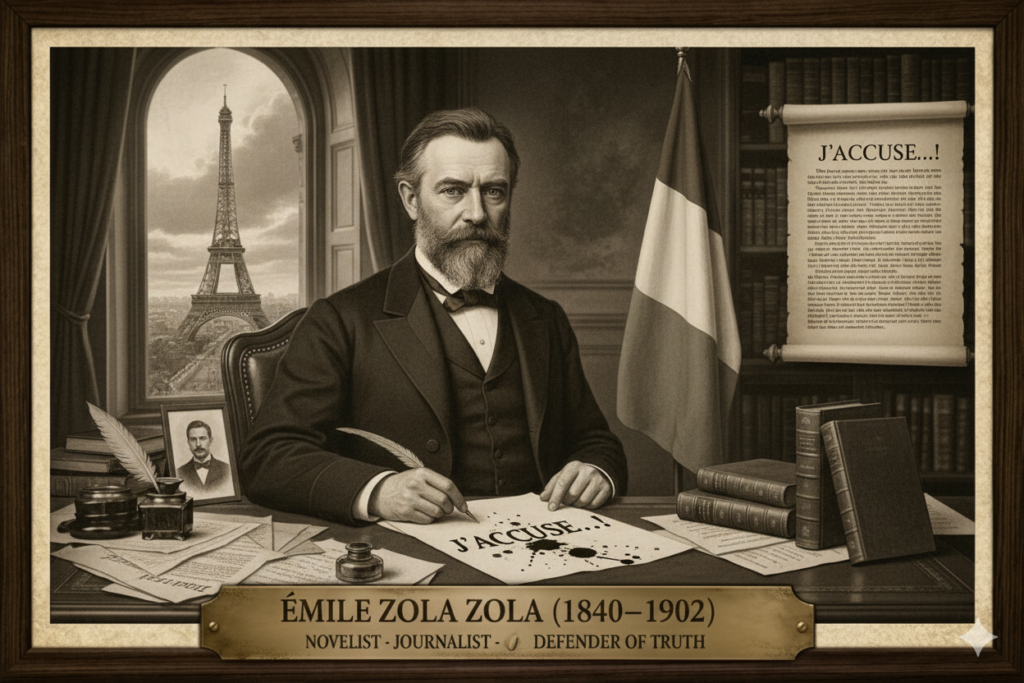
His famous open letter “J’Accuse…!” became one of the most powerful statements of moral protest in modern history and helped transform the Dreyfus Affair into a national debate about justice, equality, and the rule of law.
Historical Context
In 1894, a French army officer named Alfred Dreyfus was accused of passing military secrets to Germany. Despite weak and questionable evidence, Dreyfus was convicted of treason by a military court.
The case quickly became one of the most controversial political crises in modern French history. Many officials within the army and government worked to protect the original verdict, even when evidence began to suggest that Dreyfus had been wrongly accused.
The affair exposed deep divisions within French society. Some defended the military establishment, while others argued that justice and the rule of law required a full investigation.
At the same time, antisemitism played a major role in shaping public opinion, as Dreyfus was Jewish and many critics believed prejudice influenced the trial.
Within this tense political environment, Émile Zola emerged as one of the most prominent voices demanding truth and justice.
Civic Virtue and Leadership
Émile Zola believed that intellectuals and writers had a moral responsibility to speak out against injustice. His reputation as one of France’s most respected authors gave him a powerful public platform.
As new evidence began to reveal errors and misconduct in the Dreyfus trial, Zola became increasingly convinced that a grave miscarriage of justice had occurred.
Rather than remain silent, Zola chose to confront the issue directly. He used his position as a public intellectual to challenge the military establishment, the government, and the judicial system.
His actions demonstrated a commitment to moral courage, showing that defending truth sometimes requires challenging powerful institutions.
Righteous Act: “J’Accuse…!” and the Defense of Justice
Zola’s most famous act occurred on January 13, 1898, when he published the open letter “J’Accuse…!” on the front page of the French newspaper L’Aurore.
In this letter, Zola directly accused high-ranking military officials and government authorities of wrongfully convicting Alfred Dreyfus and deliberately concealing evidence that could prove his innocence.
The letter listed specific accusations against officials involved in the trial and argued that the case represented a serious failure of justice.
Zola knew that publishing the letter would have serious consequences, but he believed that public truth and justice were more important than personal safety.
The publication caused a national political crisis and forced the Dreyfus Affair into the center of public debate. Although Zola was later prosecuted for libel and forced into temporary exile in England, his actions helped trigger a broader investigation.
Eventually, the case was reopened, and in 1906, Alfred Dreyfus was fully exonerated and reinstated in the French army.
Challenges and Adversity
Zola’s intervention in the Dreyfus Affair provoked intense political backlash. Many supporters of the military establishment viewed him as a traitor who had attacked the honor of the French army.
Following the publication of “J’Accuse…!”, Zola was charged with criminal libel and convicted by a French court. Facing imprisonment, he fled temporarily to England, where he continued to advocate for Dreyfus’s innocence.
During this period, Zola endured widespread criticism, public hostility, and political pressure. Nevertheless, he remained firm in his belief that justice must prevail over political convenience.
His willingness to accept personal risk for the sake of truth demonstrated a remarkable commitment to ethical responsibility and civic integrity.
Legacy
Émile Zola is remembered not only as a major figure in French literature, but also as a powerful example of moral courage in public life.
His defense of Alfred Dreyfus helped expose corruption within the French military and judicial systems and played a crucial role in ultimately restoring justice in the case.
The Dreyfus Affair also helped establish a new role for public intellectuals in modern society—individuals who use their influence to defend truth, justice, and democratic principles.
Today, Zola’s actions are widely regarded as a defining example of speaking truth to power and standing against injustice even when doing so carries great personal risk.
His legacy continues to inspire advocates for human rights, legal fairness, and the rule of law around the world.
References
Brown, F. (1995). Zola: A life. Farrar, Straus and Giroux.
Burns, M. (1991). Dreyfus: A family affair, 1789–1945. HarperCollins.
Horne, A. (2001). The fall of Paris: The siege and the Commune 1870–71. Penguin Books.
Pagès, A. (2010). Émile Zola: A life. Yale University Press.