
Civil Rights Movement — United States (1954–1968)
Overview
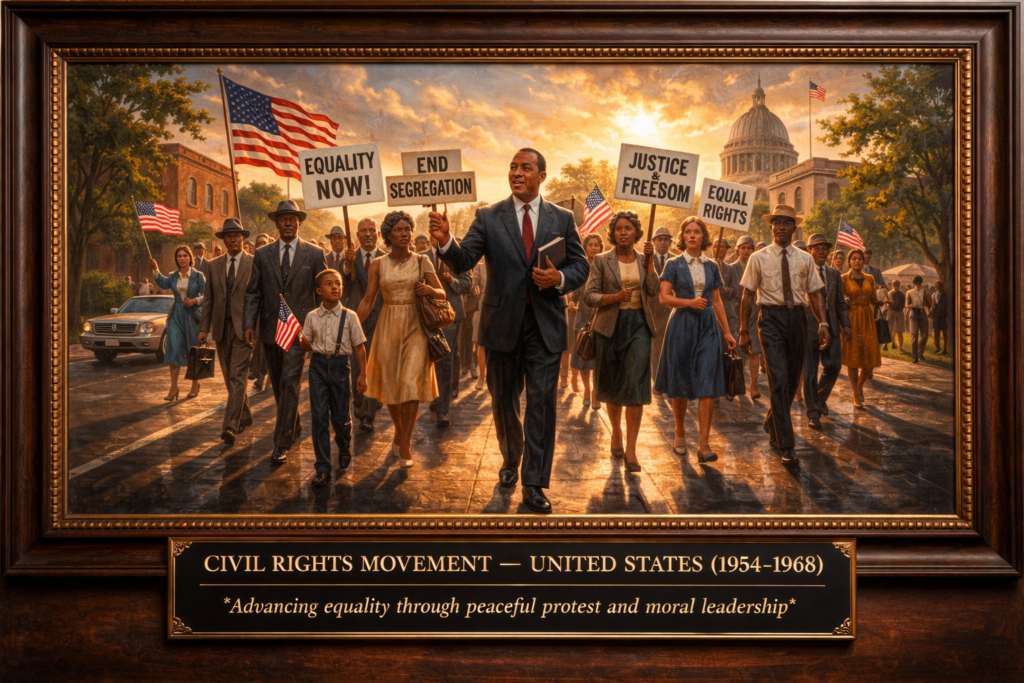
The Civil Rights Movement was a defining struggle for justice, equality, and human dignity in the United States. From 1954 to 1968, individuals and communities united to challenge racial segregation and systemic discrimination through peaceful protest, legal reform, and moral leadership. The movement reshaped the nation’s laws and conscience.
Historical Background
Following the American Civil War and the abolition of slavery, African Americans still faced widespread discrimination, particularly under Jim Crow laws in the South. These laws enforced segregation in schools, transportation, and public spaces, denying Black Americans equal rights and opportunities.
Momentum for change grew through grassroots activism, legal challenges, and increasing national awareness of injustice.
Righteous Leadership and Advocacy
The movement was guided by leaders committed to nonviolence, justice, and moral courage:
- Martin Luther King Jr.: Advocated peaceful resistance and inspired millions through his vision of equality and justice
- Rosa Parks: Her act of civil disobedience sparked the Montgomery Bus Boycott
- Thurgood Marshall: Led legal efforts to dismantle segregation, including landmark court victories
Key Events (1954–1968)
- 1954: Brown v. Board of Education declares school segregation unconstitutional
- 1955–1956: Montgomery Bus Boycott challenges segregated public transportation
- 1963: March on Washington highlights demands for civil rights and economic justice
- 1964: Civil Rights Act outlaws segregation and discrimination
- 1965: Voting Rights Act protects voting rights for African Americans
Challenges
The movement faced significant obstacles and risks:
- Violence and Intimidation: Protesters were met with arrests, brutality, and even assassination
- Institutional Resistance: Local and state governments resisted desegregation
- Social Division: Deep-rooted prejudice created widespread opposition
- Personal Sacrifice: Activists risked their safety, livelihoods, and lives
- Slow Progress: Achieving legal and cultural change required sustained effort
Despite these hardships, participants remained committed to nonviolence and justice.
Righteousness in Action
- Nonviolent Resistance in the face of injustice
- Moral Courage to stand against oppression
- Equality and Justice as guiding principles
- Collective Action to transform society
Legacy
The Civil Rights Movement led to transformative legal and social changes, helping to secure equal rights under the law. It continues to inspire movements worldwide that պայք for freedom, justice, and human dignity.
Its enduring message: righteous action, grounded in truth and courage, can reshape a nation.
References (APA Format)
- National Archives. (n.d.). The Civil Rights Act of 1964. Retrieved from https://www.archives.gov
- Library of Congress. (n.d.). Civil Rights Movement. Retrieved from https://www.loc.gov
- Encyclopaedia Britannica. (n.d.). Civil Rights Movement. Retrieved from https://www.britannica.com
- BBC. (n.d.). American civil rights movement. Retrieved from https://www.bbc.co.uk/history