From: The Lord of the Rings (1954–1955) by J.R.R. Tolkien (UK)
Research Wing — Literary Righteousness Research Hall
The Righteous Museum
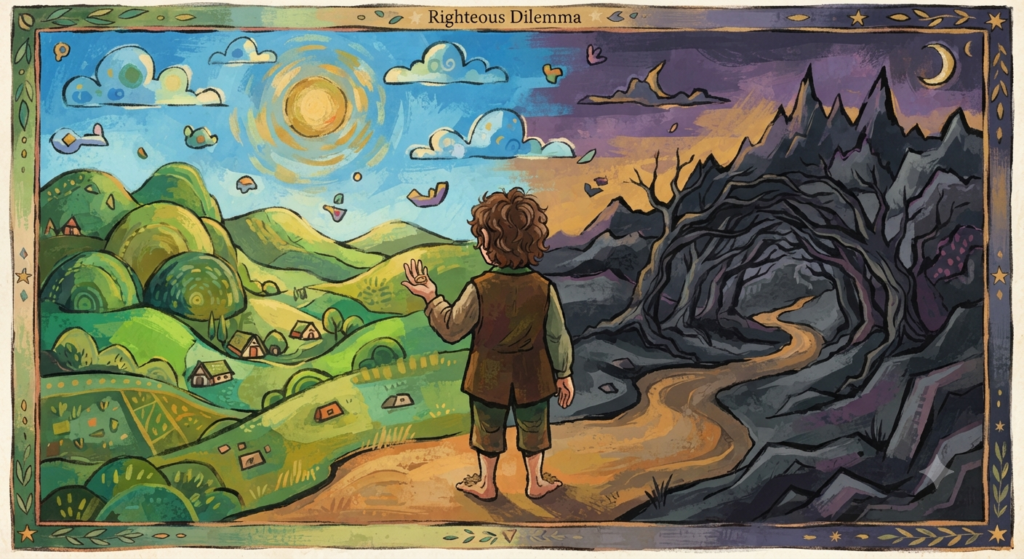
Figure 1 — Frodo: The Reluctant Bearer
Figure Description: A small hobbit with curly brown hair stands at the edge of a green, rolling countryside, clutching a simple gold ring in his hand. His expression is thoughtful and burdened—he knows the weight of what he carries. Behind him, the peaceful Shire stretches out under a bright sky. Before him, the road leads into shadow and uncertainty. The mood is quiet, heroic, and bittersweet—capturing the moment a humble hobbit accepts a quest that will change him forever.
Introduction
Frodo Baggins is the protagonist of J.R.R. Tolkien‘s epic fantasy The Lord of the Rings, first published in three volumes between 1954 and 1955. He is a hobbit—a small, unassuming member of an obscure race living in the peaceful Shire—who inherits the One Ring from his cousin and adoptive uncle, Bilbo Baggins.
The One Ring is the most powerful and dangerous object in Middle-earth, created by the Dark Lord Sauron to dominate all free peoples. It corrupts anyone who possesses it, feeding on their desires and twisting them toward evil. Frodo‘s task is to carry the Ring across Middle-earth and destroy it in the fires of Mount Doom—a mission that seems impossible for a simple hobbit with no great strength or power.
“I should like to save the Shire, if I could… I feel that as long as the Shire lies behind, safe and comfortable, I shall find wandering more bearable.” — Frodo Baggins
Frodo is not a traditional hero. He is brave, selfless, thoughtful, and wise, yet he is also frequently wracked with doubt and feels unable to surmount the obstacles before him. He has no otherworldly powers or physical prowess—he is initially so weak he can barely leave the Shire without help. Yet he volunteers to carry the Ring when no one else can.
What makes Frodo a compelling figure for the study of righteousness is his relentless endurance in the face of overwhelming evil. He does not seek glory or adventure. He carries the Ring because he must, because he loves the Shire and its people, and because he believes that even the smallest person can make a difference. His righteousness is not found in triumph—it is found in the daily, painful act of continuing when every step feels impossible.
Frodo’s name comes from the Old English word Fróda, meaning “wise by experience”. This is precisely what he becomes—a hobbit who grows in understanding, compassion, and wisdom through his suffering.
The Righteous Dilemma: What Does It Mean to Endure When Victory Is Impossible?
Frodo‘s story forces readers to confront one of the most difficult questions of righteousness: What does it mean to be righteous when success is impossible and failure is almost certain?
The series presents a world where the forces of evil are overwhelmingly powerful. Sauron’s armies outnumber the free peoples. His power is vast, his reach endless. And yet, the quest is not abandoned. The hope of the story is not that Frodo will succeed—it is that even the attempt, even the willingness to bear the burden, has value in itself.
The Ring is not merely a weapon—it is a moral test. It tempts each bearer with what they most desire: power, knowledge, control, or the ability to protect what they love. Frodo resists the Ring’s temptation longer than anyone else could. Yet at the final moment, at the Cracks of Doom, he cannot destroy it. He claims the Ring for himself.
This is not a moral failure. Tolkien himself wrote that Frodo‘s “failure” at the end is not a mark of weakness but of the Ring’s absolute power. He wrote:
“I do not think that Frodo’s was a moral failure. At the last moment the pressure of the Ring would reach its maximum – impossible, I should have said, for any one to resist, certainly after long possession, months of increasing torment, and when starved and exhausted.”
Frodo had done what he could and spent himself completely as an instrument of Providence. His humility and his sufferings were justly rewarded by the highest honour, and his exercise of patience and mercy towards Gollum gained him Mercy: his failure was redressed.
Table 1. The Righteousness Paradox: What Frodo Could Do vs. What the Ring Demanded
| Frodo‘s Endurance | The Ring’s Power |
|---|---|
| Resisted temptation for months | Corrupted every other bearer |
| Carried the Ring to Mount Doom | Overwhelmed him at the final moment |
| Showed mercy to Gollum | Twisted Gollum into a monster |
| Sacrificed his health, peace, and home | Offered power and domination |
| Completed the quest as an instrument of Providence | Required destruction to be defeated |
Note. This table contrasts Frodo‘s endurance and moral choices with the overwhelming power of the Ring. The central righteous question is: Does failure at the final moment undo a life of righteousness, or is the willingness to carry the burden itself the measure of a righteous life?
The critical insight of the story is that righteousness is not about winning—it is about enduring. Frodo could not destroy the Ring, but he brought it to the place where it could be destroyed. His mercy toward Gollum, his patience, and his willingness to suffer for others made the victory possible. He succeeded not by his own strength but by grace, mercy, and the help of others.
Key Moral Dilemmas in the Story
Dilemma 1: Accepting the Burden — Choosing to Leave Home
When Frodo learns the truth about the Ring, he initially wishes it had never been found. He does not want to leave the Shire. He does not want to be a hero. Yet when he understands the danger, he accepts the burden willingly.
The Righteous Question: What does it mean to accept a burden you did not choose? Is there virtue in doing what must be done, even when you do not want to do it?
The Lesson: Righteousness is not about desire—it is about duty. Frodo does not want to carry the Ring, but he does so because it is the right thing to do.
Dilemma 2: The Barrow-downs — Choosing to Save Others
When Frodo is trapped in the barrow-downs with his companions, he has the opportunity to use the Ring to escape. Instead, he chooses to stay and save his friends.
The Righteous Question: Is it more righteous to save yourself or to risk your life for others?
The Lesson: Righteousness is measured by what we are willing to give up for others. Frodo chooses to save his friends rather than save himself.
Dilemma 3: Sparing Gollum — Choosing Mercy Over Justice
Time and again, Frodo has the opportunity to kill Gollum. Sam urges him to do so. Yet Frodo shows mercy—he spares Gollum’s life. This mercy seems foolish. Gollum betrays them, leads them into danger, and eventually bites off Frodo‘s finger to reclaim the Ring.
The Righteous Question: Is mercy ever foolish? Is it right to show compassion to someone who will betray you?
The Lesson: Mercy is never wasted. Frodo’s mercy toward Gollum is what ultimately destroys the Ring—Gollum’s intervention at the Cracks of Doom is what completes the quest. Righteousness is not about calculating outcomes—it is about doing what is right and trusting the rest to Providence.
Dilemma 4: The Cracks of Doom — Choosing to Fail
At the final moment, Frodo cannot destroy the Ring. He claims it for himself. This is the moment he has dreaded, the moment he has fought against for months. He fails.
The Righteous Question: Does failure at the end undo a life of righteousness? Can a person be righteous even when they cannot complete the task?
The Lesson: Righteousness is not about perfection—it is about perseverance. Frodo fails, but he does not give up. He carries the Ring to the place where it can be destroyed. His willingness to suffer, to endure, and to show mercy makes the victory possible. He is not a perfect hero—but he is a righteous one.
What Frodo Teaches Us About Righteousness
Table 2. Lessons on Righteousness from Frodo Baggins
| Lesson | Application |
|---|---|
| Righteousness is not about strength—it is about endurance | Frodo is not powerful, but he endures. Righteousness is measured not by what we achieve, but by what we are willing to carry. |
| Mercy is never wasted | Frodo spares Gollum, and Gollum ultimately destroys the Ring. Showing compassion is always righteous, even when the outcome is uncertain. |
| Small people can do great things | Frodo is a hobbit—small, humble, ordinary. Righteousness is not reserved for the powerful. Even the smallest can change the world. |
| Failure does not define us | Frodo fails at the final moment, yet the quest succeeds. Righteousness is not about being perfect—it is about persevering, even when we fail. |
| Love of home is a righteous motivation | Frodo leaves the Shire because he loves it. Love for our community, our home, and our people is a righteous reason to act. |
| Righteousness requires sacrifice | Frodo loses his health, his peace, and eventually his home. True righteousness costs something. |
The Reluctant Righteous Figure
Frodo is not a traditional hero. He does not seek glory, power, or adventure. He is small, ordinary, and often afraid. Yet he carries the greatest burden in Middle-earth because someone must.
What makes Frodo a compelling figure for the study of righteousness is precisely his ordinariness. He is not a great warrior or a powerful wizard. He is a hobbit—a person who loves simple things: good food, peace, friendship, and home. Yet when the world needs him, he steps forward.
His righteousness is not found in dramatic victories or heroic speeches. It is found in the quiet, painful act of putting one foot in front of the other, day after day, when every step feels impossible. It is found in his mercy toward Gollum, his loyalty to Sam, and his willingness to suffer for the Shire.
Key Righteous Qualities of Frodo Baggins:
| Quality | How It Manifests |
|---|---|
| Humility | He does not seek power or recognition |
| Endurance | He carries the Ring for months despite increasing torment |
| Mercy | He spares Gollum, even when Sam urges him to kill him |
| Self-Sacrifice | He gives up his home, his health, and ultimately his peace in the Shire |
| Loyalty | He remains faithful to his quest and his companions |
Frodo‘s journey—from a simple hobbit who dreams of adventure to a wounded veteran who cannot return to ordinary life—offers a powerful model of how righteousness is not about being born great, but about choosing to carry a burden for the sake of others.
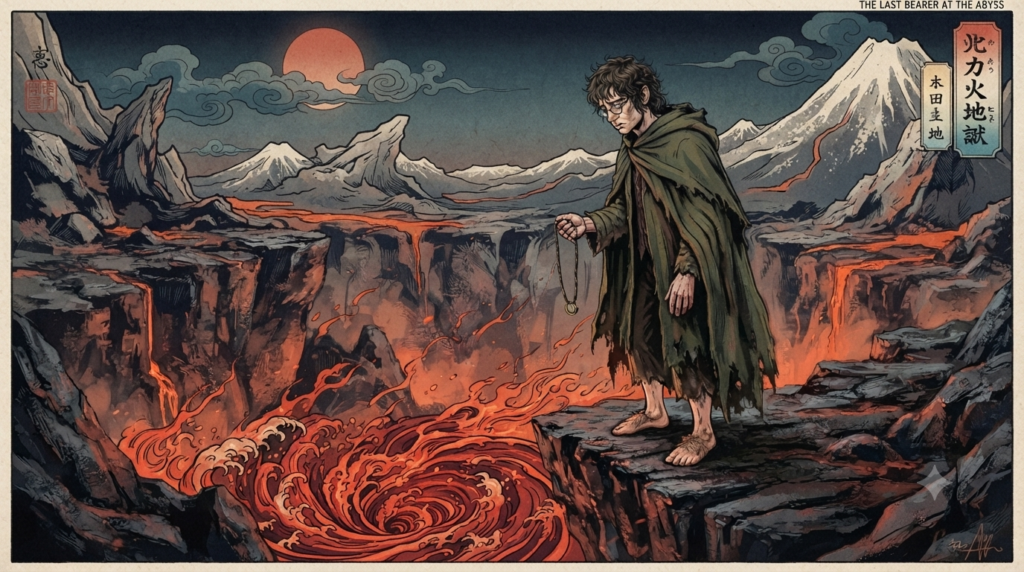
Figure 2 — Mount Doom: The Final Test
Research Recommendations
For those interested in exploring the righteousness themes of The Lord of the Rings further, the following scholarly works are recommended:
- Tolkien, J. R. R. (1963). Letter to Eileen Elgar, September 1963. The Tolkien Estate. In this letter, Tolkien defends Frodo’s character, arguing that his “failure” at Mount Doom was not a moral failure but a testament to the Ring’s overwhelming power.
- Minshew, A. J. W. (2025). The Wheel of Fire: An Obsessive-Compulsive Reading of Frodo Baggins. Journal of Tolkien Research, 21(1), Article 8. This paper argues that an obsessive-compulsive reading accounts for Frodo‘s ego-dystonic relationship with the Ring.
- Cal State ScholarWorks. Rings, Quests, and Hobbits: Tolkien’s Frodo Baggins as the Archetypal Hero. This thesis demonstrates that Frodo’s journey parallels the stages of the mythic hero as recognized by Joseph Campbell.
- Baggett, D., & Klein, S. E. (Eds.). (2004). Harry Potter and philosophy: If Aristotle ran Hogwarts. Open Court. While focused on Harry Potter, this volume offers philosophical frameworks applicable to Tolkien‘s work.
- Beal, J. Baggins and Tom Bombadil‘s Role in the Healing of Traumatic Memory in J.R.R. Tolkien’s Lord of the Rings. Examines how Frodo‘s trauma is addressed through the character of Tom Bombadil.
References
Minshew, A. J. W. (2025). The wheel of fire: An obsessive-compulsive reading of Frodo Baggins. Journal of Tolkien Research, 21(1), Article 8. https://scholar.valpo.edu/journaloftolkienresearch/vol21/iss1/8/
Rings, quests, and hobbits: Tolkien‘s Frodo Baggins as the archetypal hero. Cal State ScholarWorks. https://scholarworks.test.calstate.edu/concern/theses/nc580m96k
Tolkien, J. R. R. (1954). The fellowship of the ring. George Allen & Unwin.
Tolkien, J. R. R. (1954). The two towers. George Allen & Unwin.
Tolkien, J. R. R. (1955). The return of the king. George Allen & Unwin.
Tolkien, J. R. R. (1963, September). Letter to Eileen Elgar. The Tolkien Estate. https://www.tolkienestate.com/letters/letter-to-eileen-elgar-september-1963/
Jackson, P. (Director). (2001). The lord of the rings: The fellowship of the ring [Film]. New Line Cinema.
Jackson, P. (Director). (2002). The lord of the rings: The two towers [Film]. New Line Cinema.
Jackson, P. (Director). (2003). The lord of the rings: The return of the king [Film]. New Line Cinema.
Disclaimer
“The Lord of the Rings” and “Frodo Baggins” are registered trademarks of Middle-earth Enterprises, LLC. This website is an independent educational research project and is not affiliated with, endorsed by, or sponsored by the Tolkien Estate, Middle-earth Enterprises, HarperCollins, New Line Cinema, or any other rights holders. All original content on this page is for educational and research purposes under the principles of fair use.