
Jan Karski — Poland (1914–2000)
Jan Karski was a Polish resistance fighter, courier, and diplomat who became one of the first individuals to bring eyewitness reports of the Nazi Holocaust to the Western Allies during the Second World War. Through extraordinary courage and personal risk, he attempted to alert world leaders to the systematic extermination of Jews and other victims under Nazi rule.
Serving as a courier for the Polish Underground State, Karski secretly traveled across occupied Europe to deliver intelligence to Allied governments. His reports included firsthand observations of conditions inside the Holocaust.
Despite the dangers he faced, Karski believed it was a moral duty to bear witness and inform the world about the atrocities taking place.
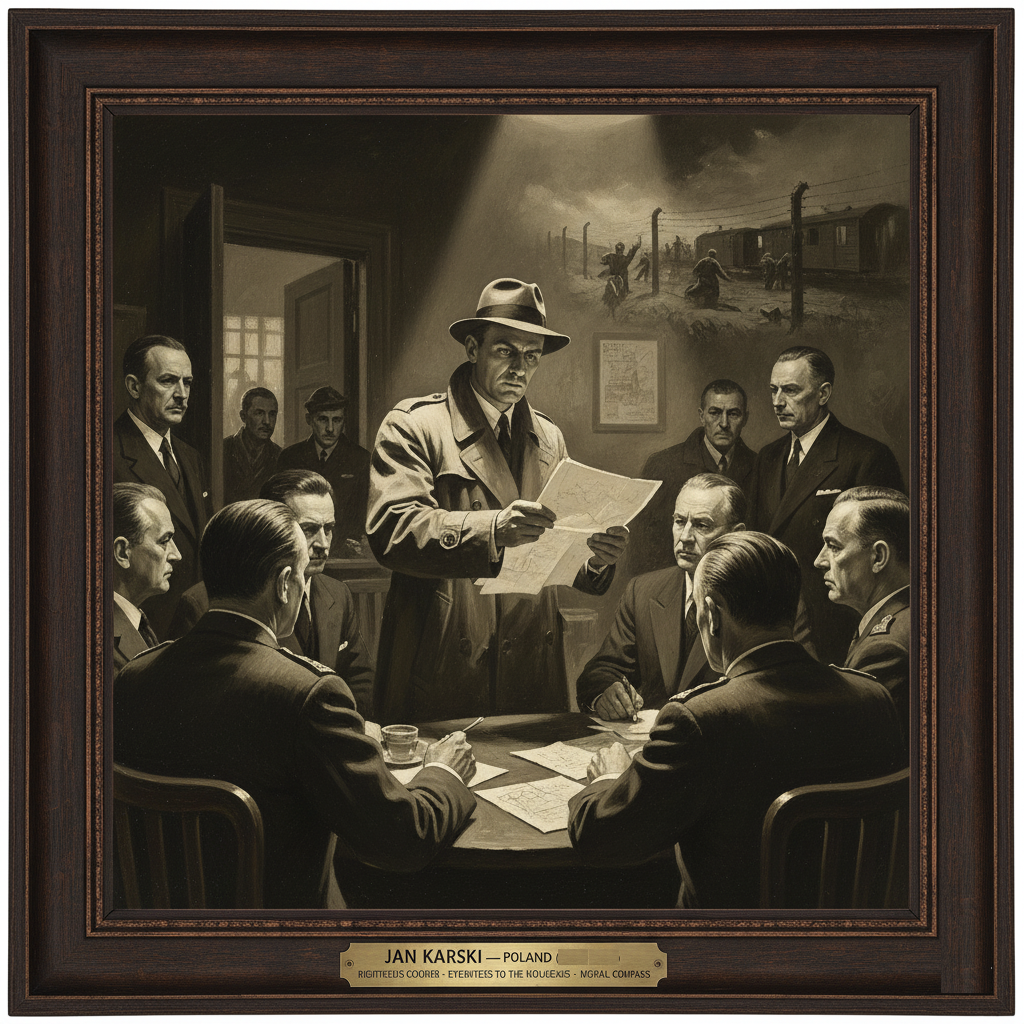
Historical Context
In 1939, Nazi Germany invaded Poland, beginning the World War II.
Under Nazi occupation, millions of Polish citizens suffered persecution, imprisonment, and execution. Jewish communities were forced into segregated districts known as ghettos, where they faced starvation, disease, and violence.
Eventually, the Nazi regime began implementing a systematic program of mass murder, transporting Jews and other victims to extermination camps.
During this time, the Polish underground resistance worked to gather information about Nazi crimes and communicate these reports to the Allied governments.
Jan Karski became one of the most important messengers in this effort.
Civic Virtue and Leadership
Jan Karski served as a courier between the underground resistance in occupied Poland and the Polish government-in-exile based in London.
His role required traveling secretly across heavily guarded borders while carrying reports about the situation inside Nazi-occupied territories.
In 1942, Jewish resistance leaders asked Karski to personally witness the conditions faced by Jews under Nazi rule so that he could deliver credible testimony to the Allies.
Risking his life, Karski entered the Warsaw Ghetto, where he saw severe overcrowding, starvation, and suffering among the imprisoned population.
He also secretly observed conditions at a Nazi transit camp used to transport victims to extermination facilities.
Righteous Act: Warning the World about the Holocaust
Jan Karski’s most significant act of moral courage was his mission to inform Allied leaders about the Nazi extermination of Jews.
After escaping occupied Europe, Karski traveled to Britain and the United States to deliver detailed reports about the atrocities he had witnessed.
In 1943, he met with political leaders, diplomats, and journalists, including Franklin D. Roosevelt.
Karski described the suffering of Jews in Nazi-controlled territories and urged Allied governments to take stronger action to stop the genocide.
Although many officials listened to his testimony, the scale of the atrocities was difficult for some leaders to fully comprehend at the time.
Despite these challenges, Karski’s efforts represented one of the earliest and most courageous attempts to alert the world to the Holocaust.
Challenges and Adversity
Jan Karski’s work as a resistance courier exposed him to constant danger.
Early in the war, he was captured by the Gestapo and subjected to severe interrogation and torture.
Fearing that he might reveal information about the resistance network, Karski attempted suicide while imprisoned. He was later rescued by members of the Polish underground.
Throughout the war, he continued carrying out dangerous missions despite the constant risk of arrest or execution.
Even after delivering his reports to Allied leaders, he struggled with the painful realization that the international response to the Holocaust was limited.
Legacy
Jan Karski is remembered as a courageous witness to one of history’s greatest tragedies.
After the war, he became a professor at Georgetown University, where he taught international relations for many years.
In recognition of his efforts to expose Nazi crimes and help Jews during the Holocaust, he was honored by Yad Vashem as one of the Righteous Among the Nations.
Today, Karski’s life stands as a powerful example of moral responsibility, truth-telling, and the courage to speak out against injustice even when the world is reluctant to listen.
References
Karski, J. (2013). Story of a secret state: My report to the world. Georgetown University Press.
Wood, E. T., & Jankowski, S. M. (1994). Karski: How one man tried to stop the Holocaust. Wiley.
Tec, N. (1993). Resistance: Jews and Christians who defied the Nazi terror. Oxford University Press.
Bartoszewski, W. (1999). The Warsaw Ghetto: A guide to the vanished city. Jewish Historical Institute.