
Jean Moulin — France (1899–1943)
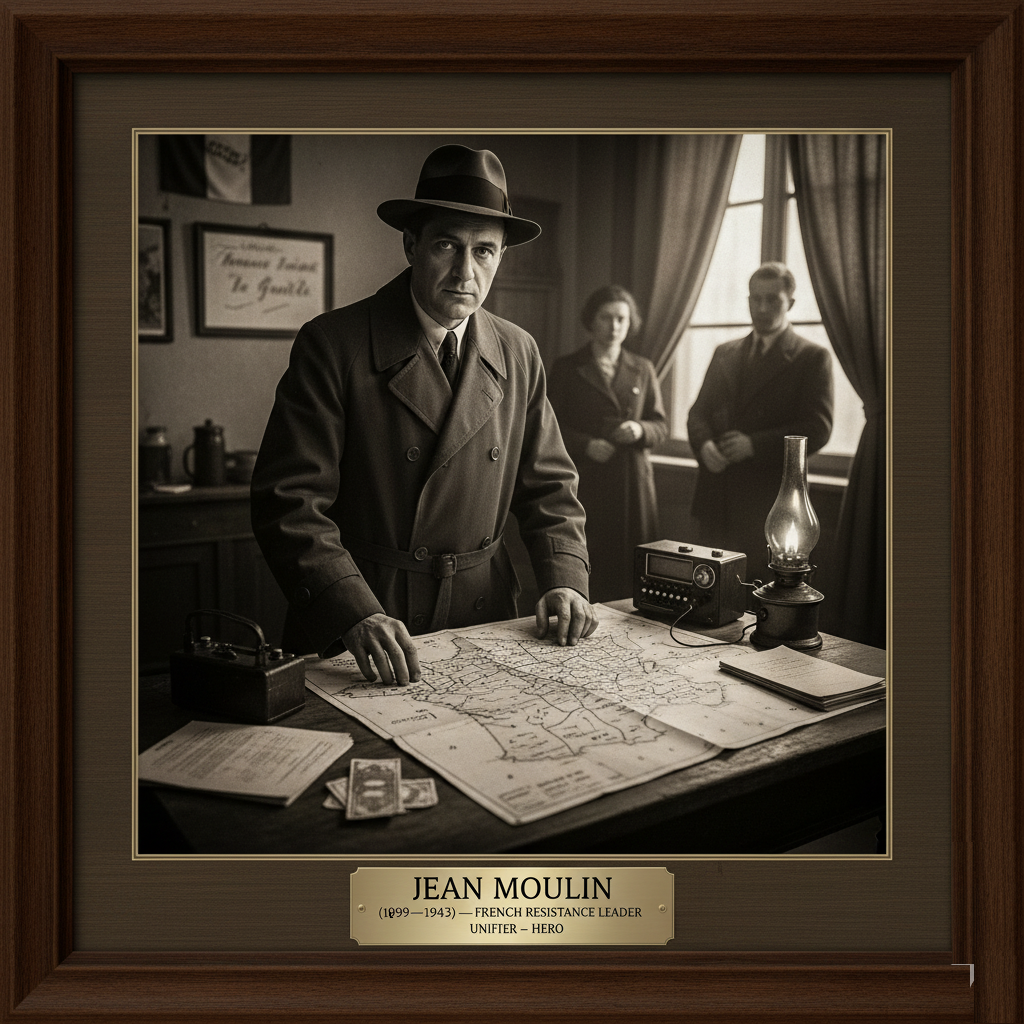
Jean Moulin was a French civil servant, resistance leader, and one of the most important figures in the French Resistance during the Second World War. He played a crucial role in organizing and unifying resistance movements against Nazi occupation and the collaborationist Vichy regime.
Moulin worked to coordinate diverse resistance groups across France and establish communication between them and the Free French government led by Charles de Gaulle. His leadership helped strengthen the resistance movement and provided a foundation for the eventual liberation of France.
His courage, sacrifice, and dedication to the defense of freedom, national sovereignty, and human dignity made him one of the most revered figures in modern French history.
Historical Context
During the Second World War, France was defeated by Nazi Germany in 1940. Following the military collapse, the country was divided between areas directly controlled by Germany and regions governed by the Vichy regime, which collaborated with the occupying forces.
Many French citizens opposed the occupation and began forming underground networks dedicated to resistance, intelligence gathering, and sabotage against German military operations.
However, these resistance groups were initially fragmented and lacked coordination. Without unity, their ability to challenge the occupation remained limited.
Recognizing the need for organization and leadership, the Free French movement led by Charles de Gaulle sought to unify the resistance. Jean Moulin would become the central figure in achieving this goal.
Civic Virtue and Leadership
Before the war, Jean Moulin served as a prefect, a senior government administrator responsible for regional governance. Known for his dedication to public service and republican principles, he believed strongly in defending the values of democracy, liberty, and national independence.
In 1940, after Germany occupied France, Moulin refused to cooperate with Nazi propaganda efforts. When German authorities attempted to force him to sign a false statement blaming French colonial troops for atrocities, Moulin refused, choosing instead to endure imprisonment and abuse rather than participate in political deception.
This early act of defiance marked the beginning of his deeper involvement in the French Resistance.
Later, Moulin traveled secretly to London, where he met with Charles de Gaulle. De Gaulle entrusted him with the mission of returning to France to unify the resistance movements under a coordinated national structure.
Righteous Act: Unifying the French Resistance
Jean Moulin’s most significant contribution to history was his role in uniting the major resistance groups operating throughout occupied France.
Returning secretly to France in 1942, Moulin began building connections among various underground movements that often differed in political ideology and strategy. Through diplomacy, patience, and leadership, he worked to overcome divisions and encourage cooperation.
His efforts culminated in the creation of the National Council of the Resistance (Conseil National de la Résistance) in 1943, which brought together multiple resistance organizations, political parties, and labor groups.
This unified structure allowed the resistance to coordinate intelligence operations, sabotage missions, and political planning for the future liberation of France.
By strengthening cooperation among resistance networks, Moulin helped create a more effective national movement dedicated to freedom, democracy, and the restoration of the French Republic.
Challenges and Adversity
Jean Moulin carried out his work under extremely dangerous conditions. The German occupation authorities and the Gestapo actively pursued resistance leaders and imposed severe punishments on those involved in underground activities.
In June 1943, Moulin was arrested near Lyon by the Gestapo, led by the notorious officer Klaus Barbie.
He was subjected to severe interrogation and torture, as German authorities sought to uncover the structure of the resistance networks he had helped organize.
Despite the brutality he endured, Moulin refused to reveal information that could endanger other resistance members.
He died later in 1943, likely from the injuries he sustained during interrogation. His refusal to betray the resistance made him a symbol of loyalty, courage, and sacrifice.
Legacy
Jean Moulin is remembered as one of the greatest heroes of the French Resistance.
His efforts to unify resistance groups strengthened the struggle against Nazi occupation and helped prepare the groundwork for France’s liberation in 1944.
After the war, Moulin became a national symbol of patriotism, moral courage, and commitment to freedom. In 1964, his ashes were transferred to the Panthéon in Paris, one of France’s highest honors for national heroes.
Today, Jean Moulin’s life stands as a powerful example of resistance against tyranny, demonstrating how individual courage and integrity can play a decisive role in the defense of democratic values and human dignity.
References
Foot, M. R. D. (2001). SOE in France: An account of the work of the British Special Operations Executive in France 1940–1944. Routledge.
Jackson, J. (2001). France: The dark years, 1940–1944. Oxford University Press.
Wieviorka, O. (2016). The French Resistance. Harvard University Press.
Azéma, J. P. (2012). Jean Moulin: The man who united the French Resistance. Tallandier.