
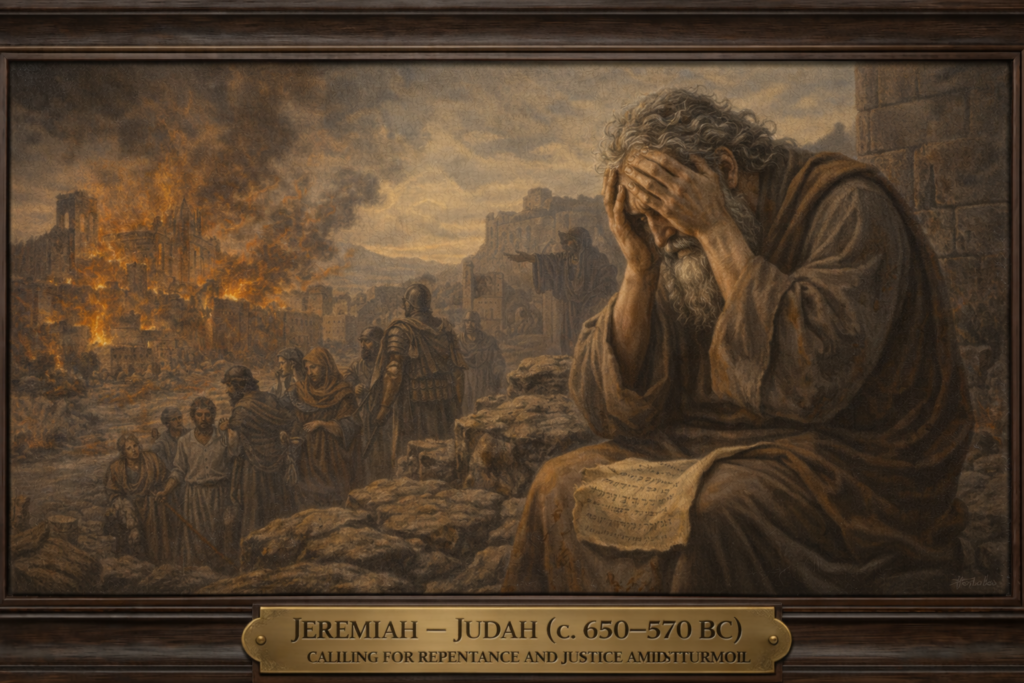
Jeremiah — Judah (c. 650–570 BC)
Jeremiah was a prophet in ancient Judah known for his warnings about moral decline, social injustice, and the consequences of abandoning spiritual and ethical principles. His life and teachings are recorded in the Book of Jeremiah, where he called the people of Judah to repentance, justice, and renewed faithfulness.
Jeremiah’s ministry took place during a turbulent period in the history of Judah, as political instability and foreign threats grew stronger. He urged both leaders and citizens to pursue righteousness, faithfulness, and moral responsibility rather than relying on political alliances or military strength.
Despite facing persecution and rejection, Jeremiah continued delivering his message, demonstrating a powerful example of moral courage, prophetic integrity, and commitment to truth.
Historical Context
During the late seventh and early sixth centuries BC, the kingdom of Judah faced increasing political pressure from powerful empires in the region.
The rising influence of the Babylonian Empire eventually led to the conquest of Jerusalem and the exile of many of its inhabitants.
This event, known as the Babylonian Exile, marked one of the most significant crises in the history of the Jewish people.
Jeremiah’s prophetic ministry took place during the years leading up to this disaster. He warned that corruption, injustice, and abandonment of moral principles would bring severe consequences for the nation.
Civic Virtue and Leadership
Jeremiah served as a prophetic voice during the reigns of several kings of Judah. Unlike many leaders who reassured the population that their nation would remain secure, Jeremiah spoke honestly about the dangers facing the kingdom.
He urged rulers and citizens to practice justice, care for the poor and vulnerable, and maintain faithfulness to their moral and spiritual responsibilities.
Jeremiah’s messages often challenged political leaders who ignored ethical principles or relied on false assurances of safety.
Through his teachings, he emphasized that the strength of a nation depended not only on military power but also on moral integrity and social justice.
Righteous Act: Speaking Truth Despite Opposition
Jeremiah’s most significant act of righteousness was his willingness to speak the truth about the nation’s moral condition, even when his message was deeply unpopular.
According to the Book of Jeremiah, he warned that unless the people of Judah changed their behavior, the city of Jerusalem would eventually fall to foreign forces.
His warnings challenged both religious and political leaders who believed the city would always remain protected.
Jeremiah’s message emphasized that true security comes from justice, humility, and faithfulness, not merely from political power or religious rituals.
Challenges and Adversity
Jeremiah’s prophetic message often brought him into conflict with powerful individuals.
He faced opposition from political leaders, priests, and other prophets who disagreed with his warnings.
At times, he was imprisoned, threatened, and publicly humiliated for delivering messages that many people did not want to hear.
Despite these hardships, Jeremiah continued his mission, demonstrating perseverance and dedication to what he believed was a necessary message for the survival of his nation.
His personal struggles and emotional reflections are also recorded in the Book of Lamentations, which mourns the destruction of Jerusalem.
Legacy
Jeremiah remains one of the most influential prophetic figures in the traditions of Judaism and Christianity.
His teachings emphasized the importance of ethical responsibility, social justice, and personal commitment to righteousness.
The warnings he delivered before the Babylonian Exile became a lasting reminder of the importance of moral leadership and national accountability.
Today, Jeremiah is remembered as a powerful example of integrity, demonstrating the courage to speak truth even when doing so brings hardship and opposition.
References
Coogan, M. D. (2018). The Old Testament: A historical and literary introduction to the Hebrew Scriptures. Oxford University Press.
Brueggemann, W. (1998). A commentary on Jeremiah: Exile and homecoming. Eerdmans.
Freedman, D. N. (2000). Eerdmans dictionary of the Bible. Eerdmans.
Holladay, W. L. (1986). Jeremiah: A commentary on the book of the prophet Jeremiah. Fortress Press.