
Juan José Gerardi Conedera — Guatemala (1922–1998)
Juan José Gerardi Conedera was a Guatemalan Catholic bishop, human rights advocate, and defender of victims of political violence during and after the Guatemalan Civil War. Through his commitment to truth, justice, and reconciliation, he became one of the most significant voices documenting human rights abuses in Guatemala.
As a leader within the Roman Catholic Church, Gerardi dedicated much of his ministry to supporting communities affected by violence, particularly indigenous populations who had suffered during decades of armed conflict.
He is remembered for his courageous efforts to reveal the truth about human rights violations and to promote justice, historical memory, and national reconciliation.
Historical Context
From 1960 to 1996, Guatemala experienced a prolonged internal conflict known as the Guatemalan Civil War.
During the war, government military forces and insurgent groups fought for political control. The conflict resulted in widespread violence, including massacres, disappearances, and forced displacement.
Many of the victims were members of indigenous Mayan communities living in rural areas. Human rights organizations later documented thousands of cases of killings and other abuses.
Following the peace agreements in 1996, Guatemalan society faced the difficult challenge of confronting the truth about what had occurred during the war.
Juan José Gerardi played a key role in this effort.
Civic Virtue and Leadership
As a bishop and church leader, Juan José Gerardi believed that reconciliation could only be achieved through truth and accountability.
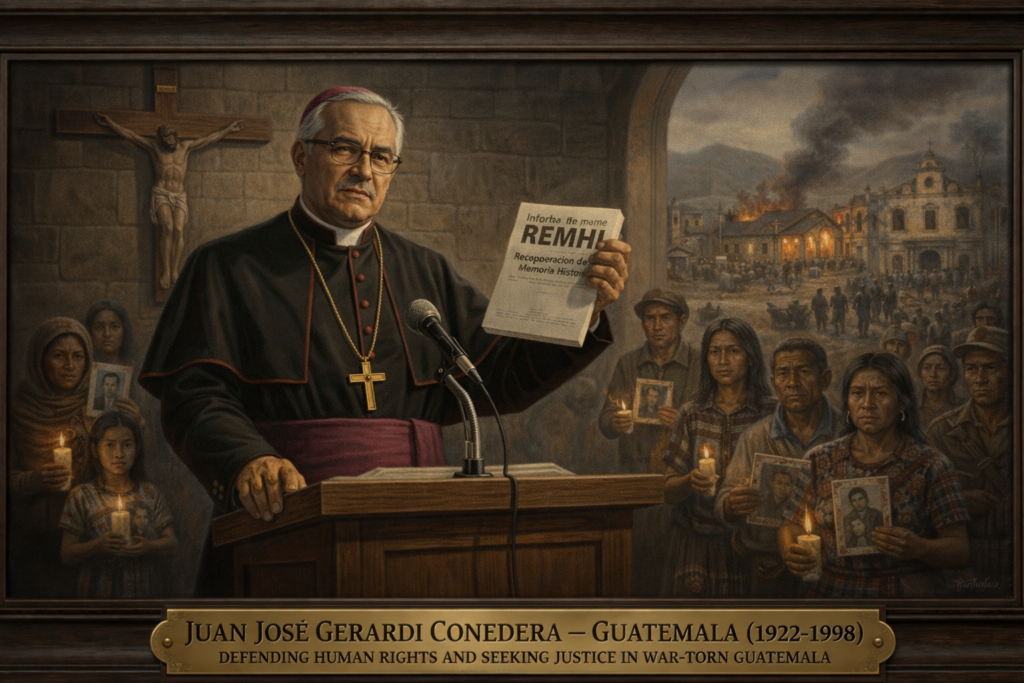
He helped organize a major human rights investigation known as the Recovery of Historical Memory Project (REMHI).
The project collected testimonies from thousands of victims and witnesses across the country, documenting crimes committed during the civil war.
Gerardi believed that giving victims the opportunity to tell their stories was essential for healing and justice. His leadership encouraged communities to speak openly about experiences that had long been silenced by fear.
Through this work, he demonstrated a commitment to human dignity, truth, and moral responsibility.
Righteous Act: Revealing the Truth about Human Rights Abuses
Juan José Gerardi’s most significant act of courage was his leadership in publishing a report documenting human rights violations committed during the civil war.
In 1998, the Recovery of Historical Memory Project released a report titled Guatemala: Nunca Más.
The report presented extensive testimony and evidence describing the scale of violence and suffering experienced by civilians.
It emphasized that confronting the truth about past abuses was necessary to prevent future violence and build a just society.
Gerardi publicly supported the report and called for accountability and recognition of the victims.
Challenges and Adversity
Juan José Gerardi’s efforts to expose human rights abuses placed him at serious risk.
Many individuals and institutions implicated in the violence opposed investigations into the past and resisted efforts to hold perpetrators accountable.
Only two days after presenting the report, Gerardi was brutally murdered outside his residence in Guatemala City in April 1998.
His assassination shocked the nation and drew international attention to the ongoing dangers faced by human rights defenders.
Despite attempts to silence him, Gerardi’s work continued to influence efforts to pursue justice and historical accountability.
Legacy
Juan José Gerardi Conedera is remembered as a courageous defender of truth, human rights, and the dignity of victims.
His work documenting the experiences of survivors helped preserve an important historical record of the conflict in Guatemala.
The report he helped lead remains a significant resource for historians, human rights advocates, and legal investigators studying the civil war.
Today, Gerardi’s life stands as a powerful example of moral courage, demonstrating the importance of speaking truth even when doing so carries great personal risk.
References
Brett, R. (2006). Political violence and the construction of national identity in Guatemala. Palgrave Macmillan.
Grandin, G. (2010). The last colonial massacre: Latin America in the Cold War. University of Chicago Press.
Sanford, V. (2003). Buried secrets: Truth and human rights in Guatemala. Palgrave Macmillan.
CEH (Historical Clarification Commission). (1999). Guatemala: Memory of silence. United Nations.