
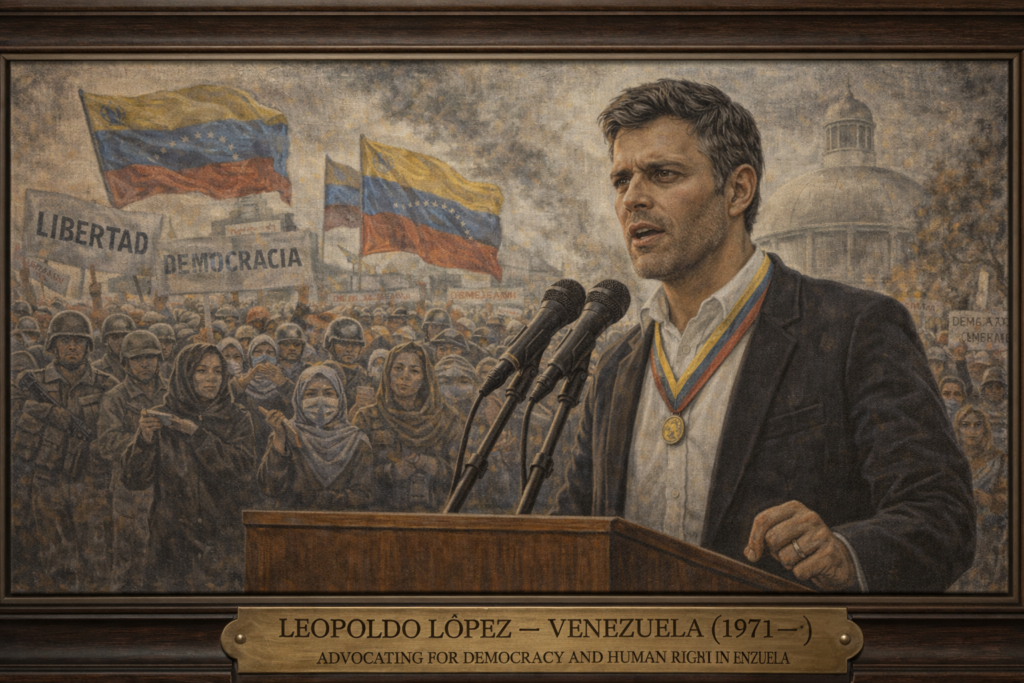
Leopoldo López — Venezuela (1971– )
Leopoldo López is a Venezuelan politician, opposition leader, and democracy activist known for his efforts to promote political freedom, human rights, and democratic reform in Venezuela. Over the course of his career, he has become one of the most prominent figures opposing authoritarian governance in the country.
As the founder of the Voluntad Popular, López has worked to mobilize citizens around the principles of free elections, rule of law, and civic participation.
Historical Context
In the early 21st century, Venezuela experienced increasing political polarization and economic crisis.
Following the leadership of Hugo Chávez and later Nicolás Maduro, critics raised concerns about the concentration of political power, restrictions on opposition parties, and limitations on press freedom.
During this period, opposition leaders and activists began organizing movements calling for democratic reforms and fair elections.
Leopoldo López emerged as a central figure within this opposition movement.
Civic Virtue and Leadership
López began his political career as mayor of the Chacao district in Caracas from 2000 to 2008.
In 2009, he founded the Voluntad Popular, aiming to build a grassroots movement focused on democratic change.
He became widely known for organizing and supporting peaceful protests and civic movements advocating for political accountability and institutional reform.
His leadership emphasized nonviolent resistance, citizen engagement, and the importance of democratic institutions.
Righteous Act: Leading Nonviolent Protests for Democracy
Leopoldo López’s most significant contribution was his leadership in organizing nonviolent protests calling for democratic reform.
In 2014, he helped lead nationwide demonstrations advocating for free elections, justice, and an end to political repression. (Wikipedia)
These protests drew widespread attention both within Venezuela and internationally.
López openly encouraged peaceful civic participation, urging citizens to demand accountability through nonviolent means.
His actions made him a central figure in the pro-democracy movement.
Challenges and Adversity
Following the 2014 protests, López was arrested and later sentenced to a long prison term on charges related to incitement and public disorder. (Wikipedia)
Many international organizations and human rights groups expressed concern that his imprisonment was politically motivated.
He spent years in prison and under house arrest before eventually leaving Venezuela in 2020 and continuing his advocacy from abroad. (McCain Institute)
Throughout this period, López became widely regarded as a symbol of political imprisonment and resistance.
Legacy
Leopoldo López remains an important figure in the global conversation about democracy, human rights, and political freedom.
His activism has drawn international attention to political conditions in Venezuela and inspired ongoing efforts to promote democratic reform.
His legacy reflects moral courage, commitment to nonviolent resistance, and the enduring struggle for democratic governance.
References
Corrales, J., & Penfold, M. (2015). Dragon in the tropics: Hugo Chávez and the political economy of revolution in Venezuela. Brookings Institution Press.
Human Rights Watch. (2017). Crackdown on dissent in Venezuela.
Smilde, D., & Hellinger, D. (2011). Venezuela’s Bolivarian democracy: Participation, politics, and culture under Chávez. Duke University Press.
McCain Institute. (2023). Leopoldo López profile.