
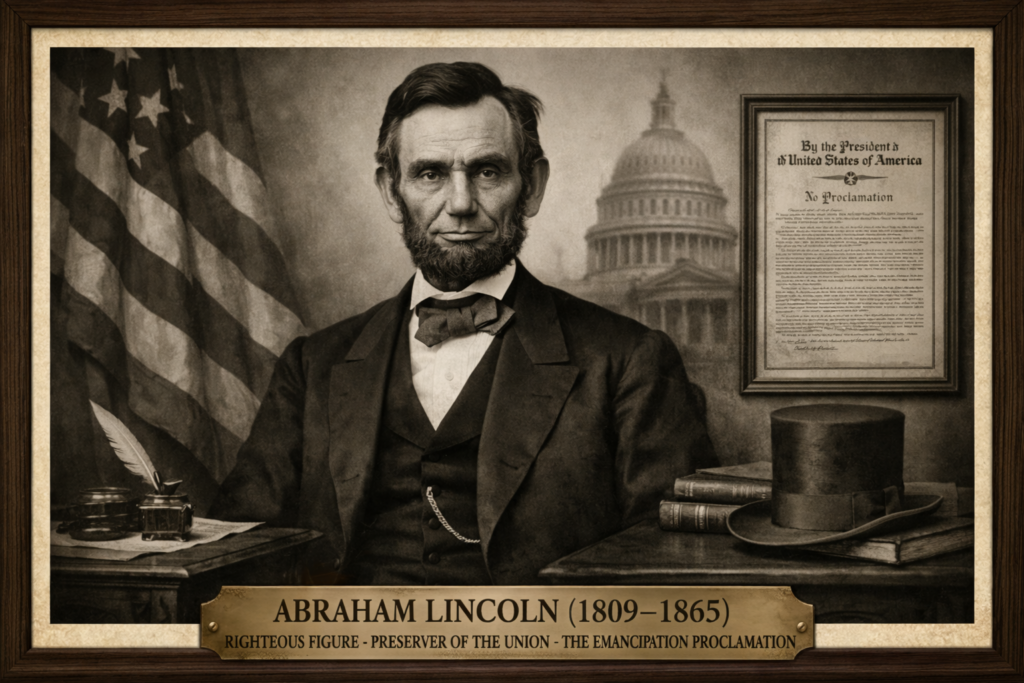
The Lincoln Exhibit invites readers to reflect on righteousness in political leadership through the life and decisions of Abraham Lincoln. Here, Lincoln is not presented as a perfect hero, but as a human figure facing real choices, pressures, and moral crossroads. This space focuses on how courage, conviction, justice, and mercy shape public life. Readers are invited to consider what righteous leadership looks like today — and what it might ask of them in their own spheres of influence.
Focus of the Exhibit
- Righteous Innovation 1: The Emancipation Proclamation
Lincoln’s decision to issue the Emancipation Proclamation transformed the Civil War from a struggle to preserve the Union into a moral crusade for human freedom. He used his wartime powers to declare “that all persons held as slaves” within rebellious states “are, and henceforward shall be free.” This act fundamentally redefined the nation’s purpose and aligned the cause of the Union with the cause of justice. - Righteous Innovation 2: The Team of Rivals
Lincoln appointed his political opponents—men who had run against him for the presidency—to his Cabinet. William Seward, Salmon Chase, and Edward Bates were all rivals who brought diverse perspectives and fierce disagreements. Rather than surrounding himself with yes-men, Lincoln created a leadership environment where ideas were tested, challenged, and refined. This was not weakness—it was righteous leadership that prioritized the best outcome for the nation over personal pride. - Righteous Innovation 3: The Homestead Act — Land as a Tool for Justice and Opportunity
Lincoln signed the Homestead Act in 1862, granting 160 acres of public land to any adult citizen willing to settle and cultivate it for five years. This act democratized land ownership, opening opportunities for ordinary families, immigrants, and formerly enslaved people. It was a radical act of economic justice—using the nation’s resources to create opportunity for those who had none.
Reflection Methodologies
For this exhibit, one or more reflection methodologies may be applied to help readers move from story to self‑examination, such as:
- Decision Simulation Method: Readers imagine themselves in Lincoln’s situation, consider the options he faced, and explore what they might have done — and why.
- Life Application Method: Readers connect Lincoln’s principles to their own lives: family, community, workplace, or civic engagement.
Other applicable reflection methods may also be used, depending on the focus of the case or theme.
Questions for Reflection
- Where do I hold influence — large or small — in the lives of others?
- When have I faced a choice between what is popular and what is right?
- What does righteous leadership look like in my context today?
- Is there a decision I need to revisit, repair, or strengthen with greater integrity?
- Am I willing to stand alone for what is right, even when it costs me?