
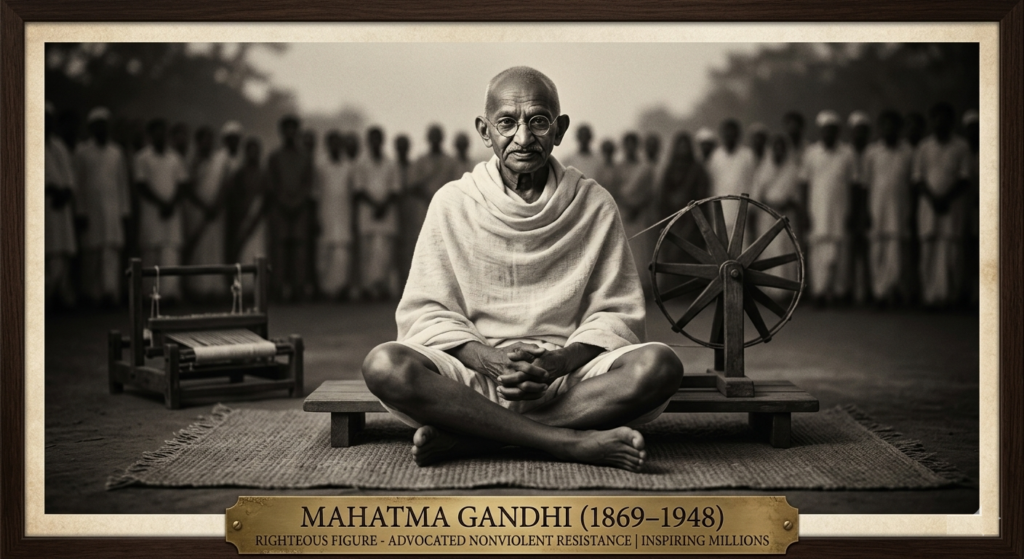
Mahatma Gandhi — India (1869–1948)
Mahatma Gandhi was an Indian political leader, social reformer, and one of the most influential advocates of nonviolent resistance in modern history. Through his philosophy of truth, nonviolence, and civil disobedience, he led a mass movement that challenged colonial rule and inspired struggles for justice around the world.
Gandhi became the central figure in India’s movement for independence from the British Empire, encouraging millions of people to participate in peaceful protests and acts of civil resistance. His leadership transformed the independence movement into a moral campaign grounded in justice, human dignity, and ethical action.
Today, Gandhi is remembered as a global symbol of peaceful resistance, moral courage, and the belief that social change can be achieved without violence.
Historical Context
During the late nineteenth and early twentieth centuries, India was under the control of the British Empire. British colonial authorities governed the country through political and economic systems that often limited the rights and participation of the local population.
As dissatisfaction with colonial rule grew, many Indian leaders began organizing movements to demand greater political representation and eventually full independence.
In this environment, Gandhi emerged as a leader who believed that political freedom must be pursued through nonviolent means. His philosophy, known as Satyagraha, emphasized truth, peaceful protest, and the moral power of collective action.
Through this approach, Gandhi mobilized large segments of Indian society—including farmers, workers, and students—to challenge colonial authority.
Civic Virtue and Leadership
Gandhi believed that moral principles should guide political action. He taught that individuals must resist injustice without hatred or violence.
After studying law in London and working in South Africa, Gandhi developed his ideas about nonviolent resistance while confronting racial discrimination.
When he returned to India, he began organizing peaceful campaigns that encouraged people to refuse cooperation with unjust laws. These efforts included boycotts, marches, and acts of civil disobedience.
Through his leadership, Gandhi demonstrated how ethical discipline, personal sacrifice, and collective solidarity could challenge powerful political systems.
Righteous Act: The Salt March
One of Gandhi’s most famous acts of resistance was the Salt March of 1930, a peaceful protest against British colonial taxation.
At the time, the British government controlled the production and sale of salt in India and imposed taxes that affected ordinary citizens. Gandhi believed that this policy symbolized the broader injustice of colonial rule.
In March 1930, Gandhi led a 240-mile march from Sabarmati Ashram to the coastal village of Dandi.
Upon reaching the sea, Gandhi publicly produced salt from seawater in defiance of British law. This symbolic act encouraged thousands of Indians to break the salt laws and participate in civil disobedience.
The protest attracted worldwide attention and strengthened the movement for Indian independence.
Challenges and Adversity
Gandhi’s campaigns for independence were met with strong resistance from colonial authorities. Throughout his life, he was arrested multiple times for organizing protests and encouraging civil disobedience.
He also faced criticism and disagreement from various political groups within India, some of whom believed that stronger or more confrontational methods were necessary.
Despite these challenges, Gandhi remained committed to his principles of nonviolence and truth, believing that moral integrity was essential for achieving lasting social change.
His dedication to peaceful resistance required significant personal sacrifice, including long periods of imprisonment and repeated hunger strikes.
Legacy
Mahatma Gandhi is widely regarded as one of the most influential figures in the history of nonviolent political movements.
His philosophy of peaceful resistance inspired later leaders and activists around the world, including Martin Luther King Jr. and Nelson Mandela.
In India, Gandhi is honored as the “Father of the Nation” for his leadership in the struggle for independence.
Today, his teachings continue to influence movements advocating human rights, peace, and social justice across the globe.
Gandhi’s life remains a powerful example of how moral conviction, nonviolent resistance, and ethical leadership can transform societies and challenge injustice.
References
Brown, J. (1991). Gandhi: Prisoner of hope. Yale University Press.
Fischer, L. (2002). The life of Mahatma Gandhi. HarperCollins.
Hardiman, D. (2003). Gandhi in his time and ours: The global legacy of his ideas. Columbia University Press.
Parekh, B. (2001). Gandhi: A very short introduction. Oxford University Press.