
Medieval Knight’s Plackart: The Unbreakable Standard
The Plackart represents the peak of European defensive metallurgy during the 15th century. As the “arms race” between piercing weaponry and defensive plating intensified, the traditional one-piece breastplate evolved into a more sophisticated, two-part construction. The plackart was an additional reinforced steel plate worn over the lower half of the breastplate, often extending upward in a decorative point to double the protection over the vital midsection and heart (Edge & Paddock, 1988). This innovation allowed for greater torso rotation—essential for mounted combat—while rendering the knight virtually “unbreakable” against frontal assaults.
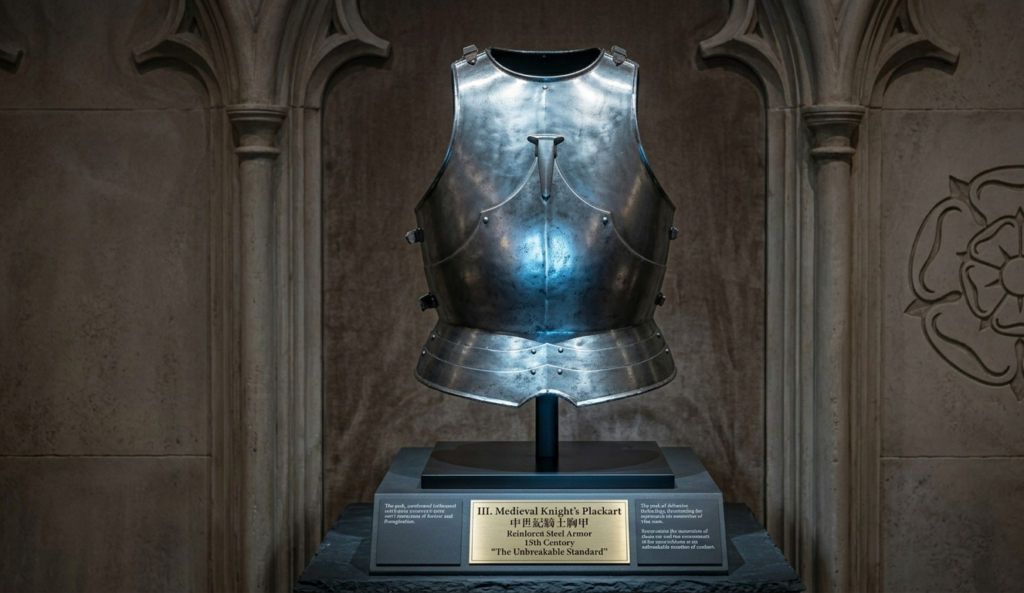
Figure 1. Medieval Knight’s Plackart
The Evolution of the Steel Shell
By the late Middle Ages, the development of the longbow and the heavy lance necessitated a change in armor geometry. Master armorers began “glancing” the surfaces of the plackart, curving the steel so that incoming strikes would slide off rather than penetrate (Gravett, 2006). This technical refinement mirrors the development of a mature character: a life of sustained righteousness creates a “surface” where the accusations and temptations of the world find no grip, sliding away without leaving a mark.
Table 1. Technical Specifications and Historical Context
| Feature | Description | Historical Significance |
| Material | Heat-treated carbon steel. | Offered the highest weight-to-strength ratio of the medieval era (Williams, 2003). |
| Structure | Overlapping secondary chest plate. | Doubled the protection over the heart and stomach while allowing waist flexibility (Edge & Paddock, 1988). |
| Design | Fluted and “glancing” surfaces. | Specifically engineered to deflect the force of high-impact projectiles and lances (Gravett, 2006). |
Table 2. Comparative Analysis of Defensive Maturation
| Armor Stage | Era | Level of Integrity |
| Chainmail Hauberk | 11th – 13th Century | Basic: Flexible but vulnerable to high-velocity piercing. |
| Solid Breastplate | 14th Century | Intermediate: Stronger, but restricted movement and lacked reinforcement. |
| Reinforced Plackart | 15th Century | Advanced: Peak protection; articulated for maximum mobility and defense. |
Biblical Reflection
The Medieval Plackart symbolizes the “Full Armor” in its most mature and refined state. In the scriptures, righteousness is not described as a thin or brittle layer, but as a robust defense that has been tested and strengthened through trial. Just as the plackart was forged in fire and hammered into shape, our righteousness is often refined through the “heat” of life’s challenges.
“In the word of truth, by the power of God, by the armour of righteousness on the right hand and on the left,” — 2 Corinthians 6:7 (KJV)
The Apostle Peter also speaks of the “tried” nature of our faith, which is more precious than gold or steel. When we layer our lives with consistent integrity, we develop a spiritual plackart that can withstand the most direct attacks.
“That the trial of your faith, being much more precious than of gold that perisheth, though it be tried with fire, might be found unto praise and honour and glory…” — 1 Peter 1:7 (KJV)
Reflection
The Plackart was an addition to the breastplate—a second layer of defense for the most critical areas. It represents the “extra mile” of integrity. It is one thing to be generally good; it is another to have a reinforced, “unbreakable” standard that protects you when the battle is at its most intense.
Consider your own standards: Is your righteousness a single, thin layer that might fail under a heavy strike? Or have you “reinforced” your heart with deep-rooted habits of truth and accountability? As you look at this heavy steel, ask yourself if your character has been forged and layered enough to deflect the “heavy lances” of modern ethical pressure.
References
- Edge, D., & Paddock, J. M. (1988). Arms & Armor of the Medieval Knight. Bison Books.
- Gravett, C. (2006). Knight: Noble Warrior of England 1200–1600. Osprey Publishing.
- Williams, A. (2003). The Knight and the Blast Furnace: A History of the Metallurgy of Armour in the Middle Ages. Brill.