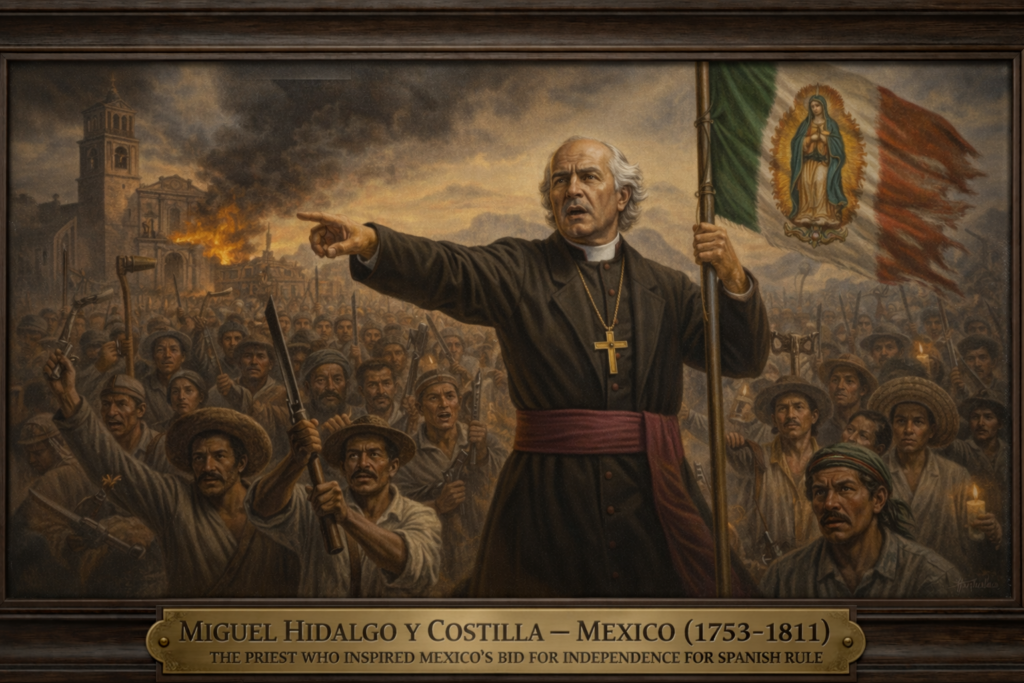
Miguel Hidalgo y Costilla — Mexico (1753–1811)
Miguel Hidalgo y Costilla was a Mexican Catholic priest, social reformer, and revolutionary leader who played a central role in initiating the movement for Mexican independence from Spanish colonial rule. Through his leadership and public call for resistance, he helped inspire one of the most significant political transformations in the history of Mexico.
Known for his advocacy for the rights of indigenous and mestizo populations, Hidalgo challenged social inequalities that had developed under Spanish colonial administration. His leadership mobilized thousands of people who sought greater justice, representation, and freedom.
Today, he is widely remembered as one of the founding figures of Mexico’s independence movement and a symbol of courage, social justice, and national self-determination.
Historical Context
During the late eighteenth and early nineteenth centuries, Mexico was part of the Viceroyalty of New Spain, governed by the Spanish Empire.
Colonial society was highly stratified, with political and economic power concentrated among Spanish-born elites. Indigenous peoples and mixed-heritage communities often faced discrimination, limited political rights, and economic hardship.
Inspired partly by political changes in Europe and the Americas, reformers and intellectuals began questioning the legitimacy of colonial rule.
These growing tensions eventually contributed to the outbreak of the Mexican War of Independence.
Miguel Hidalgo emerged as an early leader in this revolutionary movement.
Civic Virtue and Leadership
Miguel Hidalgo served as a parish priest in the town of Dolores. In addition to his religious duties, he promoted education, agricultural development, and social reforms within his community.
Hidalgo was known for encouraging economic opportunities for local residents and supporting the welfare of indigenous and mestizo populations.
As political tensions increased, Hidalgo became involved in discussions with reformers and intellectuals who sought independence from Spanish colonial rule.
He believed that social justice and political freedom were necessary for the well-being of the Mexican people.
Righteous Act: The Call for Independence
Miguel Hidalgo’s most famous action occurred on September 16, 1810, when he issued a historic call for rebellion against Spanish authority.
In what became known as the Grito de Dolores, Hidalgo rang the church bell in Dolores and delivered a speech urging people to rise against colonial rule.
His message called for an end to injustice and encouraged the population to seek political freedom and social reform.
Thousands of people joined the uprising, forming a large revolutionary force that marched toward major cities in central Mexico.
Although the early stages of the movement faced military setbacks, Hidalgo’s call for independence ignited a broader national struggle that eventually led to Mexico’s independence in 1821.
Challenges and Adversity
The independence movement led by Hidalgo faced strong resistance from Spanish colonial authorities.
Royalist forces defeated the insurgent army in several major battles. Hidalgo was eventually captured by Spanish authorities in 1811.
After a trial for treason and rebellion, he was executed later that year.
Despite the defeat of the early uprising, the movement he helped inspire continued under other revolutionary leaders.
Legacy
Miguel Hidalgo y Costilla is widely recognized as one of the founding figures of modern Mexico.
His call for independence inspired a decade-long struggle that ultimately ended Spanish colonial rule in the region.
Today, September 16—the anniversary of the Grito de Dolores—is celebrated as Mexican Independence Day.
Miguel Hidalgo’s life remains an enduring symbol of courage, national identity, and the pursuit of justice and freedom.
References
Hamnett, B. (2006). A concise history of Mexico. Cambridge University Press.
Knight, A. (2010). The Mexican Revolution: A very short introduction. Oxford University Press.
Anna, T. E. (1998). The fall of the royal government in Mexico City. University of Nebraska Press.
Tutino, J. (2013). Making a new world: Founding capitalism in the Bajío and Spanish North America. Duke University Press.