
The Modern Ballistic Vest: The Articulated Shield
The Modern Ballistic Vest represents the peak of personal protection in the 21st century. Unlike single-plate armor, the modern vest consists of multiple, specialized components: a soft ballistic backing (woven aramid fibers such as those found in para-aramid materials), hard trauma plates (ceramic/polyethylene), and load-distributing cummerbunds. This “segmented” design allows a soldier or officer to retain spinal flexibility and weapon maneuverability, preventing the “turtle shell” rigidity of earlier flak jackets. By channeling weight to the hips and shoulders via padded straps, the wearer can run, kneel, and fight for hours without respiratory collapse.
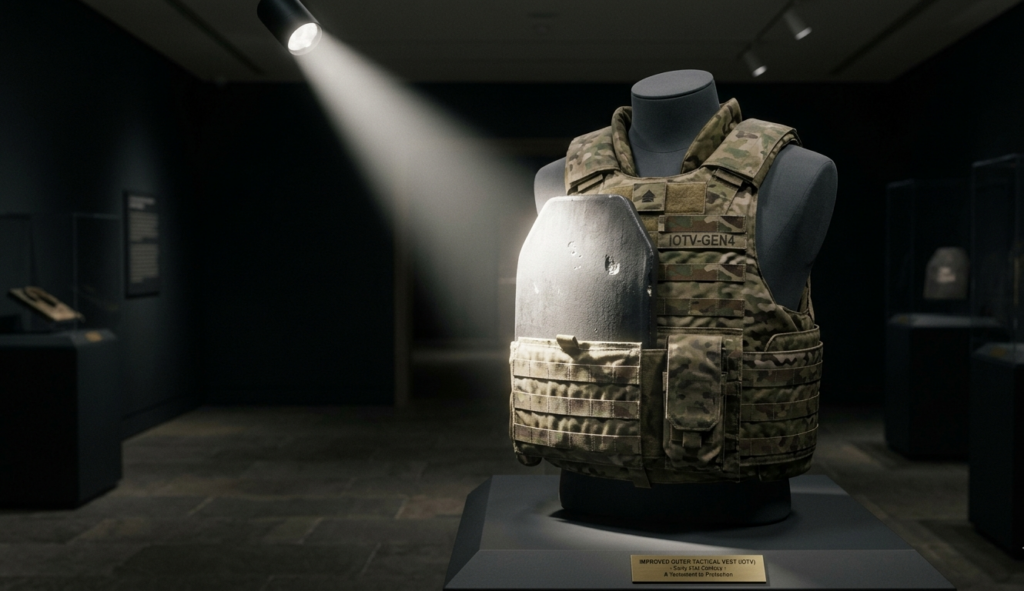
Figure 1. Modern Ballistic Vest
Key Details to Notice
- Articulated Panels: Look at the front and back plate carriers (hard armor) versus the soft armor sides. The hard plates stop rifle rounds over the heart and lungs, while the flexible aramid panels stop shrapnel and pistol rounds over the abdomen and lower back. This is the direct descendant of the Lorica Segmentata’s iron bands over the organs and leather under the arms.
- Quick-Release Fastening: The modern vest uses a central cable pull (or velcro/quick buckles). Just as the Roman used brass buckles for rapid donning, the modern soldier has a “pull-pin” emergency release to shed 30+ lbs of armor instantly for medical evacuation or water survival.
- The “Heart” Focus: The heaviest, thickest plate is inserted into the chest pocket of the carrier. Most modern vests have an additional “trauma pad” directly over the sternum to prevent blunt force injury from a stopped bullet—visually and functionally protecting the same vital area as the polished left chest of the Roman armor.
Table 1. Technical Specifications and Modern Context
| Feature | Description | Tactical Significance |
|---|---|---|
| Material | Ceramic (e.g., boron carbide) or UHMWPE (ultra-high-molecular-weight polyethylene) strike face, backed by aramid fibers. | Provides superior protection against supersonic rifle rounds (e.g., 5.56mm, 7.62mm) while being 40% lighter than steel (DeVries, 2020). |
| Structure | Hard armor plates (front/back) + soft armor panels (sides/shoulders/groin). | Balances maximum protection of the thoracic cavity (heart/aorta/lungs) with the spinal mobility required for urban warfare and vehicle operations (US Army PEO Soldier, 2022). |
| Fastening | Hook-and-loop cummerbund, shoulder quick-buckles, drag handle, emergency release cable. | Enables the soldier to self-don the vest in under 30 seconds, adjust for prone shooting, and be dragged to safety by a comrade if incapacitated. |
Table 2. Comparison of Vital Protection
| Armor Type | Coverage Area | Vulnerability Level |
|---|---|---|
| Modern Ballistic Vest (Hard + Soft) | Heart, lungs, aorta, liver, kidneys, upper spine. | Low (Stops rifle rounds; vulnerable only to armor-piercing or high-velocity impacts at plate edges). |
| Legacy Flak Jacket (M-1955) | General torso (soft fabric only). | High (Vulnerable to rifle fire, shrapnel penetration, and blunt trauma). |
The Heart of the Modern Warrior
While the soft aramid vest stops fragmentation (shrapnel) from explosives—the #1 threat in modern war—the hard ceramic plate is specifically engineered for a single, terrifying purpose: to stop a direct rifle bullet aimed at the heart. The plate is designed to sacrifice itself: upon impact, it shatters its ceramic face to “catch” the bullet, then the polyethylene backing catches the fragments. It is a single-use shield for the most vital organ. This is the Lorica Segmentata’s principle of “impenetrable strength over the heart” updated for supersonic ballistics.
Biblical Reflection
In the Righteousness Museum, we connect this physical defense to the spiritual reality of the believer. When the Apostle Paul wrote to the Ephesians from a Roman prison, he was chained to a Praetorian Guard—a soldier who may have worn the Lorica Segmentata. But if Paul were writing to a modern soldier, sailor, marine, or airman, he would look at the ceramic plate and aramid layers and say the same thing: physical armor protects the heart that beats blood; spiritual armor protects the soul that will live forever.
The “breastplate of righteousness” is not self-righteousness—our own moral performance cannot stop the “bullets” of accusation, guilt, and temptation. Rather, it is the righteousness from God, given to the believer. Just as a ballistic vest is issued to a soldier (not earned or fabricated by the soldier), so righteousness is a gift:
“God made him who had no sin to be sin for us, so that in him we might become the righteousness of God.” — 2 Corinthians 5:21 (NIV)
This is the hard plate of the Christian faith. When the enemy fires a round of accusation (“You are guilty; you have failed; God cannot use you”), the believer does not rely on his own perfection. Instead, he deflects the blow with the issued armor: “I am covered by the righteousness of Christ.”
Furthermore, the soft armor (the flexible aramid that covers the sides and lower back) represents the daily, practical righteousness of obedience. As John writes:
“If we walk in the light, as he is in the light, we have fellowship with one another, and the blood of Jesus, his Son, purifies us from all sin.” — 1 John 1:7 (NIV)
Just as the Roman armor had iron plates over the heart and leather straps under the arms, the Christian has:
- The Hard Plate (Imputed Righteousness): Christ’s perfect record credited to the believer. This stops the fatal round of condemnation.
- The Soft Armor (Imparted Righteousness): The Holy Spirit’s work producing love, patience, and integrity. This stops the fragmentation of daily small sins.
The Old Testament prophet Isaiah saw this same armor—not on a Roman soldier, but on the Messiah Himself:
“He put on righteousness as his breastplate, and the helmet of salvation on his head.” — Isaiah 59:17 (NIV)
Jesus wore this armor perfectly. The believer is invited to wear the same—not by earning it, but by receiving it and then walking in it.
Reflection in Life
The Modern Ballistic Vest is composed of many layers working together to form one protective system. If the ceramic plate is cracked (from a previous impact or improper storage), the entire chest is exposed to a fatal round. If the soft armor side panels are removed (for comfort or weight savings), the kidneys and liver are vulnerable to shrapnel.
Consider your own spiritual armor:
1. The Hard Plate (Imputed Righteousness)
- Have you “cracked” your plate by believing that your good behavior earns God’s favor? Or by believing that your bad behavior disqualifies you permanently?
- A cracked plate is one that has been struck by the lie: “God is angry with you. You are too sinful to be forgiven.”
- Truth: The plate of Christ’s righteousness is not cracked by your failures. It was already cracked—on the cross—so that you could be protected. When the enemy fires at you, the plate has already absorbed the blow. You are safe.
2. The Soft Armor (Imparted Righteousness)
- Have you removed the side panels for comfort? Have you stopped forgiving a family member because it’s “too hard”? Have you stopped being generous because it’s “too expensive”? Have you stopped telling the truth in small matters because it’s “inconvenient”?
- A missing side panel exposes you to the fragmentation of bitterness, greed, and deceit. These wounds are not instantly fatal, but they bleed slowly over years. A soldier who loses his soft armor will eventually collapse from a thousand tiny cuts.
3. The Quick-Release (Confession and Repentance)
- Every modern vest has an emergency release cable. When a soldier falls into water or is wounded, he pulls the cable and sheds the armor instantly for rescue.
- Spiritually, do you have a “quick release”? Or do you drag the weight of guilt and shame around, pretending you are still wearing armor that has already been penetrated?
- The biblical quick release is confession: “If we confess our sins, he is faithful and just and will forgive us our sins and purify us from all unrighteousness” (1 John 1:9). You do not have to die under the weight of a compromised vest. Pull the cable. Shed the pretense. Be rescued.
As you look at this ceramic and aramid armor, ask yourself:
- Is my hard plate in place? Do I trust the righteousness of Christ, or my own performance?
- Is my soft armor intact? Am I walking in daily obedience, forgiveness, and love—even in small matters?
- Is my quick-release accessible? Do I confess quickly, or do I let guilt accumulate until I am spiritually immobilized?
The Roman legionary checked his brass buckles before battle. The modern soldier checks his plate and straps before the mission. Check your spiritual armor today. Your heart—your eternal heart—depends on it.
References
- DeVries, M. R. (2020). Body Armor Ballistics: From Medieval Plate to Modern Ceramics. Armor Research Institute.
- US Army PEO Soldier. (2022). Soldier Protection System (SPS) Technical Manual. Fort Belvoir.
- National Institute of Justice. (2018). Ballistic Resistance of Body Armor NIJ Standard-0101.06.
Disclaimer:
This website is an independent digital museum. All product names, trademarks, and brands are the property of their respective owners and are used for identification and educational purposes only. No affiliation or endorsement is implied.