
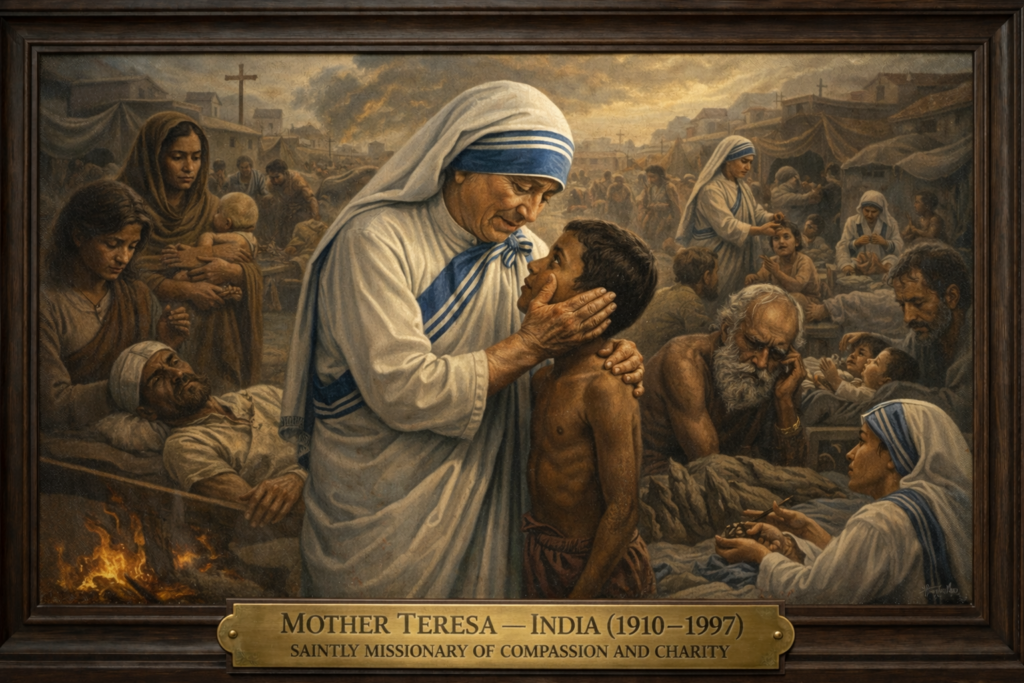
Mother Teresa — India (1910–1997)
Mother Teresa was a Catholic nun, humanitarian, and founder of the Missionaries of Charity, an organization dedicated to serving the poor, the sick, and the destitute. Through her lifelong commitment to helping the most vulnerable members of society, she became one of the most recognized symbols of compassion, charity, and selfless service in the twentieth century.
Working primarily in Kolkata (formerly Calcutta), Mother Teresa devoted her life to caring for people suffering from poverty, illness, and abandonment. Her work focused especially on those who had been neglected or rejected by society.
Through the expansion of the Missionaries of Charity, her humanitarian efforts eventually reached many countries around the world.
Today, she is remembered as a powerful example of human compassion, service to the poor, and moral dedication to helping others.
Historical Context
During the mid-twentieth century, India faced widespread poverty, disease, and social inequality, particularly in densely populated urban areas.
In cities such as Kolkata, many people lacked access to adequate healthcare, housing, and basic social support. Large numbers of individuals—including the elderly, the sick, and the homeless—were left without assistance.
Although government programs and charitable organizations existed, the scale of poverty remained immense.
Within this environment, Mother Teresa dedicated her life to serving those who were often ignored or abandoned by society.
Civic Virtue and Leadership
Mother Teresa believed that every human life possessed inherent dignity and deserved care and compassion, regardless of social status or condition.
After joining a Catholic religious order and working as a teacher, she experienced what she later described as a “call within a call”—a spiritual conviction that she should dedicate her life to helping the poorest people in society.
In 1950, she founded the Missionaries of Charity, an order of nuns devoted to serving the poor and the dying.
The organization began with a small group of volunteers but eventually expanded across the world, establishing homes for the sick, shelters for the homeless, and centers for people suffering from serious illness.
Through this work, Mother Teresa demonstrated a leadership style based on service, humility, and compassionate action.
Righteous Act: Caring for the Dying and Abandoned
One of Mother Teresa’s most significant contributions was her effort to care for individuals who had been abandoned due to illness or poverty.
In 1952, she established the Nirmal Hriday, a hospice where people who were dying on the streets could receive care, dignity, and companionship in their final days.
Volunteers and members of the Missionaries of Charity provided medical assistance, food, and emotional support to those who had often been neglected by society.
Mother Teresa believed that even when a person could not be cured, they deserved to be treated with respect, compassion, and human dignity.
Her work brought global attention to the suffering of the poor and inspired many others to engage in humanitarian service.
Challenges and Adversity
Mother Teresa’s work was not without difficulties. Serving the poorest communities required constant effort to obtain resources, volunteers, and medical supplies.
She also faced criticism from some observers regarding the methods and conditions of her charitable institutions. Despite these criticisms, she remained committed to her mission of serving those most in need.
The daily realities of caring for individuals suffering from severe illness, poverty, and abandonment also required immense personal strength and emotional resilience.
Throughout these challenges, Mother Teresa maintained her focus on compassionate service and the belief that helping even one person was meaningful.
Legacy
Mother Teresa became one of the most widely recognized humanitarian figures in the world.
Her work through the Missionaries of Charity expanded to more than 100 countries, providing assistance to people suffering from poverty, illness, and social exclusion.
In 1979, she received the Nobel Peace Prize for her humanitarian efforts.
After her death in 1997, she was honored by the Roman Catholic Church, which declared her a saint in 2016, recognizing her lifelong dedication to helping the poor.
Today, Mother Teresa’s life continues to inspire people around the world to practice compassion, charity, and service to humanity. Her example demonstrates how individual acts of kindness and dedication can bring dignity and hope to those most in need.
References
Kolodiejchuk, B. (2007). Mother Teresa: Come be my light. Doubleday.
Spink, K. (2011). Mother Teresa: An authorized biography. HarperCollins.
Chatterjee, A. (2003). Mother Teresa: The final verdict. Meteor Books.
Slavicek, L. (2007). Mother Teresa. Chelsea House.