
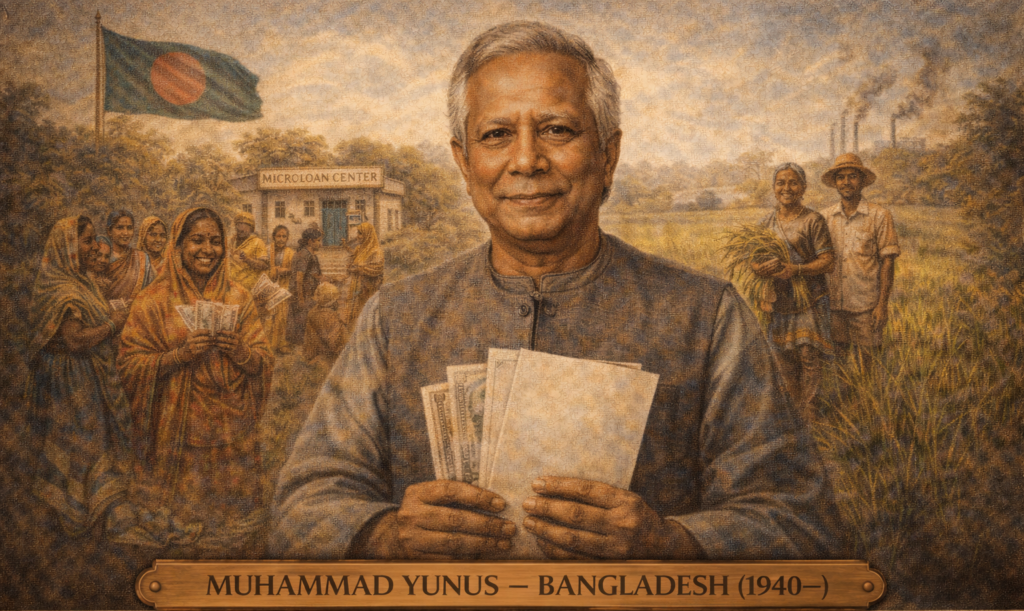
Muhammad Yunus — Bangladesh (1940– )
Exhibit Music: The Banker of Chittagong, [Lyrics]
Muhammad Yunus is a Bangladeshi economist, social entrepreneur, and humanitarian leader known for pioneering microfinance and promoting economic opportunities for the poor. Through his innovative approach to lending, he has helped millions of people escape poverty by enabling access to small loans without traditional collateral in Bangladesh.
He is the founder of the Grameen Bank, an institution that transformed the way financial services can support low-income communities.
Historical Context
After gaining independence in 1971, Bangladesh faced widespread poverty, economic instability, and limited access to financial services.
Traditional banking systems often excluded the poorest individuals, especially women, who lacked collateral or formal credit histories.
During the 1970s, famine and economic hardship highlighted the need for new approaches to poverty reduction and rural development.
Muhammad Yunus began exploring ways to provide small-scale financial support directly to those most in need.
Civic Virtue and Leadership
As a professor of economics, Yunus became deeply concerned about the gap between economic theory and the realities of poverty.
He initiated small experimental lending programs in rural villages, offering tiny loans to individuals—especially women—to start businesses and support their families.
These efforts led to the creation of the Grameen Bank, which operates on principles of trust, community support, and social responsibility.
His leadership emphasized economic empowerment, dignity, and the belief that access to financial resources is a fundamental tool for human development.
Righteous Act: Creating Microfinance for the Poor
Muhammad Yunus’s most significant contribution was the development of microfinance as a tool to combat poverty.
By providing small, low-interest loans without requiring collateral, he enabled millions of people to start small businesses, generate income, and improve their living conditions.
His model focused particularly on empowering women, who became the majority of borrowers and key contributors to household and community development.
This approach challenged traditional banking practices and demonstrated that even the poorest individuals are capable of entrepreneurship when given opportunity.
In recognition of his work, Yunus and the Grameen Bank were awarded the Nobel Peace Prize in 2006.
Challenges and Criticism
Despite its global success, microfinance has also faced criticism and debate.
Some observers have questioned the long-term impact of small loans on poverty reduction, while others have raised concerns about interest rates and financial sustainability in certain contexts.
In addition, Yunus has encountered political and institutional challenges within Bangladesh, including disputes over leadership roles and governance.
These debates highlight the complexity of addressing poverty through financial systems.
Legacy
Muhammad Yunus is widely regarded as a pioneer in the field of social entrepreneurship and inclusive finance.
His work has inspired similar microfinance initiatives around the world and influenced global discussions on poverty alleviation and economic development.
His legacy reflects innovation, compassion, and a commitment to creating systems that expand opportunity for the most vulnerable.
References
Yunus, M. (1999). Banker to the poor: Micro-lending and the battle against world poverty. PublicAffairs.
Yunus, M. (2007). Creating a world without poverty: Social business and the future of capitalism. PublicAffairs.
Armendáriz, B., & Morduch, J. (2010). The economics of microfinance. MIT Press.
Dowla, A., & Barua, D. (2006). The poor always pay back: The Grameen II story. Kumarian Press.