
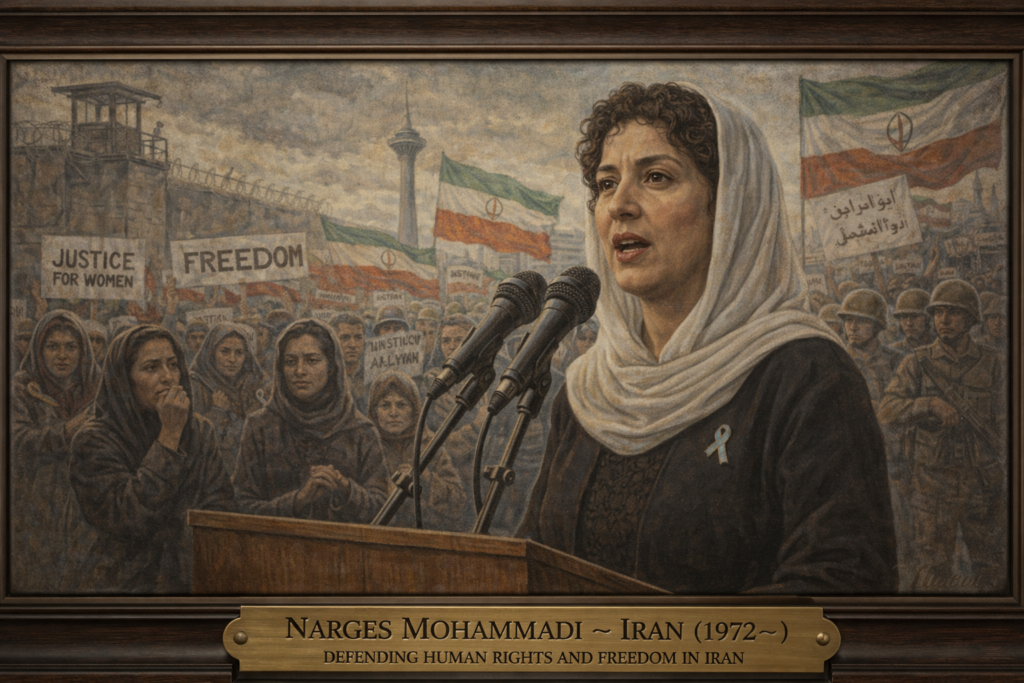
Narges Mohammadi — Iran (1972– )
Narges Mohammadi is an Iranian human rights activist, journalist, and democracy advocate known for her long-standing efforts to defend women’s rights, oppose the death penalty, and promote freedom and justice in Iran. Her work, often carried out under conditions of imprisonment and political pressure, has made her one of the most prominent voices for human rights in Iran.
She serves as a leading member of the Defenders of Human Rights Center, an organization dedicated to supporting political prisoners and advocating legal reform. (Wikipedia)
Historical Context
Since the Iranian Revolution, Iran has experienced a political system in which dissent and activism are often restricted.
Over the decades, journalists, activists, and reform advocates have faced surveillance, imprisonment, and legal penalties for criticizing government policies or advocating for change.
In this environment, movements supporting women’s rights, freedom of expression, and legal reform have emerged, often at significant personal risk to participants.
Narges Mohammadi became a key figure within this broader movement, focusing particularly on the treatment of political prisoners and the rights of women.
Civic Virtue and Leadership
Narges Mohammadi began her activism as a writer and student advocate, later becoming deeply involved in human rights organizations.
Through her work with the Defenders of Human Rights Center, she has documented prison conditions, supported detainees, and campaigned against capital punishment.
She has also spoken out against discriminatory laws affecting women and has supported peaceful civic movements advocating reform.
Her leadership is defined by persistence, moral conviction, and a commitment to nonviolent advocacy, even under repeated arrests and legal penalties.
Righteous Act: Defending Human Rights Despite Imprisonment
Narges Mohammadi’s most significant contribution is her continued advocacy for human rights while facing repeated imprisonment.
She has been arrested numerous times and sentenced to long prison terms for her activism, including charges related to “propaganda” and national security. (Tom Lantos Human Rights Commission)
Even while detained, she has continued to report on prison conditions, including the treatment of female prisoners and the use of solitary confinement.
Her efforts have drawn international attention to human rights conditions in Iran and helped amplify the voices of those who cannot speak freely.
In recognition of her work, she was awarded the Nobel Peace Prize in 2023 for her fight against the oppression of women and her efforts to promote human rights and freedom. (Wikipedia)
Challenges and Adversity
Narges Mohammadi has faced extensive personal and professional challenges throughout her life.
She has been arrested multiple times, subjected to long prison sentences, and experienced periods of solitary confinement.
Her health has also been affected during detention, with reports of limited access to medical care and ongoing physical strain. (Encyclopedia Britannica)
Despite these hardships, she has remained committed to her advocacy and continues to speak out for justice.
Legacy
Narges Mohammadi is widely regarded as a leading figure in the global struggle for human rights and women’s freedom.
Her work has helped bring international awareness to issues such as political imprisonment, gender inequality, and the use of the death penalty.
Her legacy reflects moral courage, resilience, and the determination to pursue justice even under severe personal risk.
She stands as a powerful example of how individual conviction can influence global conversations about human dignity and freedom.
References
Britannica. (2026). Narges Mohammadi.
Mohammadi, N. (2017). White torture: Interviews with Iranian women prisoners.
Amnesty International. (2022). Iran: Human rights defenders under attack.
Human Rights Commission. (2023). Profile of Narges Mohammadi.