
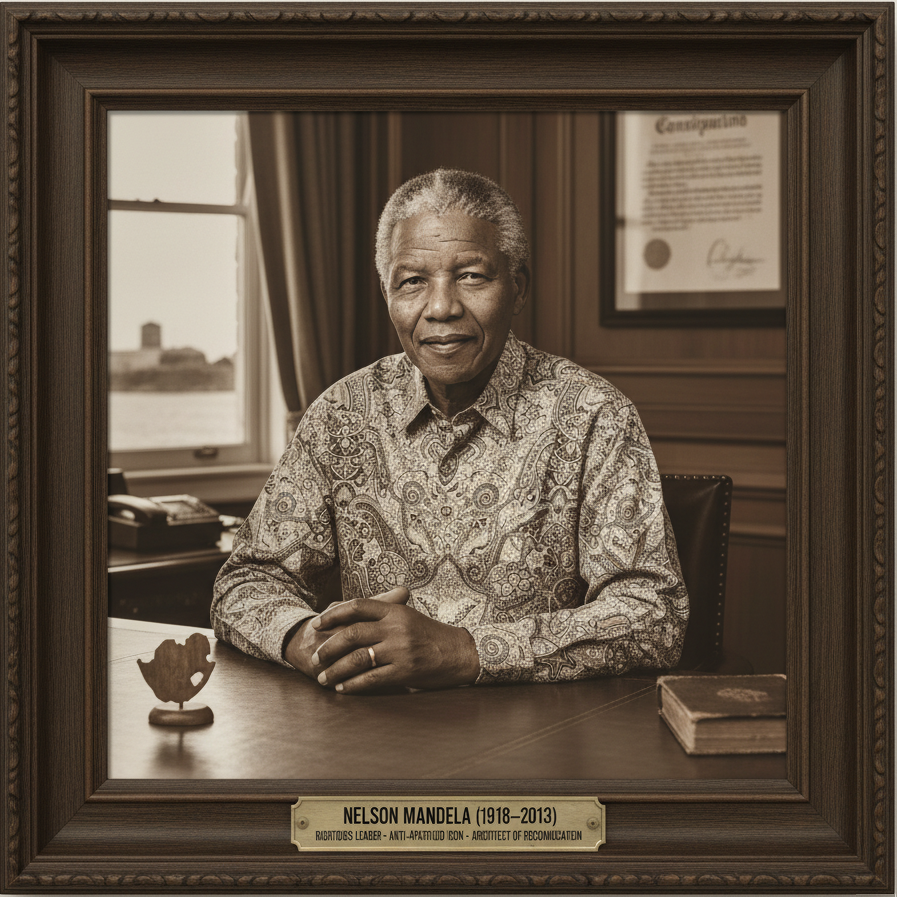
Nelson Mandela — South Africa (1918–2013)
Nelson Mandela was a South African political leader, anti-apartheid activist, and statesman who played a central role in ending the system of racial segregation known as apartheid in South Africa. Through decades of resistance, imprisonment, and leadership, he became one of the most widely respected figures in the global struggle for human rights, justice, and democratic equality.
Mandela dedicated his life to challenging racial discrimination and advocating for a society based on equal rights for all citizens. After spending 27 years in prison for his opposition to apartheid, he later became the first democratically elected president of South Africa.
His leadership during the country’s transition from apartheid to democracy demonstrated the power of reconciliation, forgiveness, and ethical political leadership.
Historical Context
For much of the twentieth century, South Africa was governed under a system known as Apartheid.
Established officially in 1948, apartheid enforced strict racial divisions between the white minority government and the non-white majority population. Laws restricted where people could live, work, travel, and participate in political life.
Non-white South Africans were denied basic political rights, including the right to vote and hold political office.
Many activists, organizations, and international movements began resisting apartheid, demanding equal rights and democratic reform. Nelson Mandela emerged as one of the most influential leaders in this struggle.
Civic Virtue and Leadership
Nelson Mandela joined the African National Congress (ANC) in 1944 and became deeply involved in the movement for racial equality.
As a lawyer and political activist, Mandela helped organize campaigns of civil resistance against discriminatory laws. He advocated for justice through both legal action and organized protest.
In 1964, Mandela was arrested and sentenced to life imprisonment for his role in anti-apartheid activities. He spent most of his imprisonment on Robben Island, where many political prisoners were held.
During his years in prison, Mandela became an international symbol of resistance to injustice. His moral authority and steadfast commitment to equality inspired activists around the world.
Righteous Act: Leading the Peaceful Transition from Apartheid
One of Mandela’s most significant contributions was his leadership in guiding South Africa’s peaceful transition from apartheid to democracy.
After being released from prison in 1990, Mandela worked with political leaders, including F. W. de Klerk, to negotiate the dismantling of apartheid laws.
Rather than promoting revenge or retaliation, Mandela emphasized national reconciliation, encouraging South Africans of all racial backgrounds to build a shared future.
In 1994, South Africa held its first multiracial democratic election, and Mandela was elected as the country’s first Black president.
His leadership helped prevent large-scale violence and laid the foundation for a democratic society based on equality, justice, and human rights.
Challenges and Adversity
Nelson Mandela’s life was marked by profound personal hardship.
His imprisonment lasted 27 years, during which he endured harsh prison conditions, physical labor, and long periods of isolation.
He was separated from his family and unable to participate in normal public life for decades.
Despite these hardships, Mandela maintained his commitment to reconciliation and justice. After his release, he resisted calls for revenge and instead promoted peaceful cooperation between former political enemies.
His ability to transform personal suffering into a message of unity became one of the defining features of his leadership.
Legacy
Nelson Mandela is widely regarded as one of the most influential political leaders of the twentieth century.
In recognition of his role in ending apartheid and promoting peaceful reconciliation, Mandela and F. W. de Klerk jointly received the Nobel Peace Prize in 1993.
Mandela’s presidency helped establish democratic institutions and promote national healing after decades of racial division.
Today, his life remains a powerful example of moral courage, forgiveness, and ethical leadership in the pursuit of justice.
References
Mandela, N. (1994). Long walk to freedom. Little, Brown and Company.
Sampson, A. (2011). Mandela: The authorized biography. HarperCollins.
Lodge, T. (2006). Mandela: A critical life. Oxford University Press.
Meredith, M. (2010). The state of Africa: A history of the continent since independence. Simon & Schuster.