
The Olive Tree (Olea europaea): Faithful Fruitfulness, Enduring Righteousness
Introduction to the Plant
The olive tree, known in Hebrew as zayit, is one of the most enduring and significant plants in the biblical world. Native to the Mediterranean basin, the olive tree can live for over 1,000 years, with some specimens in the Garden of Gethsemane believed to be 2,000 years old (Goor & Nurock, 2021). These trees grow slowly, reaching heights of 8-15 meters (25-50 feet), with twisted trunks, silvery-green leaves, and a remarkable ability to regenerate from the root even after being cut down.
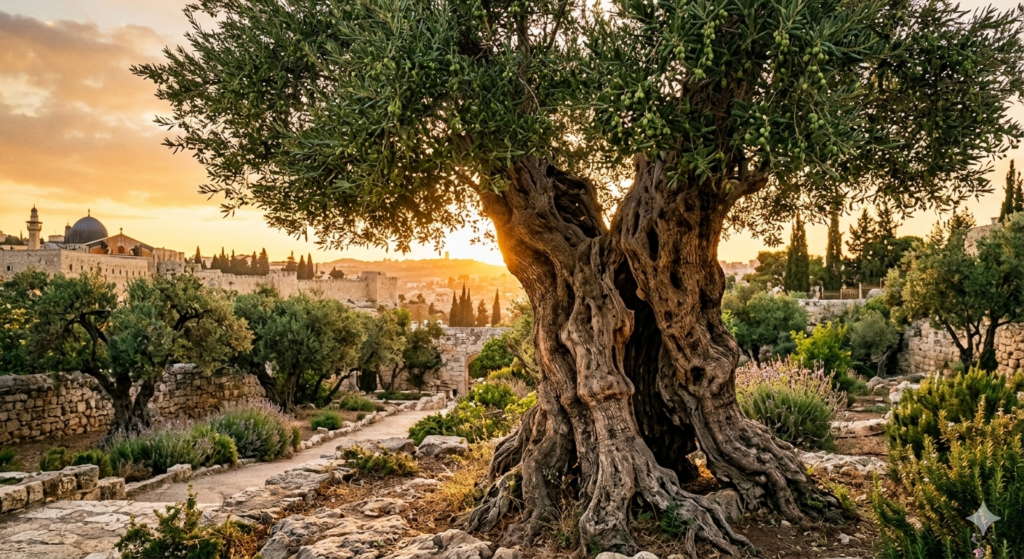
Figure 1. Ancient Olive Tree in the Garden of Gethsemane. A gnarled, ancient olive tree with a thick, twisted trunk stands against the golden light of a Jerusalem sunset. The tree shows visible signs of age—bark deeply furrowed, trunk hollowed in places—yet its upper branches are full of green leaves and small unripe olives. The image captures the paradox of aged endurance and continued fruitfulness.
The Bible mentions the olive tree over 30 times, making it one of the most frequently referenced plants in Scripture. Olive oil was used for:
- Lighting the golden lampstand in the Tabernacle (Exodus 27:20)
- Anointing priests and kings (1 Samuel 16:13)
- Healing wounds (Isaiah 1:6; Luke 10:34)
- Offering as a grain offering (Leviticus 2:1-2)
The olive branch became the universal symbol of peace after the flood, when a dove returned to Noah’s ark with an olive leaf in its beak (Genesis 8:11). Yet it is in the Psalms that the olive tree receives its highest moral commendation, as a metaphor for the righteous person who remains faithful to God:
“But I am like an olive tree flourishing in the house of God; I trust in God’s unfailing love for ever and ever.” — Psalm 52:8 (NIV)
The Wisdom of the Olive Tree
The wisdom of the olive tree is rooted in deep rooting and patient endurance. Unlike annual plants that sprout, seed, and die within a single season, the olive tree invests its first several years growing roots before producing any visible fruit. An olive tree typically does not bear a significant harvest until it is 20-40 years old (Goor & Nurock, 2021).
Table 1. Wisdom Traits of the Olive Tree and Their Practical Lessons
| Wisdom Trait | Botanical Evidence | Practical Lesson |
|---|---|---|
| Deep rooting | Roots can penetrate 20 feet (6 meters) into rocky soil | Righteousness must be rooted deeply in truth to survive drought |
| Slow growth | Takes 20-40 years to reach full fruitfulness | Maturity cannot be rushed; faithfulness requires patience |
| Regeneration | New shoots emerge from the root even after the trunk is cut | Even after failure, righteousness can grow again |
| Drought resistance | Survives on minimal water in arid climates | The righteous endure through dry seasons of life |
| Longevity | Lives 1,000+ years, bearing fruit for centuries | Righteousness spans generations, not just moments |
The olive tree’s wisdom also includes the ability to thrive where nothing else can. Olive trees grow in rocky, limestone soil of the Middle East—terrain that supports little else. They send taproots deep into cracks in the bedrock, drawing water from hidden sources. This is the wisdom of adaptation and perseverance: not demanding ideal conditions, but flourishing in the conditions that are given.
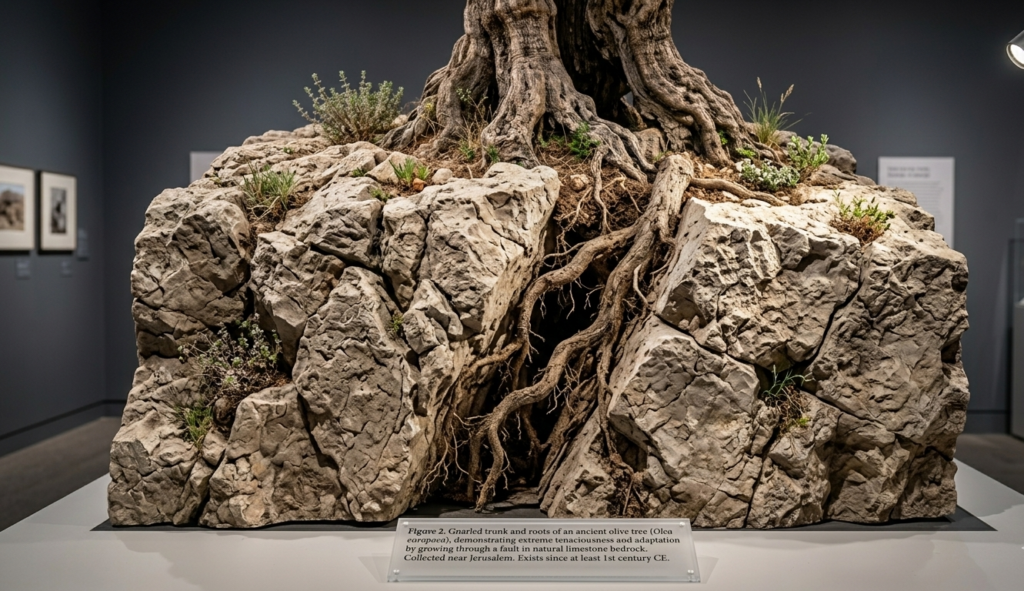
Figure 2. Olive Tree Growing Out of Rocky Soil. A close-up museum photograph showing the base of an olive tree growing directly out of a crack in limestone bedrock. The roots are visible, snaking deep into the crevice. The image conveys the tenacity of life that refuses to surrender to harsh conditions.
Furthermore, the olive tree demonstrates wisdom through generative pruning. Farmers prune olive trees severely, cutting back branches to encourage new growth. An unpruned olive tree becomes wild and bears little fruit. The pruned tree, though appearing reduced, produces abundantly. This agricultural wisdom teaches that loss is sometimes necessary for increase (Mazar, 2019).
The Righteousness of the Olive Tree
If wisdom is the knowledge of how to survive and thrive, righteousness is the faithful practice of that wisdom over a lifetime. The olive tree’s choice to “flourish in the house of God” (Psalm 52:8) is not a single decision but a daily, decades-long posture of remaining planted in the right place.
Table 2. Virtues of the Olive Tree and Their Ethical Implications
| Virtue Demonstrated | Botanical Evidence | Ethical Implication |
|---|---|---|
| Faithfulness | Bears fruit year after year for centuries | Righteousness is consistency, not occasional heroism |
| Generativity | Produces oil that lights lamps and heals wounds | The righteous produce light and healing for others |
| Resilient hope | Sends up new shoots even after being cut down | Righteousness never despairs of a second chance |
| Contentment | Thrives in poor soil without complaint | Righteousness does not demand ideal circumstances |
| Peace-making | The olive branch is the universal symbol of peace | The righteous are peacemakers, not agitators |
The prophet Jeremiah used the olive tree as a metaphor for God’s continuing faithfulness to Israel, despite their unfaithfulness:
“The Lord called you a thriving olive tree with fruit beautiful in form.” — Jeremiah 11:16 (NIV)
Even the location of Jesus’s greatest agony—Gethsemane—means “olive press.” In an olive press, the olives are crushed to release their oil. The oil that lights the temple and heals the wounded comes only through crushing. This is the deepest righteousness of the olive tree: it gives its best only when pressed.
The apostle Paul picks up this imagery when he writes:
“We have this treasure in jars of clay to show that this all-surpassing power is from God and not from us. We are hard pressed on every side, but not crushed; perplexed, but not in despair.” — 2 Corinthians 4:7-8 (NIV)
Table 3. The Olive Press as a Spiritual Metaphor
| Element of Olive Press | Spiritual Meaning |
|---|---|
| The olive is harvested | God gathers His people |
| The olive is crushed | Trials, suffering, pressure |
| The oil flows out | Healing, light, anointing, joy |
| The oil is used in the temple | Service to God and others |
| The pressed olive is not destroyed | New growth comes from the root |
Even the olive tree’s designation in the Hebrew Bible carries a lesson about righteousness. The olive tree was one of the trees that the trees of the forest wanted to anoint as king over them. But the olive tree refused, saying:
“Should I give up my oil, by which God and men are honored, to hold sway over the trees?” — Judges 9:9 (NIV)
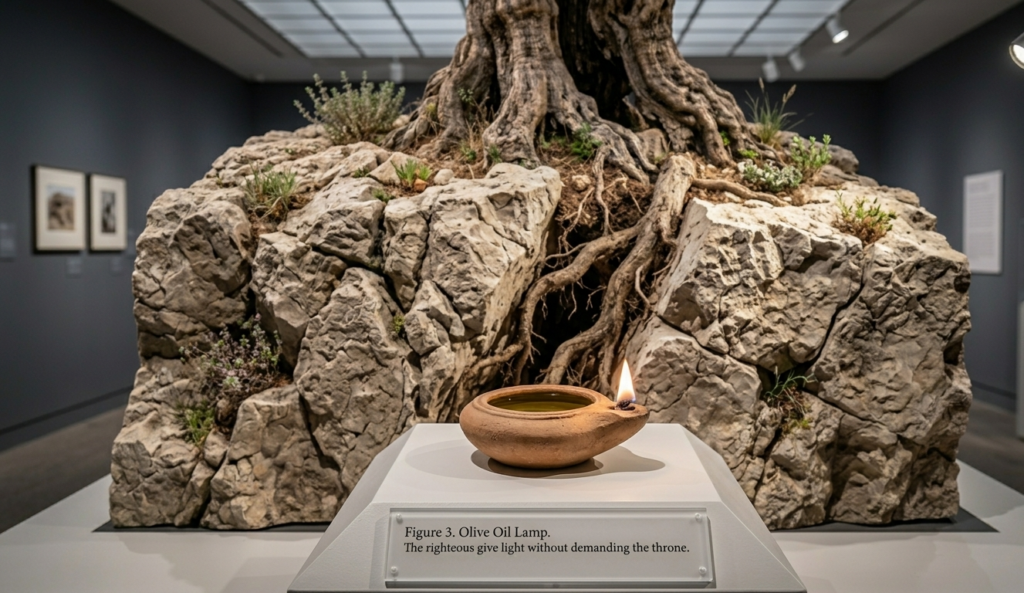
Figure 3. Olive Oil Lamp. A museum photograph of a simple terracotta oil lamp, filled with olive oil, burning with a small, steady flame. The caption reads: “The righteous give light without demanding the throne.”
The olive tree understood that its highest calling was not power or status, but fruitfulness and service. It refused to abandon its God-given purpose—producing oil that honors both God and humanity—for the empty honor of ruling over other trees. This is the righteousness of knowing one’s calling and staying in it.
Reflection
The olive tree invites every visitor to this museum to ask a searching question: Am I willing to be crushed so that others may have light and healing?
In a world that celebrates speed, youth, and immediate results, the olive tree stands as a patient rebuke. It does not apologize for taking 40 years to bear significant fruit. It does not complain about the rocky soil. It does not resist the pruner’s knife or the press’s weight. Instead, it simply remains—rooted, faithful, generative—and in remaining, it becomes a source of light, healing, and peace for generations.
Consider your own life:
1. Are you rooted deeply enough?
- An olive tree with shallow roots cannot survive a drought. Have you invested time in the invisible, underground work of prayer, study, and community—or do you demand visible results immediately?
- Example: Refusing to do the slow, hidden work of spiritual formation because it produces no “quick fruit.”
2. Are you willing to be pruned?
- Pruning hurts. It removes branches that seem healthy. But without pruning, the tree becomes wild and unfruitful. Have you accepted God’s pruning in your life—or do you fight every removal of comfort, status, or control?
- Example: Resisting a season of loss or reduction, not realizing that the pruning is preparation for greater fruitfulness.
3. Are you willing to be pressed?
- The olive gives its oil only under pressure. Have you allowed your trials to produce healing and light for others—or have you become bitter under pressure?
- Example: Using your suffering as an excuse for selfishness rather than as a source of compassion for others.
4. Do you know your calling?
- The olive tree refused to be king of the trees. It knew its purpose was to produce oil, not to rule. Have you abandoned your true calling—faithful fruitfulness in obscurity—to chase status, recognition, or power?
- Example: Leaving a place of quiet, effective service for a “promotion” that removes you from your gift and calling.
As you look upon this olive tree, ask yourself:
- Where am I rooted? (Am I planted in the house of the Lord, or in the soil of worldly approval?)
- What pruning have I been resisting? (What comfort, relationship, or ambition is God asking me to release?)
- What pressure am I feeling? (Is this trial crushing me—or crushing oil out of me?)
- And crucially: For whom am I producing light and healing? (Is my life making others see God and find wholeness?)
The olive tree does not produce its best fruit in the first season. It produces its best fruit after centuries. The oil from the oldest trees is the most precious. The light from the most pressed olives is the purest.
May all who visit the WiseRighteous Nature Hall look upon the ancient olive tree and remember: true righteousness is not found in speed, status, or immediate results. It is found in deep rooting, patient endurance, willing pruning, and—when the press comes—the faithful flow of oil that lights the world and heals the wounded.
“The righteous will flourish like the olive tree. They will still bear fruit in old age; they will stay fresh and green.” — Psalm 92:12-14 (NIV, paraphrased)
References
- Goor, A., & Nurock, M. (2021). The Fruits of the Holy Land: A Botanical and Historical Study. Israel Exploration Society.
- Mazar, E. (2019). Biblical Plants in Archaeological Context. Magnes Press.
- Reyburn, W. D., & Fry, E. M. (2000). A Handbook on Proverbs. United Bible Societies.
Disclaimer:
This website is an independent digital museum. All product names, trademarks, and brands are the property of their respective owners and are used for identification and educational purposes only. No affiliation or endorsement is implied.