
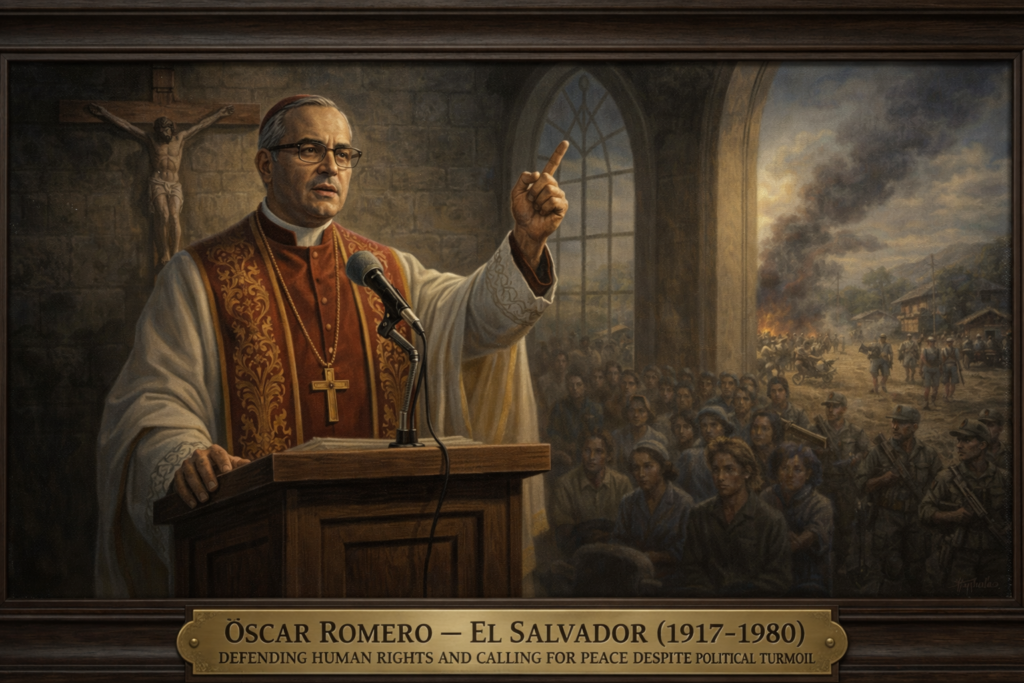
Óscar Romero — El Salvador (1917–1980)
Óscar Romero was a Catholic archbishop, human rights advocate, and moral leader who became internationally known for speaking out against political violence, social injustice, and human rights abuses in El Salvador. Through his sermons, public statements, and pastoral leadership, he defended the rights of the poor and called for an end to violence during a time of deep political conflict.
As the Archbishop of San Salvador, Romero used his position to denounce oppression and urge both the government and armed groups to respect human dignity. His commitment to justice and truth ultimately made him a powerful voice for those who had no political power.
Today, he is remembered as a symbol of moral courage, defense of human rights, and faithful leadership in times of crisis.
Historical Context
During the 1970s, El Salvador faced severe political instability and social inequality. A small elite controlled much of the country’s wealth, while large portions of the population lived in poverty.
Political tensions increased as labor groups, farmers, and social organizations demanded reforms. In response, government forces and paramilitary groups often used violence to suppress dissent.
Human rights violations, including arrests, disappearances, and killings of political activists, became increasingly common. These conditions contributed to rising conflict that eventually led to the Salvadoran Civil War.
Within this environment, Óscar Romero emerged as one of the most influential religious leaders advocating for justice and peace.
Civic Virtue and Leadership
Óscar Romero served as the Archbishop of San Salvador beginning in 1977.
Initially considered a cautious church leader, Romero’s perspective changed after witnessing violence against priests and community members who worked with the poor.
Through weekly sermons broadcast on national radio, he spoke directly to the people of El Salvador, condemning human rights abuses and urging the government to respect the dignity of every person.
Romero believed that religious leadership required defending those who suffered injustice. He consistently emphasized that faith should inspire compassion, justice, and protection of the vulnerable.
His words provided hope and encouragement to many citizens who feared speaking publicly about the violence occurring in their country.
Righteous Act: Speaking Against Political Violence
One of Romero’s most courageous actions occurred during the final months of his life when he openly condemned violence carried out by government security forces.
In a widely known sermon in 1980, he directly addressed members of the military and urged them to refuse orders that violated moral and humanitarian principles.
Romero appealed to their conscience, reminding them that no government authority justified killing innocent people.
By publicly challenging the violence of powerful institutions, Romero demonstrated extraordinary moral conviction and commitment to human dignity.
His message emphasized that peace and justice could only be achieved through respect for human rights and ethical responsibility.
Challenges and Adversity
Romero’s outspoken criticism of violence made him a controversial figure among political leaders and powerful elites.
He received frequent threats and warnings that his life was in danger. Despite these risks, he continued speaking publicly about the suffering of the Salvadoran people.
On March 24, 1980, while celebrating Mass in a chapel in San Salvador, Romero was assassinated by a gunman linked to extremist political forces.
His death shocked the nation and the international community, drawing attention to the severe human rights crisis in El Salvador.
Legacy
Óscar Romero is remembered as one of the most important religious defenders of human rights and social justice in Latin America.
His life and death became a powerful symbol of resistance to oppression and advocacy for the poor.
In recognition of his moral courage and religious witness, the Roman Catholic Church later declared him a martyr.
In 2018, he was canonized as a saint by Pope Francis.
Today, Óscar Romero’s legacy continues to inspire movements for justice, peace, and human dignity around the world.
References
Brockman, J. R. (2015). Oscar Romero: Love must win out. Orbis Books.
Peterson, A. (1997). Martyrdom and the politics of religion: Progressive Catholicism in El Salvador’s civil war. SUNY Press.
Wood, E. J. (2003). Insurgent collective action and civil war in El Salvador. Cambridge University Press.
Sobrino, J. (1990). Archbishop Romero: Memories and reflections. Orbis Books.