
Oskar Schindler — Germany (1908–1974)
Oskar Schindler was a German industrialist who became known for saving the lives of more than a thousand Jewish refugees during the Holocaust. Although initially motivated by business opportunities during the war, Schindler gradually used his influence, resources, and personal courage to protect Jewish workers from persecution and death under the Nazi regime.
Through his factory operations and strategic negotiations with Nazi authorities, Schindler provided employment and protection to Jewish workers who otherwise faced deportation to concentration camps. His actions ultimately saved approximately 1,200 lives, making him one of the most recognized rescuers during the Holocaust.
Today, Schindler is remembered as a powerful example of moral transformation, compassion, and courage during one of the darkest periods in modern history.
Historical Context
During the Second World War, Nazi Germany carried out a systematic campaign of persecution and extermination against Jewish communities across Europe. This campaign, known as the Holocaust, resulted in the murder of approximately six million Jews.
Following the German occupation of Poland in 1939, Jewish populations were confined to ghettos, stripped of civil rights, and subjected to forced labor. Many were eventually deported to extermination camps where mass killings were carried out.
Within this brutal system, a small number of individuals attempted to help persecuted Jews by providing shelter, protection, or escape.
Oskar Schindler, a businessman operating factories in occupied Poland, eventually became one of the most notable individuals who used his position to save lives.
Civic Virtue and Leadership
Oskar Schindler was originally a member of the Nazi Party and arrived in occupied Poland seeking economic opportunities through wartime industry. He acquired a factory in Kraków, where he manufactured enamelware and later military supplies.
At first, Schindler employed Jewish workers primarily because they were a source of inexpensive labor. However, as he witnessed the brutal persecution and systematic violence inflicted upon Jewish communities, his attitude began to change.
Schindler developed relationships with his workers and became increasingly determined to protect them from deportation and death. Using his wealth, charm, and political connections, he began negotiating with Nazi officials to keep his workers classified as essential industrial laborers.
His actions demonstrated a growing commitment to human compassion, moral responsibility, and the protection of innocent lives.
Righteous Act: Saving Jewish Workers
Oskar Schindler’s most significant contribution was his effort to protect Jewish workers from deportation to Nazi concentration camps.
As the Nazi regime intensified the deportation of Jews to extermination camps, Schindler began taking extraordinary steps to shield his employees. He bribed officials, falsified production records, and argued that his workers were necessary for the German war effort.
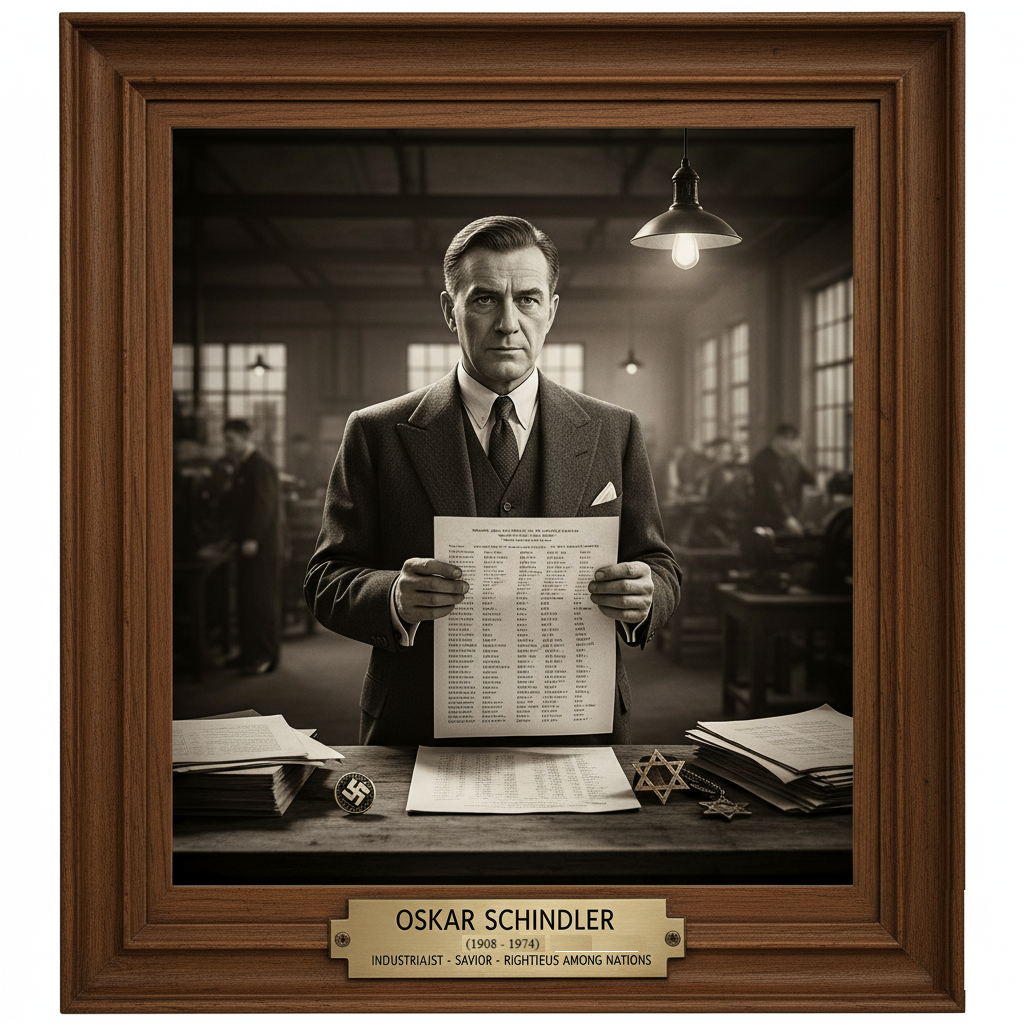
In 1944, when the Kraków labor camps were scheduled for liquidation, Schindler arranged to relocate his factory to Brünnlitz (in present-day Czech Republic). To do this, he created a list of Jewish workers who would be transferred to the new factory.
This document, later known as “Schindler’s List,” included more than 1,000 Jewish men and women whose lives were spared from deportation to extermination camps.
By protecting these workers within his factory, Schindler ensured their survival until the end of the war in 1945.
Challenges and Adversity
Schindler’s efforts to protect Jewish workers required constant negotiation with Nazi authorities and involved significant personal risk. His actions could have been interpreted as defiance of Nazi policy, which could lead to severe punishment.
To maintain the safety of his workers, Schindler spent most of his personal wealth bribing military officials, camp administrators, and government authorities.
He was also arrested multiple times by the Gestapo, the Nazi secret police, on suspicion of illegal activities related to protecting Jewish workers.
Despite these dangers, Schindler continued his efforts, prioritizing the safety and survival of those under his protection over his own financial security.
Legacy
Oskar Schindler is remembered as one of the most remarkable rescuers during the Holocaust.
After the war, many of the people he saved—often referred to as “Schindlerjuden” (Schindler’s Jews)—remained deeply grateful for his actions and helped preserve the memory of his courage.
In 1963, Schindler was honored as Righteous Among the Nations by Yad Vashem, a recognition given to non-Jews who risked their lives to save Jews during the Holocaust.
His story later gained international recognition through the book Schindler’s Ark and the award-winning film Schindler’s List directed by Steven Spielberg.
Today, Oskar Schindler’s life stands as a powerful reminder that individual courage and compassion can make a profound difference even during times of widespread injustice and violence.
References
Crowe, D. M. (2004). Oskar Schindler: The untold account of his life, wartime activities, and the true story behind the list. Westview Press.
Keneally, T. (2007). Schindler’s ark. Scribner.
Steinhouse, F. (1994). Schindler’s list: The making of a film and the real story behind it. Carol Publishing.
United States Holocaust Memorial Museum. (2020). Oskar Schindler and the rescue of Jews during the Holocaust. USHMM.