
Qu Yuan (屈原) — China (340 BCE – 278 BCE)
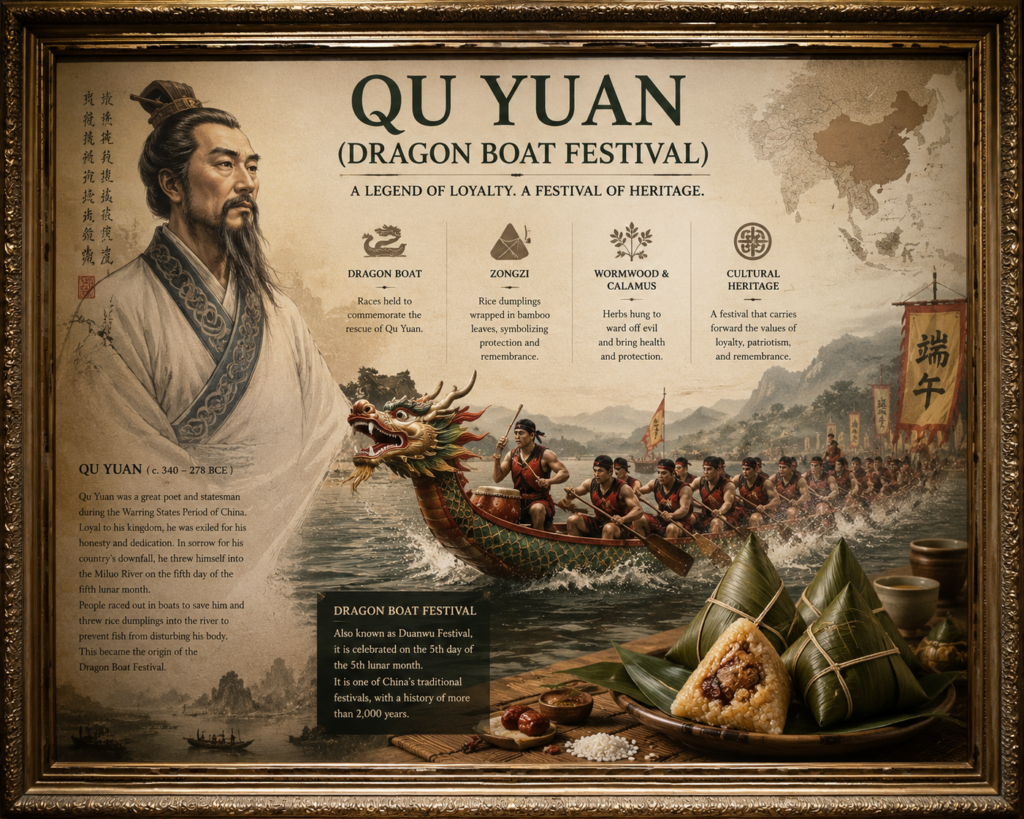
Figure 1. Dragon Boat Festival: The Legacy of Qu Yuan
Qu Yuan’s Place in the Moral Tradition of Chinese Righteousness
Qu Yuan occupies a singular position in the moral tradition of Chinese righteousness, standing as one of the earliest and most enduring embodiments of loyalty, integrity, and moral courage in Chinese cultural memory. While many figures in Chinese history are celebrated for their contributions to governance, warfare, or scholarship, Qu Yuan is remembered primarily for his ethical stance—a stance so uncompromising that it ultimately cost him his life. His legacy has shaped Chinese understandings of righteousness for more than two millennia, influencing literature, political thought, and cultural rituals such as the Dragon Boat Festival.
In the classical Chinese worldview, righteousness was closely tied to moral integrity, public duty, and loyalty to the state (Yao, 2010). Qu Yuan exemplified these ideals through his unwavering commitment to the State of Chu, even as political corruption and factionalism threatened its stability. His refusal to compromise with corrupt ministers and his insistence on speaking truth to power placed him within the Confucian lineage of moral exemplars, despite predating the full institutionalization of Confucian ethics (Loewe & Shaughnessy, 1999).
What distinguishes Qu Yuan from other historical figures is the literary articulation of his righteousness. Through works such as Li Sao and Tian Wen, he transformed personal suffering and political frustration into a moral and poetic vision. His writings reveal a profound commitment to inner purity, ethical self‑cultivation, and the pursuit of cosmic justice, elevating righteousness from a political virtue to a spiritual and philosophical ideal (Hawkes, 2011). This literary dimension allows Qu Yuan’s righteousness to transcend his historical moment, making him not only a political martyr but also a cultural symbol of moral integrity.
Over centuries, Qu Yuan’s image has been continually reinterpreted. During the Han dynasty, he was celebrated as a loyal minister; in the Song dynasty, he became a model for scholar‑officials resisting corruption; and in modern times, he is often invoked as a symbol of national integrity and cultural identity (Wang, 2016). This evolving reception underscores his unique role in shaping the Chinese conception of righteousness as both steadfast loyalty and ethical resistance.
In the broader moral tradition of China, Qu Yuan stands alongside figures such as Confucius, Mencius, and later loyalists like Wen Tianxiang. Yet his contribution is distinct: he embodies a righteousness that is emotional, literary, and existential, expressed not only through action but through poetic self‑reflection and philosophical questioning. His life and works continue to inspire discussions about the nature of moral integrity, the cost of ethical commitment, and the meaning of righteousness in times of political turmoil.
Historical Context: The Warring States and the Crisis of Righteousness
The world into which Qu Yuan was born was one of profound instability, political fragmentation, and moral uncertainty. The Warring States period (c. 475–221 BCE) marked the final centuries of the Zhou dynasty, a time when the traditional ritual‑moral order (禮) had collapsed and competing states struggled for dominance. In this environment, the meaning of righteousness (義)—once grounded in inherited norms and hierarchical harmony—became contested, reinterpreted, and often overshadowed by realpolitik and strategic calculation (Lewis, 1999).
The State of Chu, where Qu Yuan served, was a major cultural and military power, yet internally weakened by court factionalism, corruption, and ideological conflict. Ministers competed for influence, alliances shifted rapidly, and rulers often favored expedient counsel over principled governance. This environment created what scholars describe as a “crisis of righteousness”, in which moral integrity was increasingly difficult to uphold (Pines, 2018). It was precisely within this moral vacuum that Qu Yuan’s unwavering commitment to loyalty, integrity, and ethical remonstration became both exceptional and dangerous.
The Warring States period also witnessed the flourishing of the Hundred Schools of Thought, including Confucianism, Mohism, Daoism, and Legalism. Each school proposed different visions of virtue, governance, and human nature, reflecting the era’s intellectual dynamism and moral anxiety. Confucian thinkers emphasized benevolence (仁) and righteousness (義); Mohists advocated universal love and meritocracy; Legalists promoted strict law and state power (Loewe & Shaughnessy, 1999). Qu Yuan’s thought and poetry reflect this intellectual milieu, yet his moral stance aligns most closely with the Confucian ideal of the loyal minister who speaks truth to power, even at personal cost.
To illustrate the moral landscape of Qu Yuan’s time, the following table summarizes the competing values that shaped the political and ethical environment of the Warring States period.
Table 1. Competing Moral Forces in the Warring States Period
| Moral Force | Description | Impact on Righteousness |
|---|---|---|
| Realpolitik | Power, strategy, and military advantage prioritized over ethics | Undermined moral governance; rewarded expediency |
| Court Factionalism | Rival ministers competing for influence | Encouraged corruption and slander; punished integrity |
| Confucian Ethics | Emphasis on virtue, loyalty, and righteousness | Provided a moral ideal but difficult to practice |
| Legalist Policies | Strict laws, centralized power, efficiency | Prioritized state survival over moral principles |
| Cultural Ritual Decline | Breakdown of Zhou ritual order | Created moral ambiguity and instability |
In this turbulent context, Qu Yuan’s steadfast adherence to ethical loyalty, moral purity, and principled remonstration stood in stark contrast to the prevailing political culture. His refusal to compromise with corrupt officials and his insistence on righteous governance made him both a moral exemplar and a political threat. Ultimately, the crisis of righteousness in the Warring States period not only shaped Qu Yuan’s fate but also amplified the moral significance of his life and writings.
Qu Yuan’s righteousness must therefore be understood not merely as personal virtue but as a countercultural act of resistance against a world where moral values were collapsing. His life becomes a lens through which the ethical tensions of the Warring States period are vividly illuminated.
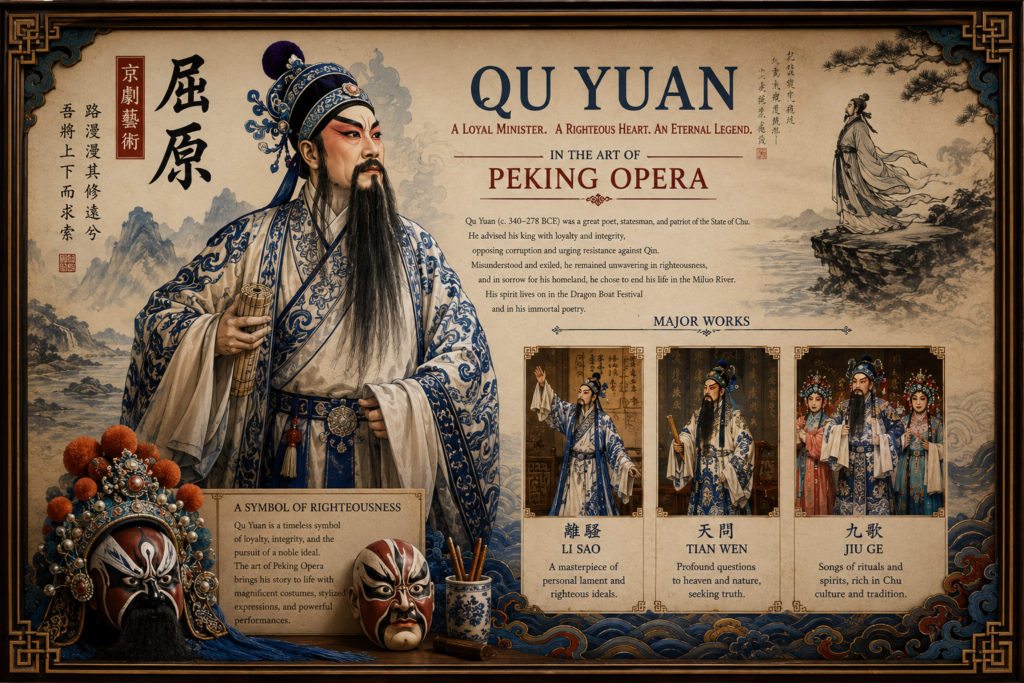
Figure 2. Qu Yuan: Loyalty and Righteousness in Peking Opera
Life Journey and Character of Qu Yuan
Qu Yuan’s life journey unfolds against the dramatic backdrop of the Warring States period, a time of political upheaval and moral uncertainty. Born around 340 BCE in the State of Chu, Qu Yuan rose to prominence as a statesman, poet, and moral thinker, serving King Huai of Chu as a trusted advisor. His early career was marked by political promise: he advocated for reform, diplomatic clarity, and ethical governance, aligning closely with the Confucian ideal of the virtuous minister (Loewe & Shaughnessy, 1999). Yet his integrity placed him in direct conflict with corrupt factions at court, leading to his eventual exile, a defining moment that shaped both his literary output and his moral legacy.
During exile, Qu Yuan transformed personal suffering into profound literary expression. Works such as Li Sao and Tian Wen reveal a character defined by inner purity, emotional depth, and unwavering righteousness. His poetry reflects a man who refused to compromise with corruption, choosing instead to cultivate a moral identity rooted in loyalty, self‑reflection, and ethical resistance (Hawkes, 2011). This combination of political commitment and poetic introspection makes Qu Yuan unique among ancient Chinese figures: he is both a public servant and a moral philosopher, both a patriot and a poet‑sage.
Qu Yuan’s character is often described through three interlocking virtues: loyalty, integrity, and moral courage. His loyalty to the State of Chu was not blind allegiance but a principled devotion to the well‑being of the people and the ethical governance of the state. His integrity was expressed through his refusal to participate in corrupt political practices, even when such refusal resulted in personal loss. His moral courage culminated in his final act—ending his life in the Miluo River—a symbolic gesture that has been interpreted as the ultimate expression of righteous protest against a world that had abandoned virtue (Wang, 2016).
To better understand the complexity of Qu Yuan’s character, the following table summarizes the major phases of his life and the moral qualities associated with each stage.
Table 2. Major Phases of Qu Yuan’s Life and Associated Moral Qualities
| Life Phase | Description | Dominant Moral Qualities |
|---|---|---|
| Early Career | Rising statesman serving King Huai of Chu | Loyalty, idealism, political vision |
| Political Conflict | Opposition from corrupt ministers; loss of influence | Integrity, courage, truth‑telling |
| Exile | Withdrawal from court; composition of major works | Self‑reflection, inner purity, moral resilience |
| Final Years | Witnessing Chu’s decline; despair over corruption | Righteous grief, patriotism, ethical steadfastness |
| Death | Suicide in the Miluo River | Ultimate moral protest, sacrifice, uncompromising righteousness |
Qu Yuan’s life journey reveals a character shaped not by political success but by moral conviction. His story illustrates the cost of righteousness in a world dominated by power struggles and corruption. Yet it also demonstrates the enduring strength of a person who chooses ethical integrity over personal gain. For this reason, Qu Yuan remains one of the most revered figures in the Chinese moral imagination, a symbol of righteousness lived with passion, purity, and unwavering resolve.
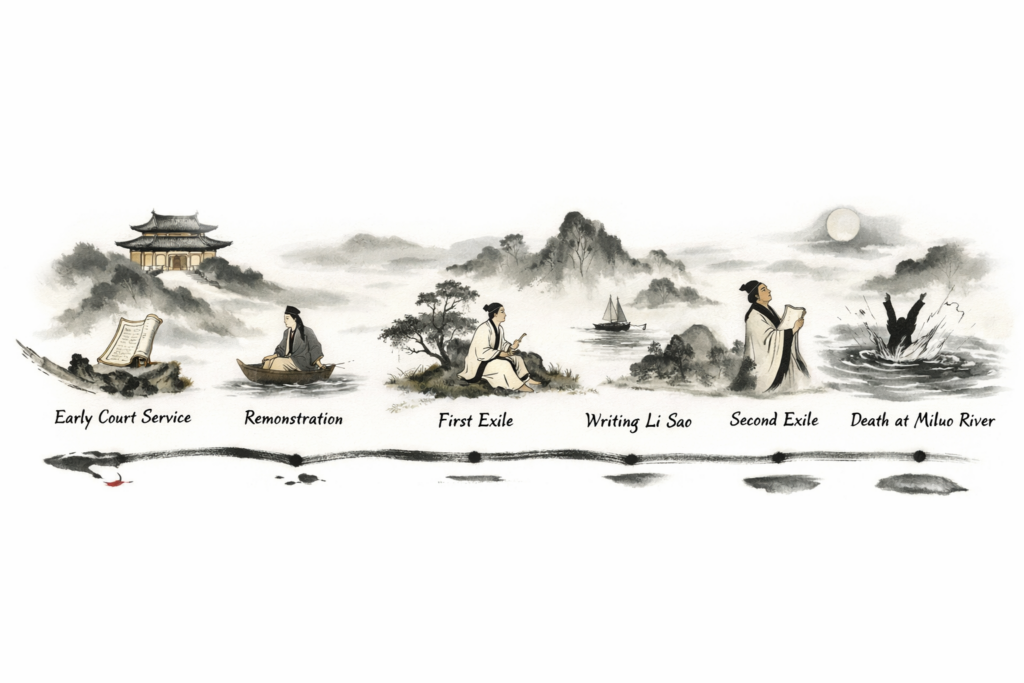
Figure 3. Timeline of Qu Yuan’s Life
Qu Yuan’s Righteousness: Loyalty, Integrity, and Moral Courage
Qu Yuan’s righteousness is best understood as a dynamic interplay of loyalty, integrity, and moral courage, expressed through both his political actions and his literary works. In the moral imagination of China, he stands as a rare figure whose righteousness was not merely professed but embodied, even at the cost of personal suffering and death. His life demonstrates how righteousness can function as both a political stance and a spiritual discipline, shaping identity, action, and legacy.
At the core of Qu Yuan’s righteousness is loyalty—not blind obedience, but a principled devotion to the State of Chu and its people. His loyalty was grounded in a belief that rulers must govern with virtue, clarity, and justice, aligning with the Confucian ideal of the loyal minister who remonstrates when the ruler errs (Yao, 2010). When corrupt factions gained influence and undermined the state’s moral foundation, Qu Yuan refused to compromise. His loyalty thus became a form of ethical resistance, demonstrating that true allegiance requires the courage to oppose wrongdoing for the sake of the greater good (Pines, 2018).
Equally central to his righteousness is integrity, expressed through his unwavering commitment to inner purity and moral self‑cultivation. In Li Sao, Qu Yuan repeatedly emphasizes the importance of maintaining a pure heart, symbolized through imagery of fragrant herbs and unblemished garments (Hawkes, 2011). This literary symbolism reflects a deeper ethical conviction: righteousness begins within the self. Even in exile, he continued to refine his moral identity, refusing to adopt the pragmatic, opportunistic behaviors that dominated the political culture of his time. His integrity was thus both a personal discipline and a public testimony.
Qu Yuan’s righteousness culminates in moral courage, the willingness to act on principle despite danger, isolation, or despair. His final act—ending his life in the Miluo River—has long been interpreted as a righteous protest against a world that had abandoned virtue (Wang, 2016). While modern scholars debate the historical motivations behind his death, its symbolic meaning remains clear: Qu Yuan chose honor over survival, principle over compromise, and truth over silence. His courage transformed him from a political figure into a moral exemplar, inspiring generations to uphold righteousness even in the face of overwhelming adversity.
To illustrate the multidimensional nature of Qu Yuan’s righteousness, the following table summarizes its three core components and their expressions in his life and works.
Table 3. Core Components of Qu Yuan’s Righteousness
| Component | Description | Expression in Qu Yuan’s Life and Works |
|---|---|---|
| Loyalty | Principled devotion to state and people | Remonstration, reform advocacy, patriotic grief |
| Integrity | Inner purity and moral self‑cultivation | Symbolism in Li Sao, rejection of corruption |
| Moral Courage | Acting on principle despite danger | Exile, poetic protest, sacrificial death |
Qu Yuan’s righteousness is therefore not a single virtue but a moral constellation, integrating political commitment, personal purity, and courageous action. His life demonstrates that righteousness is not merely a moral ideal but a lived reality, shaped through struggle, suffering, and unwavering conviction. For this reason, Qu Yuan remains one of the most powerful embodiments of righteousness in Chinese cultural history, a figure whose moral legacy continues to inspire reflections on ethical leadership, public virtue, and the cost of integrity.
Righteousness in Li Sao: Inner Purity and Self‑Cultivation
Among all of Qu Yuan’s writings, Li Sao stands as the most profound expression of his inner righteousness, revealing a moral vision rooted in purity, self‑cultivation, and ethical steadfastness. Unlike political treatises or historical chronicles, Li Sao is a deeply personal and symbolic poem in which Qu Yuan articulates his moral identity through rich imagery, emotional introspection, and spiritual aspiration. It is in this work that his righteousness becomes not merely a political stance but a spiritual discipline, cultivated through the refinement of the self (Hawkes, 2011).
At the heart of Li Sao is the theme of inner purity. Qu Yuan repeatedly uses metaphors of fragrant herbs, beautiful garments, and unblemished jade to symbolize his commitment to moral cleanliness. These images reflect the classical Chinese belief that righteousness begins within the heart and must be preserved through constant vigilance and self‑examination (Yao, 2010). In this sense, Li Sao becomes a poetic manual of ethical self‑cultivation, aligning with the Confucian ideal that virtue must be nurtured through disciplined introspection and moral clarity.
The poem also reveals Qu Yuan’s profound sense of moral isolation. Surrounded by corrupt ministers and political intrigue, he describes himself as a solitary figure wandering through a world that has abandoned virtue. Yet this isolation does not lead him to compromise; instead, it strengthens his resolve to maintain moral integrity. His refusal to conform to the corrupt norms of the court demonstrates a righteousness that is both countercultural and courageous, grounded in the conviction that personal purity is more valuable than political success (Pines, 2018).
Furthermore, Li Sao presents righteousness as a spiritual journey. Qu Yuan’s imaginative travels through mythic landscapes symbolize his search for a world where virtue is honored and truth is recognized. This journey reflects a longing for cosmic harmony, suggesting that righteousness is not only a personal virtue but also a universal ideal embedded in the structure of the cosmos. His quest anticipates the philosophical questions he later raises in Tian Wen, linking personal purity with the broader pursuit of cosmic justice (Wang, 2016).
To clarify the dimensions of righteousness expressed in Li Sao, the following table summarizes its major themes and their ethical significance.
Table 4. Major Themes of Righteousness in Li Sao
| Theme | Description | Ethical Significance |
|---|---|---|
| Inner Purity | Symbolized through fragrant herbs and pure garments | Righteousness begins with moral cleanliness and sincerity |
| Self‑Cultivation | Continuous introspection and refinement of character | Virtue must be actively nurtured and protected |
| Moral Isolation | Standing alone against corruption | Integrity requires resisting social pressure and compromise |
| Spiritual Quest | Journey through mythic realms | Righteousness is connected to cosmic order and universal truth |
In Li Sao, righteousness emerges as a deeply personal, spiritual, and aesthetic ideal. Qu Yuan’s poetic voice reveals a man who refuses to surrender his moral identity, even when confronted with betrayal, exile, and despair. His commitment to inner purity and self‑cultivation elevates righteousness from a political virtue to a spiritual calling, making Li Sao one of the most influential moral texts in the Chinese literary tradition.
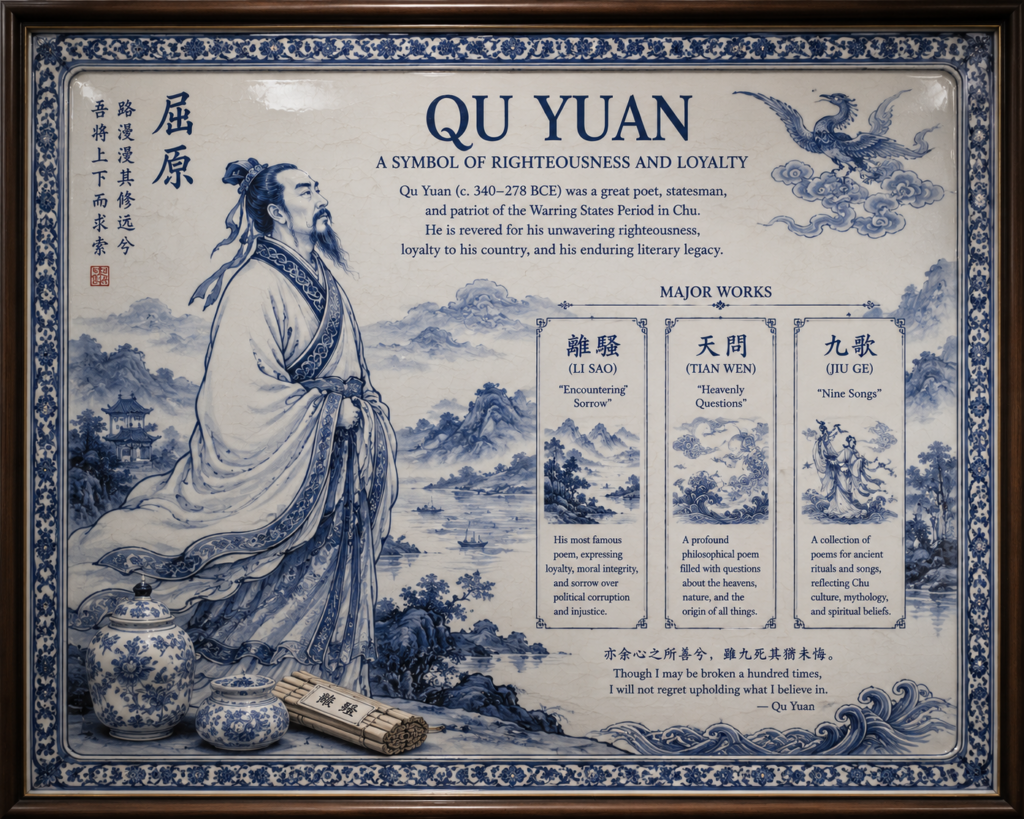
Figure 4. Qu Yuan in Porcelain: Poet of Loyalty and Righteousness
Righteousness in Tian Wen: Questioning Heaven and Seeking Cosmic Justice
Tian Wen (“Heavenly Questions”) is one of the most intellectually daring works in early Chinese literature. In this poem, Qu Yuan expresses a form of righteousness that transcends political loyalty and personal integrity, reaching into the realm of cosmic justice, moral inquiry, and philosophical courage. Unlike Li Sao, which focuses on inner purity and self‑cultivation, Tian Wen confronts the universe itself, asking whether the world is governed by justice, order, and moral coherence (Hawkes, 2011). Through 172 rapid‑fire questions, Qu Yuan challenges mythological narratives, historical events, and divine actions, revealing a righteousness grounded in the pursuit of truth.
At the heart of Tian Wen is the bold act of questioning Heaven. In traditional Chinese thought, “Heaven” (天) symbolizes cosmic authority, moral order, and the ultimate source of legitimacy. To question Heaven is therefore to question the foundations of moral reality. Qu Yuan’s inquiries—Why do the innocent suffer? Why do the wicked prosper? Why is the world filled with contradictions?—reflect a profound dissatisfaction with the moral disorder he witnessed in the State of Chu (Pines, 2018). His righteousness is expressed not through obedience but through moral interrogation, a refusal to accept injustice as natural or inevitable.
This questioning is not rebellious for its own sake. Rather, it reflects a deep commitment to cosmic justice. Qu Yuan seeks to understand whether the universe is governed by principles that align with ethical truth. His questions expose the tension between mythological ideals and human experience, suggesting that righteousness requires not only personal virtue but also a critical engagement with the moral structure of the cosmos (Wang, 2016). In this way, Tian Wen anticipates later philosophical traditions that link righteousness with rational inquiry and moral reasoning.
Furthermore, Tian Wen demonstrates a unique form of intellectual courage. In a culture that revered Heaven as the ultimate authority, Qu Yuan dared to ask whether Heaven itself was just. This courage reflects a righteousness that is philosophical, existential, and uncompromising. It positions Qu Yuan not merely as a loyal minister or moral poet but as one of the earliest Chinese thinkers to articulate a critical moral consciousness—a willingness to confront the universe with difficult questions in the pursuit of truth.
To clarify the dimensions of righteousness expressed in Tian Wen, the following table summarizes its major ethical themes and their significance.
Table 5. Major Themes of Righteousness in Tian Wen
| Theme | Description | Ethical Significance |
|---|---|---|
| Questioning Heaven | Challenging divine authority and cosmic order | Righteousness requires moral inquiry, not blind acceptance |
| Cosmic Justice | Seeking fairness in myth, history, and nature | Righteousness extends beyond politics to universal truth |
| Moral Contradictions | Highlighting inconsistencies in divine and human actions | Ethical clarity emerges through confronting paradox |
| Intellectual Courage | Daring to ask forbidden questions | Righteousness includes the bravery to pursue truth |
In Tian Wen, righteousness becomes a philosophical quest, a search for coherence between human morality and cosmic order. Qu Yuan’s willingness to interrogate Heaven reveals a righteousness that is restless, critical, and profoundly ethical. His questions do not provide answers, but they illuminate the moral tensions of his age and challenge readers to consider the deeper foundations of justice. Through this work, Qu Yuan elevates righteousness from a personal virtue to a universal inquiry, making Tian Wen one of the most significant moral texts in the Chinese tradition.
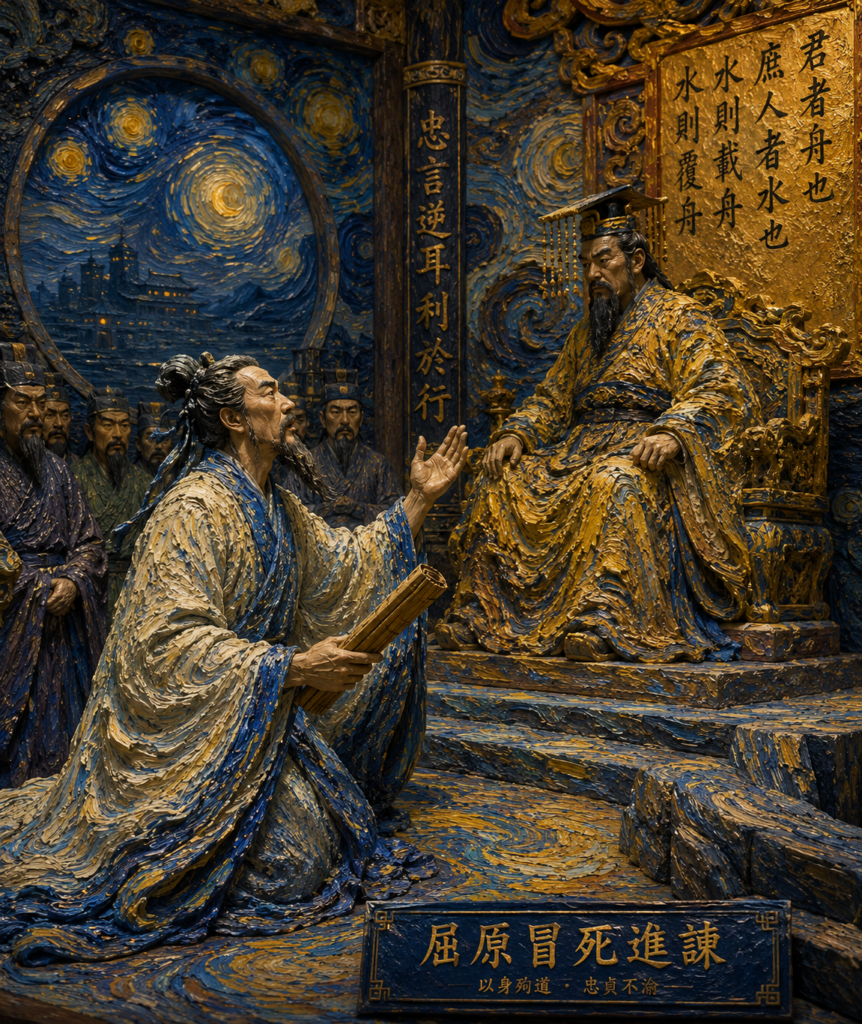
Figure 5. Qu Yuan Before the Throne: Loyalty in Van Gogh Style
Righteous Action: Remonstration, Exile, and Death for Principle
Qu Yuan’s righteousness was not confined to poetic expression or philosophical reflection; it was embodied in action. His life demonstrates how righteousness becomes visible through remonstration, endurance in exile, and ultimately death for principle. These actions reveal a moral courage that transcends personal interest and aligns with the highest ideals of Chinese ethical tradition.
The first major expression of Qu Yuan’s righteous action was his remonstration—the Confucian duty of advising the ruler with honesty and moral clarity. As a high minister in the State of Chu, Qu Yuan urged King Huai to pursue ethical governance, resist corrupt influences, and strengthen diplomatic alliances (Loewe & Shaughnessy, 1999). His remonstrations were grounded in loyalty and public virtue, not personal ambition. Yet his moral clarity threatened powerful factions at court, who accused him of disloyalty and maneuvered to remove him from influence. In this moment, Qu Yuan’s righteousness took the form of speaking truth to power, even when such truth was unwelcome.
When slander and political intrigue forced him into exile, Qu Yuan’s righteousness entered a new phase. Exile was not merely a physical displacement but a moral trial. Removed from political life, he faced the temptation to abandon his ideals or retreat into silence. Instead, he transformed exile into a space for ethical reflection and poetic protest. Works such as Li Sao and Tian Wen reveal a man who refused to compromise with corruption, choosing instead to cultivate inner purity and articulate a vision of righteousness that challenged the moral failures of his age (Hawkes, 2011). Exile thus became a crucible in which his righteousness was refined and strengthened.
Qu Yuan’s final act—his death for principle—stands as one of the most powerful symbols of righteousness in Chinese cultural memory. When the State of Chu fell into deeper corruption and military decline, Qu Yuan, overwhelmed by grief for his homeland, cast himself into the Miluo River. While scholars debate the historical motivations behind this act, its symbolic meaning is unmistakable: Qu Yuan chose honor over survival, principle over compromise, and truth over silence (Wang, 2016). His death became a moral protest against a world that had abandoned virtue, transforming him into a martyr of righteousness.
To clarify the ethical dimensions of Qu Yuan’s actions, the following table summarizes the three major forms of righteous action in his life and their moral significance.
Table 6. Forms of Righteous Action in the Life of Qu Yuan
| Righteous Action | Description | Ethical Significance |
|---|---|---|
| Remonstration | Advising the ruler with honesty and moral clarity | Demonstrates loyalty, integrity, and commitment to public virtue |
| Exile | Enduring political banishment without compromising principles | Reveals inner purity, resilience, and moral steadfastness |
| Death for Principle | Sacrificial suicide in protest of corruption and national decline | Embodies ultimate moral courage and uncompromising righteousness |
Qu Yuan’s righteous actions reveal a life shaped by ethical conviction, moral courage, and unwavering loyalty. His remonstration shows righteousness in political engagement; his exile shows righteousness in suffering; and his death shows righteousness in ultimate sacrifice. Together, these actions form a moral narrative that has inspired Chinese culture for over two millennia, establishing Qu Yuan as one of the most enduring symbols of righteous action in world history.
Righteousness Innovation: From Political Loyalty to Spiritual Civilization
Qu Yuan’s contribution to the Chinese moral tradition is not limited to his embodiment of loyalty, integrity, and moral courage. His most enduring legacy lies in his innovation of righteousness—a transformation that elevated righteousness from a political virtue into a spiritual, literary, and civilizational ideal. Through his life and writings, Qu Yuan redefined what it meant to be righteous in a world where traditional values were collapsing. His innovation can be understood as a movement from political loyalty to spiritual civilization, a shift that reshaped Chinese ethical consciousness for centuries.
In early Chinese thought, righteousness (義) was often tied to political duty, especially the loyalty of ministers to their rulers. Qu Yuan upheld this ideal, but he also expanded it. His loyalty was not blind obedience; it was grounded in a belief that rulers must govern with virtue, justice, and moral clarity (Yao, 2010). When the court of Chu abandoned these principles, Qu Yuan refused to compromise. In doing so, he transformed righteousness from a hierarchical obligation into a moral stance rooted in universal ethical principles. This shift marks the first stage of his innovation: righteousness as principled loyalty, not mere allegiance.
The second stage of Qu Yuan’s innovation is the elevation of righteousness into a form of inner cultivation. In Li Sao, he presents righteousness as a process of self‑purification, symbolized through fragrant herbs, pure garments, and unblemished jade (Hawkes, 2011). This imagery reflects a belief that righteousness begins within the heart and must be nurtured through self‑discipline, reflection, and moral sincerity. By linking righteousness to inner purity, Qu Yuan transformed it into a spiritual practice, aligning it with the broader Chinese tradition of ethical self‑cultivation.
The third and most profound stage of his innovation appears in Tian Wen, where righteousness becomes a cosmic inquiry. By questioning Heaven, myth, and the moral structure of the universe, Qu Yuan suggests that righteousness is not merely a human virtue but a universal principle embedded in the fabric of reality (Pines, 2018). His search for cosmic justice elevates righteousness to a philosophical and metaphysical level, making it a foundation for spiritual civilization—a civilization grounded not only in political order but in moral truth.
Finally, Qu Yuan’s death completes his innovation. His suicide in the Miluo River is not simply a political protest; it is a sacrificial act that transforms righteousness into a cultural symbol. Over time, Qu Yuan became a figure of collective memory, celebrated in the Dragon Boat Festival and revered as a model of ethical steadfastness (Wang, 2016). His righteousness thus transcended his own life, becoming part of the moral fabric of Chinese civilization.
To illustrate the stages of Qu Yuan’s righteousness innovation, the following table summarizes the transformation from political loyalty to spiritual civilization.
Table 7. Stages of Qu Yuan’s Righteousness Innovation
| Stage of Innovation | Description | Civilizational Significance |
|---|---|---|
| Principled Loyalty | Loyalty grounded in virtue, not obedience | Redefines political righteousness as ethical commitment |
| Inner Purification | Righteousness as self‑cultivation and moral clarity | Establishes righteousness as a spiritual discipline |
| Cosmic Inquiry | Questioning Heaven and seeking universal justice | Elevates righteousness to a philosophical and metaphysical ideal |
| Cultural Symbolism | Death as moral protest; legacy in ritual and memory | Integrates righteousness into cultural identity and civilization |
Qu Yuan’s righteousness innovation reshaped the moral imagination of China. By expanding righteousness from political duty to spiritual civilization, he created a model of ethical life that integrates personal virtue, philosophical inquiry, and cultural meaning. His legacy demonstrates that righteousness is not static but evolving, capable of inspiring new forms of moral consciousness across generations.
Qu Yuan’s Righteousness and the Spirit of Chu Culture
Qu Yuan’s righteousness cannot be fully understood without examining the spirit of Chu culture, a distinctive regional civilization that shaped his worldview, aesthetics, and moral imagination. The State of Chu, located in the southern reaches of ancient China, possessed a cultural identity markedly different from the northern Zhou heartland. Its traditions emphasized spiritual vitality, emotional expressiveness, ritual richness, and a deep connection to nature and the divine (Loewe & Shaughnessy, 1999). These cultural characteristics provided fertile ground for Qu Yuan’s unique expression of righteousness, which blended political loyalty with spiritual depth and poetic imagination.
At the core of Chu culture was a vibrant shamanistic tradition, reflected in rituals, songs, and myths that celebrated communication between humans and the spiritual world. This tradition profoundly influenced Qu Yuan’s literary style, especially in works like Li Sao and Jiu Ge, where he employs mythic journeys, divine encounters, and cosmic symbolism to articulate his moral ideals (Hawkes, 2011). For Qu Yuan, righteousness was not merely a political virtue but a spiritual alignment with cosmic order—a belief deeply rooted in Chu’s ritual worldview.
Chu culture also valued emotional authenticity, a trait that distinguished it from the more restrained northern traditions. This cultural openness allowed Qu Yuan to express righteousness through passionate grief, moral longing, and poetic vulnerability. His emotional intensity—seen in his lamentations for the state, his sorrow in exile, and his yearning for virtue—reflects a Chu cultural ethos that embraced the full range of human feeling as a legitimate expression of moral truth (Wang, 2016). In this sense, Qu Yuan’s righteousness is inseparable from his emotional sincerity.
Another defining feature of Chu culture was its aesthetic richness, characterized by elaborate imagery, lush natural symbolism, and a fascination with beauty. Qu Yuan transformed these aesthetic elements into moral metaphors: fragrant orchids symbolized purity, beautiful garments represented integrity, and mythic landscapes embodied the search for righteousness. Through this fusion of aesthetics and ethics, Qu Yuan elevated righteousness into a poetic ideal, making moral purity not only a duty but a form of spiritual beauty (Yao, 2010).
Finally, Chu culture fostered a strong sense of regional identity and loyalty, which shaped Qu Yuan’s patriotic devotion. His grief over Chu’s decline and his unwavering commitment to its moral restoration reflect a cultural tradition that valued collective belonging and ancestral heritage. His righteousness thus becomes a reflection of Chu’s cultural spirit: loyal, emotional, spiritual, and aesthetically profound.
To illustrate how Chu culture shaped Qu Yuan’s righteousness, the following table summarizes the key cultural elements and their ethical influence.
Table 8. Cultural Foundations of Chu and Their Influence on Qu Yuan’s Righteousness
| Chu Cultural Element | Description | Influence on Qu Yuan’s Righteousness |
|---|---|---|
| Shamanistic Spirituality | Rituals, divine communication, mythic imagination | Righteousness as cosmic alignment and spiritual inquiry |
| Emotional Expressiveness | Openness to grief, longing, passion | Righteousness expressed through emotional sincerity |
| Aesthetic Richness | Lush imagery, symbolism, beauty | Righteousness as purity, beauty, and poetic ideal |
| Regional Loyalty | Strong identity and cultural pride | Righteousness as patriotic devotion and moral duty |
Qu Yuan’s righteousness is therefore inseparable from the spirit of Chu culture. His moral vision reflects the region’s spiritual depth, emotional intensity, aesthetic richness, and strong sense of identity. By embodying these cultural values, Qu Yuan transformed righteousness into a civilizational expression, making him not only a moral exemplar but also the greatest representative of Chu’s cultural soul.
The Legacy of Qu Yuan’s Righteousness: Literature, Thought, and the Dragon Boat Festival
The legacy of Qu Yuan’s righteousness extends far beyond his lifetime, shaping Chinese literature, moral philosophy, and cultural ritual for more than two millennia. His unwavering commitment to loyalty, integrity, and moral courage transformed him into a cultural icon whose influence permeates both elite intellectual traditions and popular communal practices. Through his writings, his martyr‑like death, and the rituals that commemorate him, Qu Yuan became a foundational figure in the moral imagination of Chinese civilization.
In the realm of literature, Qu Yuan’s works—especially Li Sao and Tian Wen—established a new standard for poetic expression grounded in ethical introspection and spiritual aspiration. Later poets of the Han, Tang, and Song dynasties revered him as the originator of the sao style, a genre characterized by emotional depth, symbolic richness, and moral sincerity (Hawkes, 2011). Writers such as Jia Yi, Du Fu, and Su Shi invoked Qu Yuan as a model of the righteous poet‑official, someone who uses literature to critique injustice and express loyalty to the state. His influence thus shaped the Chinese tradition of the poet as a moral voice, a role that endured for centuries.
In the sphere of thought, Qu Yuan’s righteousness contributed to the development of Chinese ethical philosophy. Confucian scholars interpreted his life as a demonstration of the loyal minister’s duty to remonstrate and uphold virtue even in the face of political danger (Yao, 2010). Neo‑Confucian thinkers later elevated him as an exemplar of moral integrity, comparing his steadfastness to the ethical ideals of sages and worthies. His willingness to question Heaven in Tian Wen also influenced philosophical discussions about cosmic justice, moral order, and the relationship between human virtue and the universe (Pines, 2018). Through these interpretations, Qu Yuan became a bridge between literary expression and moral philosophy.
Perhaps the most enduring expression of Qu Yuan’s legacy is found in the Dragon Boat Festival (端午節), a major cultural ritual celebrated annually across China and the global Chinese diaspora. According to tradition, villagers raced their boats to search for Qu Yuan’s body and threw rice dumplings (粽子) into the river to protect him from fish and evil spirits. Over time, these actions evolved into the festival’s central customs: dragon boat racing and zongzi making (Wang, 2016). The festival transforms Qu Yuan’s death into a collective act of remembrance, reinforcing values of loyalty, patriotism, and righteous protest. Through this ritual, Qu Yuan’s righteousness becomes a living cultural memory, celebrated not only in texts but in embodied communal practice.
To illustrate the breadth of Qu Yuan’s legacy, the following table summarizes his influence across literature, philosophy, and cultural ritual.
Table 9. Domains of Qu Yuan’s Legacy and Their Cultural Impact
| Domain | Description | Cultural Impact |
|---|---|---|
| Literature | Influence on poetic style, themes, and moral expression | Establishes the poet as a moral voice; inspires sao‑style poetry |
| Thought | Ethical interpretations by Confucian and Neo‑Confucian scholars | Shapes ideals of loyalty, integrity, and cosmic justice |
| Cultural Ritual | Dragon Boat Festival and related traditions | Embeds righteousness in communal memory and national identity |
Qu Yuan’s legacy demonstrates that righteousness is not merely a personal virtue but a cultural force capable of shaping civilization. Through his writings, his moral example, and the rituals that honor him, Qu Yuan continues to inspire reflections on ethical leadership, patriotic devotion, and the enduring struggle for justice. His righteousness lives on not only in books and philosophy but in the hearts, traditions, and collective identity of the Chinese people.
Modern Reflections: What Qu Yuan’s Righteousness Means Today
In the twenty‑first century, Qu Yuan’s righteousness continues to resonate as a powerful moral resource for navigating the complexities of modern life. Although he lived more than two millennia ago, his commitment to integrity, moral courage, and ethical responsibility speaks directly to contemporary concerns about political corruption, cultural identity, and the search for personal meaning. Modern readers find in Qu Yuan not only a historical figure but a moral companion, someone whose struggles illuminate the enduring human quest for righteousness.
One of the most relevant aspects of Qu Yuan’s righteousness today is his insistence on speaking truth to power. In an era when misinformation, political polarization, and institutional distrust challenge democratic societies, Qu Yuan’s remonstration offers a model of ethical communication grounded in sincerity and public virtue (Yao, 2010). His example encourages individuals to uphold truth even when doing so is unpopular or risky. This resonates strongly with contemporary movements advocating transparency, accountability, and civic responsibility.
Qu Yuan’s emphasis on inner purity also holds contemporary significance. In a world shaped by rapid technological change, consumerism, and social pressure, many people struggle to maintain a coherent moral identity. Qu Yuan’s imagery of fragrant herbs, pure garments, and unblemished jade in Li Sao symbolizes a form of ethical self‑cultivation that remains deeply relevant (Hawkes, 2011). His message suggests that righteousness begins not with external success but with the cultivation of a sincere and disciplined inner life.
Furthermore, Qu Yuan’s willingness to question Heaven in Tian Wen offers a model for modern philosophical inquiry. His bold interrogation of cosmic justice reflects a mindset that values critical thinking, intellectual courage, and the refusal to accept injustice as inevitable (Pines, 2018). In contemporary contexts—whether addressing climate change, social inequality, or global conflict—Qu Yuan’s spirit of questioning encourages individuals and societies to confront uncomfortable truths and seek deeper moral coherence.
Qu Yuan’s legacy also inspires modern reflections on cultural identity. In an increasingly globalized world, many communities grapple with the tension between tradition and modernity. Qu Yuan’s deep connection to Chu culture, combined with his universal moral vision, demonstrates how cultural heritage can serve as a foundation for ethical reflection rather than a barrier to progress (Wang, 2016). His example encourages modern readers to draw strength from their cultural roots while engaging critically with global challenges.
To summarize the contemporary relevance of Qu Yuan’s righteousness, the following table highlights key modern applications of his moral ideals.
Table 10. Modern Applications of Qu Yuan’s Righteousness
| Modern Ethical Theme | Qu Yuan’s Contribution | Contemporary Significance |
|---|---|---|
| Truth and Integrity | Remonstration and moral clarity | Encourages honesty in public discourse |
| Self‑Cultivation | Inner purity and ethical discipline | Supports mental health and moral resilience |
| Critical Inquiry | Questioning Heaven and cosmic justice | Promotes critical thinking and social critique |
| Cultural Identity | Loyalty to Chu and moral heritage | Strengthens cultural continuity and ethical reflection |
Qu Yuan’s righteousness endures because it speaks to universal human concerns: the desire for justice, the struggle for integrity, and the search for meaning in a turbulent world. His life and writings remind us that righteousness is not a static virtue but a living practice, one that must be renewed through reflection, courage, and commitment. In this way, Qu Yuan remains a timeless guide for modern individuals seeking to navigate the moral challenges of contemporary society.
From Biblical Righteousness to Qu Yuan: A Cross‑Cultural Analysis of Moral Integrity
The concept of righteousness occupies a central place in both the Biblical tradition and the moral world of Qu Yuan, yet each tradition articulates this virtue through distinct cultural, theological, and philosophical frameworks. By examining these traditions side by side, we gain a deeper understanding of how righteousness functions as a universal moral ideal while taking on unique expressions across civilizations. This cross‑cultural analysis highlights the shared human longing for justice, integrity, and moral truth, even as it reveals the distinctive ways in which different cultures pursue these ideals.
In the Biblical tradition, righteousness (Hebrew: tsedeq, tsedaqah) refers to right relationship—with God, with others, and with the moral order of creation. It is fundamentally relational, grounded in covenantal faithfulness, justice, compassion, and obedience to divine will (Wright, 2010). Biblical righteousness emphasizes moral alignment with God’s character, expressed through ethical action, social justice, and personal holiness. Figures such as Abraham, Moses, and the prophets embody righteousness by trusting God, defending the oppressed, and calling communities back to moral fidelity.
Qu Yuan’s righteousness, by contrast, emerges from the Chinese moral tradition, shaped by Confucian ethics, Chu cultural spirituality, and his own poetic imagination. His righteousness is expressed through loyalty, inner purity, and moral courage, grounded not in divine command but in a commitment to ethical order, cosmic harmony, and public virtue (Yao, 2010). While Biblical righteousness is theocentric, Qu Yuan’s righteousness is cosmocentric and ethical‑philosophical, rooted in the belief that moral truth is embedded in the universe and must be pursued through self‑cultivation and principled action.
Despite these differences, striking parallels emerge. Both traditions view righteousness as a moral calling that demands courage, sacrifice, and unwavering commitment. Biblical prophets such as Jeremiah or Amos, who confronted injustice and suffered for truth, share a spiritual kinship with Qu Yuan’s remonstration, exile, and death for principle (Brueggemann, 2001). Both traditions also emphasize the importance of inner integrity: the Bible speaks of a “pure heart” (Psalm 24:4), while Qu Yuan uses fragrant herbs and pure garments to symbolize moral purity in Li Sao (Hawkes, 2011). In both worlds, righteousness is not merely external behavior but a state of the heart.
Where the traditions diverge most clearly is in their source of moral authority. Biblical righteousness is grounded in the will of God, who defines justice and calls humanity to reflect divine holiness. Qu Yuan’s righteousness, however, arises from a moral cosmos whose order must be discerned through reflection, poetry, and philosophical inquiry. His bold questioning of Heaven in Tian Wen reflects a righteousness that seeks to understand the universe rather than submit unquestioningly to it (Pines, 2018). This contrast reveals two different but complementary visions of moral integrity: one rooted in divine revelation, the other in ethical reasoning and cosmic inquiry.
To clarify these similarities and differences, the following table provides a comparative overview of Biblical righteousness and Qu Yuan’s righteousness.
Table 11. Comparing Biblical Righteousness and Qu Yuan’s Righteousness
| Dimension | Biblical Righteousness | Qu Yuan’s Righteousness |
|---|---|---|
| Source of Authority | Divine will; covenant with God | Cosmic order; ethical principles |
| Core Expression | Justice, mercy, holiness | Loyalty, purity, moral courage |
| Moral Foundation | Relationship with God | Self‑cultivation and ethical integrity |
| Primary Mode | Obedience, compassion, prophetic critique | Remonstration, poetic protest, philosophical inquiry |
| Ultimate Aim | Harmony with God and community | Harmony with virtue and the cosmos |
This cross‑cultural analysis reveals that righteousness, though expressed differently across civilizations, reflects a shared human aspiration toward moral truth, ethical coherence, and justice. Biblical righteousness emphasizes faithfulness to God and justice for others, while Qu Yuan’s righteousness emphasizes inner purity, ethical resistance, and cosmic inquiry. Together, these traditions enrich our understanding of righteousness as a universal moral ideal that transcends time, culture, and geography.
Reference
Brueggemann, W. (2001). The prophetic imagination. Fortress Press.
Hawkes, D. (2011). The songs of the South: An ancient Chinese anthology of poems by Qu Yuan and other poets. Penguin Classics.
Lewis, M. E. (1999). Writing and authority in early China. SUNY Press.
Loewe, M., & Shaughnessy, E. L. (Eds.). (1999). The Cambridge history of ancient China: From the origins of civilization to 221 BC. Cambridge University Press.
Pines, Y. (2018). The book of Lord Shang: Apologetics of state power in early China. Columbia University Press.
Wang, Y. (2016). Qu Yuan and the politics of mourning in Chinese cultural memory. Journal of Chinese Literature and Culture, 3(2), 245–270.
Wright, N. T. (2010). After you believe: Why Christian character matters. HarperOne.
Yao, X. (2010). An introduction to Confucianism. Cambridge University Press.