
Ancient Chinese Hùxīnjìng (護心鏡): The Heart-Protecting Mirror
The Hùxīnjìng, or “Heart-Protecting Mirror,” represents a unique intersection of ballistic defense and spiritual symbolism in East Asian warfare. Appearing prominently from the Tang Dynasty (618–907 C.E.) through the Qing Dynasty (1644–1912 C.E.), these circular plates were typically fashioned from polished bronze, silver, or brass and fastened directly over the chest of a warrior’s armor (D’Amato & Sumner, 2009). Unlike Western breastplates that covered the entire torso, the Hùxīnjìng focused specialized protection on the most vital organ: the heart.
Materiality and Mirror Functionality
In ancient Chinese military science, the heart-protecting mirror served a dual purpose. Physically, it provided a reinforced layer of defense against high-velocity projectiles and spears. Symbolically, however, the mirror was believed to reflect and deflect negative spiritual influences. The transition from heavy bronze to more refined alloys allowed the Hùxīnjìng to become a “Brilliant Armor” (mingguang kai), known for its ability to catch and reflect sunlight during battle, often disorienting opponents (Laidacker, 2014).
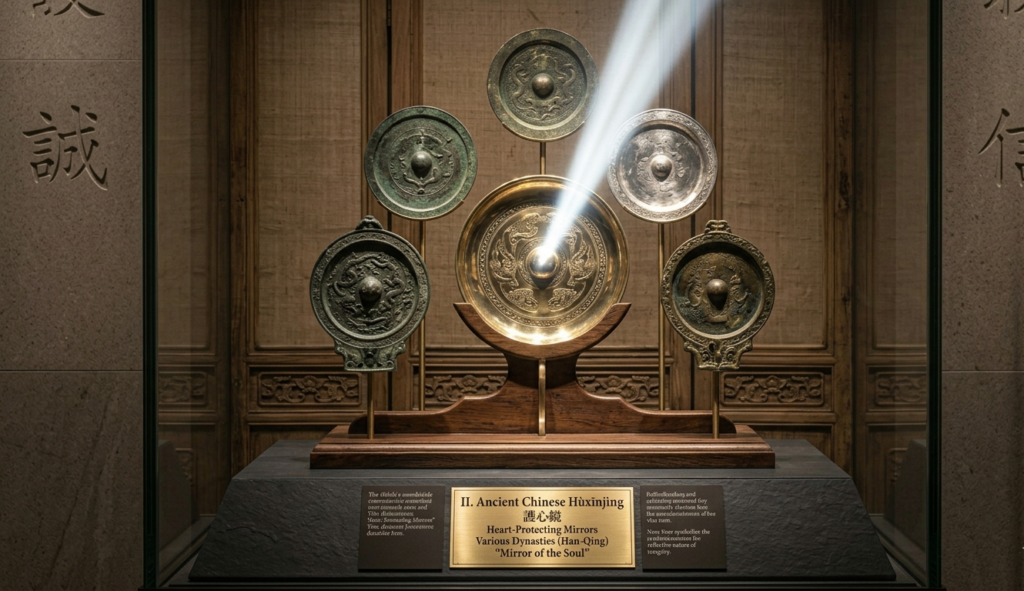
Figure 1. The Ancient Chinese Hùxīnjìng
Table 1. Technical Comparison of East Asian Defense
| Feature | Description | Historical Evolution |
| Material | Polished bronze, brass, or silver-coated iron. | Evolved from simple bronze disks to intricately engraved silver plates (Laidacker, 2014). |
| Placement | Centered precisely over the heart. | Originally tied with silk cords; later integrated into “Cord and Plaque” armor (D’Amato & Sumner, 2009). |
| Optics | Highly reflective, often convex. | Designed to reflect the sun, acting as a visual deterrent and spiritual “ward” (Needham, 1962). |
Table 2. Protective Qualities: Mirror vs. Plate
| Aspect | Hùxīnjìng (Mirror) | Traditional Breastplate |
| Defense Type | Targeted Vital Point Protection. | General Torso Coverage. |
| Symbolic Power | Reflective (Deflects “Evil”). | Absorptive (Withstands Force). |
| Mobility | High (Minimal weight). | Medium (High weight/rigidity). |
Biblical Reflection
While the Hùxīnjìng originated in the East, its function perfectly illustrates the biblical metaphor of the heart as the center of human character. In the scriptures, the heart is not merely a pump, but the “wellspring of life” that must be guarded with total vigilance.
“Keep thy heart with all diligence; for out of it are the issues of life.” — Proverbs 4:23 (KJV)
The reflective nature of the Hùxīnjìng echoes the wisdom that a righteous heart acts as a mirror, revealing the true character of a man. Just as the warrior polished his mirror to ensure its clarity, the believer must maintain a righteous heart to reflect the light of Christ.
“As in water face answereth to face, so the heart of man to man.” — Proverbs 27:19 (KJV)
Reflection in Life
The Hùxīnjìng was small, yet it protected the most critical part of the soldier. It teaches us that “righteousness” is not about a massive, outward show of strength, but about a targeted, intentional protection of our innermost desires and motives.
Consider your own heart: Is your “mirror” polished and bright, reflecting God’s light to those around you? Or has it become tarnished by hidden compromise, losing its ability to deflect the “arrows” of temptation? Remember, a single scratch on the heart-mirror can blur the entire reflection. Guard your center with the same diligence a warrior guards his life.
References
- D’Amato, R., & Sumner, G. (2009). Arms and Armour of the Imperial Roman Soldier. Frontline Books.
- Laidacker, J. (2014). The History of Chinese Armor. Museum Press.
- Needham, J. (1962). Science and Civilisation in China: Volume 4, Physics and Physical Technology. Cambridge University Press.