
Roman Lorica Segmentata: The Articulated Defense
The Lorica Segmentata represents the zenith of Roman infantry protection during the 1st and 2nd centuries C.E. This armor consisted of broad ferrous (iron) strips, or “segments,” fastened to internal leather straps. This design allowed the plates to slide over one another, providing the soldier with a degree of torso flexibility that was previously impossible with solid bronze cuirasses (Bishop & Coulston, 2006). By distributing the weight across the shoulders and hips, the Roman Legionary could remain agile during the high-stress environment of close-quarters combat (Sim & Ridge, 2002).
Key Details to Notice:
- Articulated Plates: Look at the individual iron bands. These provided flexibility (Wisdom) while maintaining impenetrable strength (Righteousness).
- Brass Fittings: The leather straps are held by small brass buckles. These are worn and patinated, showing the armor has been used.
- The “Heart” Focus: The plating over the left chest is the brightest part of the image, visually guiding the viewer to the concept of protecting the heart.
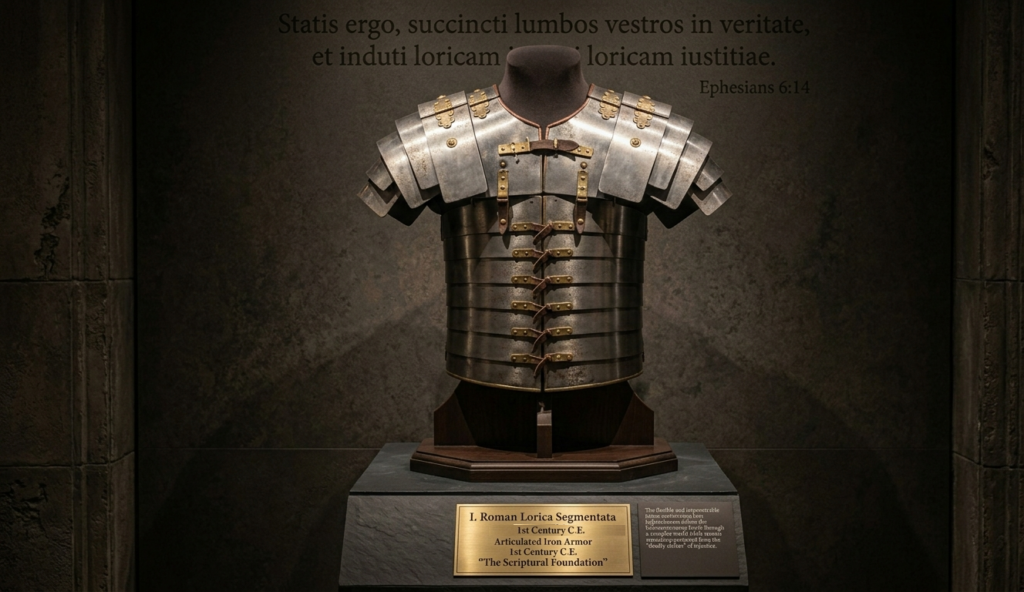
Figure 1. Roman Lorica Segmentata
Table 1. Technical Specifications and Historical Context
| Feature | Description | Historical Significance |
| Material | Low-carbon ferrous iron plates. | Provided superior protection against piercing weapons compared to bronze (Sim & Ridge, 2002). |
| Structure | Overlapping articulated bands. | Balanced maximum protection of vital organs with the mobility required for Roman tactics (Bishop & Coulston, 2006). |
| Fastening | Internal leather straps and brass buckles. | Enabled the soldier to “put on” the armor quickly and adjust the fit for combat readiness (D’Amato & Sumner, 2009). |
Table 2. Comparison of Vital Protection
| Armor Type | Coverage Area | Vulnerability Level |
| Lorica Segmentata | Torso, Shoulders, Heart, and Lungs. | Low (Highly resistant to downward strikes). |
| Lorica Hamata | Full body (Chainmail). | Medium (Vulnerable to blunt force and narrow points). |
The Heart of the Legionary
While the Lorica Hamata (chainmail) was more common throughout Roman history, the Segmentata is specifically associated with the Roman soldiers stationed in the eastern provinces during the time of the early Church. The overlapping plates were specifically engineered to deflect downward strikes and protect the vital organs—primarily the heart and lungs—which were considered the most vulnerable points of a warrior (D’Amato & Sumner, 2009).
Biblical Reflection
In the Righteousness Museum, we connect this physical defense to the spiritual imperative of the believer. When the Apostle Paul wrote his letter to the Ephesians, he was likely chained to a member of the Praetorian Guard wearing this very style of armor. He recognized that just as a soldier is “naked” on the battlefield without his chest protection, a believer is spiritually vulnerable without a life of integrity.
“Stand firm then, with the belt of truth buckled around your waist, with the breastplate of righteousness in place,” — Ephesians 6:14 (NIV)
This “breastplate” is not our own perfection, but a divine protection provided by God Himself. As prophesied in the Old Testament, the Messiah wears this same armor as He goes to battle for His people:
“He put on righteousness as his breastplate, and the helmet of salvation on his head;” — Isaiah 59:17 (NIV)
Reflection in Life
The Lorica Segmentata was composed of many individual segments working together to form one shield. If one strap broke or one plate was missing, the entire heart was exposed.
Consider your own life: Are there “segments” of your integrity that have become loose or untied? Is there an area where you have compromised, leaving your heart exposed to the arrows of guilt or accusation? As you look at this iron armor, remember that righteousness is not just a concept—it is the vital “plating” that keeps your heart safe in the heat of life’s battles.
References
- Bishop, M. C., & Coulston, J. C. (2006). Roman Military Equipment: From the Punic Wars to the Fall of Rome. Oxbow Books.
- D’Amato, R., & Sumner, G. (2009). Arms and Armour of the Imperial Roman Soldier. Frontline Books.
- Sim, D., & Ridge, J. (2002). Iron for the Eagles: The Iron Industry of Roman Britain. Tempus.

Museum Test Prep App – The Roman Lorica Segmentata