
Titus Brandsma — Netherlands (1881–1942)
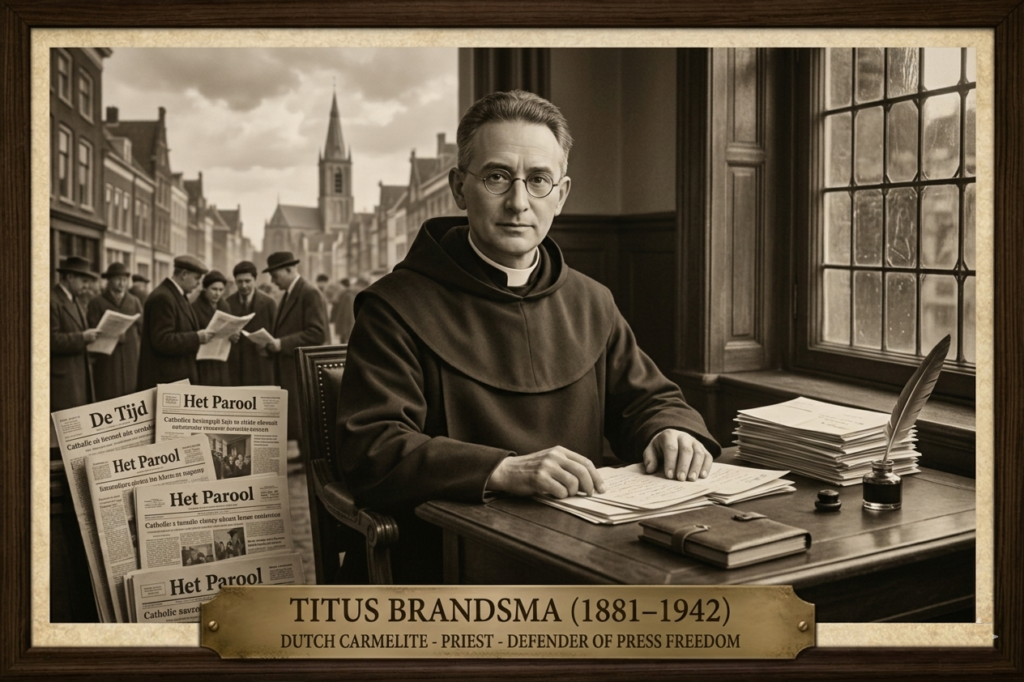
Titus Brandsma was a Dutch Catholic priest, theologian, journalist, and professor who became known for his courageous opposition to Nazi ideology during the Second World War. Through his defense of freedom of the press, human dignity, and religious independence, he stood against attempts by the Nazi regime to control public institutions and spread propaganda.
As a member of the Carmelite Order, Brandsma combined intellectual leadership with pastoral service. He spoke openly against Nazi policies and encouraged Catholic newspapers to resist publishing pro-Nazi material.
His refusal to cooperate with Nazi authorities ultimately led to his arrest and imprisonment. Today, he is remembered as a symbol of moral courage, faithful resistance, and commitment to truth in the face of oppression.
Historical Context
During the early 1940s, the Netherlands was occupied by Nazi Germany following the German invasion in 1940.
Under the occupation, the Nazi government sought to control political, social, and cultural institutions throughout the country. The press was placed under strict censorship, and newspapers were pressured to publish Nazi propaganda.
Religious institutions also faced increasing pressure to conform to the ideology of the occupying regime. Many organizations were forced to decide whether to comply with the authorities or resist their demands.
Within this environment, Titus Brandsma became an important voice defending freedom of conscience, independent journalism, and ethical responsibility.
Civic Virtue and Leadership
Before the war, Titus Brandsma was widely respected as a scholar, educator, and religious leader. He served as a professor at the Radboud University Nijmegen, where he taught philosophy and mysticism.
Brandsma was also deeply involved in Catholic journalism, serving as an advisor to Catholic newspapers across the Netherlands. He believed that journalists had a duty to promote truth and moral responsibility in public life.
When the Nazi authorities ordered newspapers to publish propaganda and advertisements from Nazi organizations, Brandsma encouraged editors to refuse cooperation.
He traveled throughout the country delivering messages to Catholic editors, urging them to maintain their ethical integrity and resist political pressure.
Righteous Act: Defending Freedom of the Press
Titus Brandsma’s most significant act of moral courage was his effort to defend the independence of Catholic newspapers under Nazi occupation.
In 1941, the Nazi authorities demanded that Catholic newspapers publish advertisements and materials supporting Nazi organizations. Brandsma believed that complying with these demands would compromise the moral responsibility of the press.
Acting on behalf of the Dutch Catholic bishops, he personally visited newspaper offices across the country to deliver a message urging editors to reject Nazi propaganda.
This act of defiance openly challenged the authority of the occupying regime. Brandsma understood that his actions placed him at serious personal risk, yet he believed that truth and conscience required resistance.
His efforts represented a powerful defense of journalistic integrity, religious freedom, and moral responsibility.
Challenges and Adversity
Titus Brandsma’s resistance to Nazi policies soon attracted the attention of the Gestapo.
In January 1942, he was arrested and imprisoned for his opposition to the regime. He was transferred through several prisons and concentration camps, enduring harsh conditions and physical suffering.
Despite these hardships, witnesses later recalled that Brandsma remained calm and compassionate toward others, offering encouragement to fellow prisoners.
Later that year, he was transferred to the Dachau concentration camp, where many clergy and political prisoners were held.
In July 1942, Titus Brandsma died at Dachau after being subjected to medical experimentation and mistreatment.
Legacy
Titus Brandsma is remembered as a powerful example of faithful resistance against tyranny and a defender of truth and human dignity.
In recognition of his moral courage and religious witness, the Roman Catholic Church declared him a martyr of the faith.
In 2022, he was officially canonized as a saint by Pope Francis, recognizing his life of service and his sacrifice during the Nazi occupation.
Today, Titus Brandsma continues to inspire journalists, religious leaders, and human rights advocates as an example of ethical leadership, freedom of conscience, and the courage to defend truth even under extreme oppression.
References
Conway, J. S. (1997). The Nazi persecution of the churches 1933–1945. Regent College Publishing.
De Jong, L. (2002). The Netherlands and Nazi Germany. Harvard University Press.
Monteiro, M. (2012). Titus Brandsma: Carmelite mystic and martyr. Peeters Publishers.
Van Vugt, W. (2018). Titus Brandsma and the struggle for truth during the Nazi occupation. Catholic University Press.