
Vladimir the Great — Kievan Rus (958–1015)
Vladimir the Great was a ruler of Kievan Rus who is best known for his decision to adopt Christianity and establish it as the official religion of his realm. His leadership played a transformative role in shaping the religious, cultural, and political development of Eastern Europe.
As Grand Prince of Kievan Rus, Vladimir initially ruled as a traditional pagan leader. However, after a period of reflection and diplomatic engagement with neighboring civilizations, he chose to convert to Christianity and guide his people toward a new religious and moral framework.
His decision led to the Christianization of Kievan Rus, an event that profoundly influenced the development of Eastern Orthodox Christianity in the region and shaped the historical identities of several Eastern European nations.
Historical Context
During the tenth century, Kievan Rus was an expanding political federation of East Slavic and Norse peoples centered around the city of Kiev.
The region was connected through trade routes that linked Northern Europe with the powerful Byzantine Empire in the south. Cultural and religious influences flowed through these trade networks.
At the time, the people of Kievan Rus practiced various forms of pagan religion, worshipping multiple deities associated with nature and warfare. However, interactions with neighboring Christian and Muslim states exposed the ruling elite to different religious traditions.
As the ruler of a rapidly growing state, Vladimir sought ways to strengthen political unity and establish stronger diplomatic relationships with neighboring powers.
Civic Virtue and Leadership
Vladimir’s reign was marked by efforts to consolidate power, maintain stability, and strengthen the legitimacy of his rule. Over time, he began exploring different religious traditions practiced by neighboring civilizations.
According to historical chronicles, Vladimir sent envoys to observe the religious practices of various cultures, including Islam, Judaism, and Christianity.
The envoys were particularly impressed by the worship services in Hagia Sophia within the Byzantine Empire, describing the experience as profoundly moving.
These encounters influenced Vladimir’s decision to adopt Eastern Orthodox Christianity, which would connect his realm culturally and politically with the Byzantine world.
Righteous Act: The Christianization of Kievan Rus
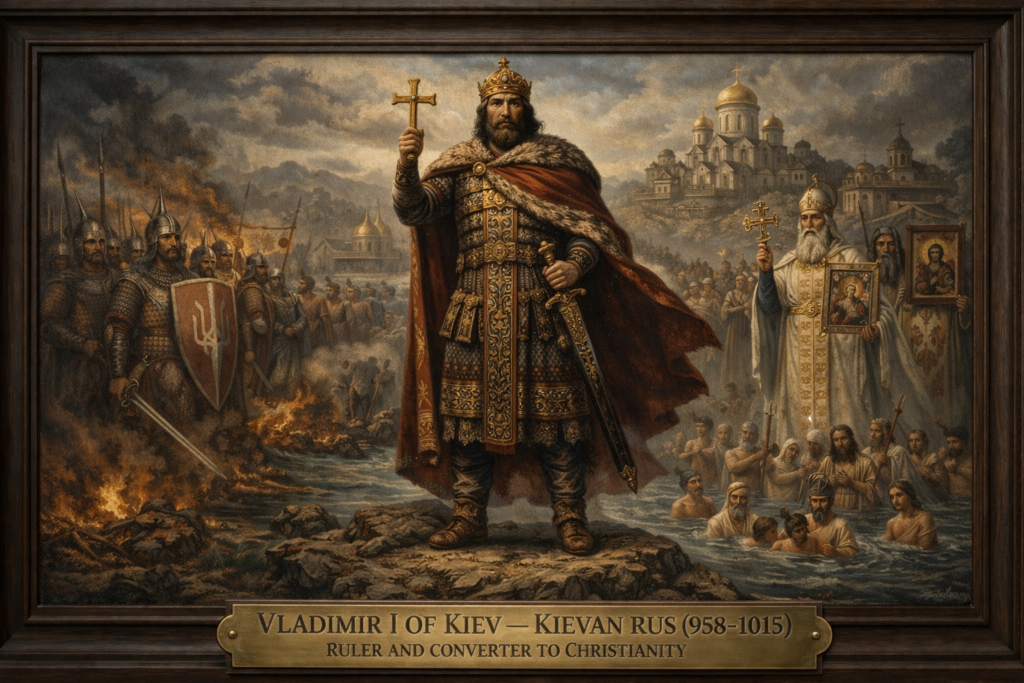
Vladimir’s most significant historical act occurred in 988, when he officially converted to Christianity and ordered the baptism of his people.
Following his own baptism, Vladimir encouraged the inhabitants of Kiev to participate in a mass baptism ceremony in the Dnieper River.
This event symbolized the formal adoption of Christianity as the guiding faith of the state.
The conversion led to the construction of churches, the introduction of Christian teachings, and the development of religious institutions that would shape the spiritual life of the region for centuries.
By adopting Christianity, Vladimir helped integrate his kingdom into the broader cultural and religious networks of medieval Europe.
Challenges and Adversity
Vladimir’s decision to adopt a new religion for the state was not without challenges. Many people in the region had long practiced traditional pagan beliefs, and the shift toward Christianity required significant cultural adjustment.
Establishing new religious institutions, educating clergy, and integrating Christian moral teachings into society took time and effort.
Additionally, the transformation of religious life required the adaptation of existing traditions and the development of new social and legal norms influenced by Christian teachings.
Despite these difficulties, the adoption of Christianity gradually became an important foundation for the cultural and spiritual identity of the region.
Legacy
Vladimir the Great is remembered as one of the most influential rulers in the history of Eastern Europe.
His decision to adopt Eastern Orthodox Christianity shaped the religious traditions of many nations that later emerged from the lands of Kievan Rus, including Ukraine, Russia, and Belarus.
He is honored as a saint in the Eastern Orthodox Church, where he is remembered for his role in bringing Christianity to the region.
Today, Vladimir’s legacy represents a major turning point in the religious and cultural development of Eastern Europe and demonstrates how the decisions of a single leader can shape the spiritual direction of an entire civilization.
References
Franklin, S., & Shepard, J. (1996). The emergence of Rus 750–1200. Longman.
Martin, J. (2007). Medieval Russia 980–1584. Cambridge University Press.
Poppe, A. (1992). The political background to the baptism of Rus. Dumbarton Oaks Papers.
Riasanovsky, N. V., & Steinberg, M. D. (2011). A history of Russia. Oxford University Press.