
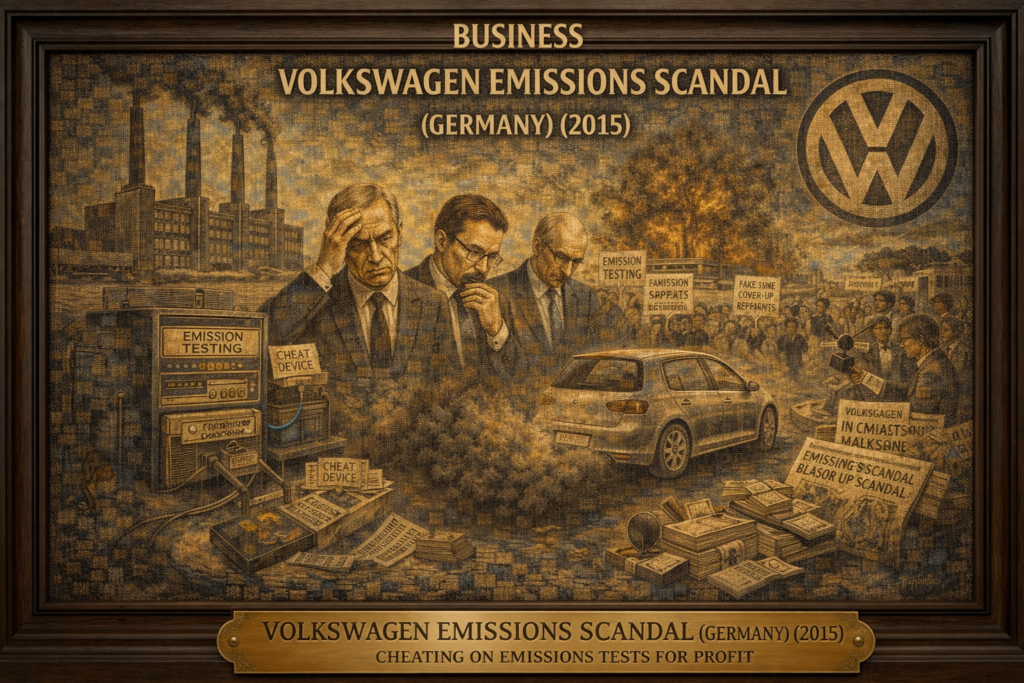
The Volkswagen Exhibit invites readers to reflect on righteousness in business through one of the most significant corporate ethics scandals of the twenty-first century. Here, Volkswagen is not presented as a monolithic villain, but as a case study of how institutional culture, pressure, and misguided priorities can lead an entire organization astray. This space focuses on how corporate decisions — made in boardrooms and engineering departments — can have far‑reaching consequences for public health, trust, and the integrity of markets. Readers are invited to consider what righteous business practice looks like today — and what it might ask of them in their own professional spheres.
Focus of the Exhibit
The Betrayal of Trust — When Corporate Culture Fails
Between 2009 and 2015, Volkswagen installed illegal “defeat device” software in approximately 11 million diesel vehicles worldwide. The software detected when a car was undergoing laboratory emissions testing and activated full emissions controls — but during normal driving, it disabled those controls, allowing the vehicles to emit nitrogen oxides (NOx) at levels up to 35 times higher than legal limits. This was not a mistake by a few rogue engineers — it was a systemic failure of corporate ethics, driven by wrongful prioritization of financial gain over social and environmental responsibility. The scandal ultimately cost Volkswagen over $34 billion in fines, penalties, and settlements, led to the resignation of its CEO, and triggered criminal charges against former executives. The Volkswagen case demonstrates that when organizations prioritize short‑term success over long‑term integrity, the cost — to public trust, to human health, and ultimately to the company itself — is devastating.
Reflection Methodologies
For this exhibit, one or more reflection methodologies may be applied to help readers move from story to self‑examination, such as:
- Decision Simulation Method: Readers imagine themselves in the position of Volkswagen engineers or executives, consider the pressures and choices they faced, and explore what they might have done — and why.
- Life Application Method: Readers connect the principles of business righteousness to their own professional lives: workplace integrity, ethical decision‑making, or organizational culture.
Other applicable reflection methods may also be used, depending on the focus of the case or theme.
Questions for Reflection
- When have I faced pressure to compromise my values for the sake of results?
- What role does organizational culture play in shaping ethical — or unethical — decisions?
- Who bears the cost when businesses prioritize profit over integrity?
- What would righteous business practice look like in my workplace today?
- Am I willing to speak up when I see something wrong, even if it costs me?
References
Ewing, J. (2017). Faster, higher, farther: The Volkswagen scandal. W. W. Norton & Company.
Hotten, R. (2015, December 10). Volkswagen: The scandal explained. BBC News. https://www.bbc.com/news/business-34324772
International Council on Clean Transportation. (2015). Real-world exhaust emissions from modern diesel cars. https://theicct.org/publications/real-world-exhaust-emissions-modern-diesel-cars
United States Environmental Protection Agency. (2015, September 18). EPA issues notice of violation to Volkswagen. https://www.epa.gov/vw
Fair Use & Disclaimer Notice
The Volkswagen emissions scandal, corporate history, and related factual events referenced in this exhibition are matters of public record and have been widely reported by authoritative sources including the U.S. Environmental Protection Agency, the International Council on Clean Transportation, and major news outlets. This exhibition is an independent, non‑commercial educational and research project and is not affiliated with, endorsed by, or sponsored by Volkswagen AG or any of its subsidiaries. Original text, commentary, analysis, and AI‑generated concept illustrations have been independently created solely for educational, commentary, and critical discussion purposes. All statements of fact are based on publicly available information and are presented for the purpose of analysis and reflection on business ethics. This use is intended to fall within the boundaries of fair use / fair dealing for the purpose of educational commentary and research.